


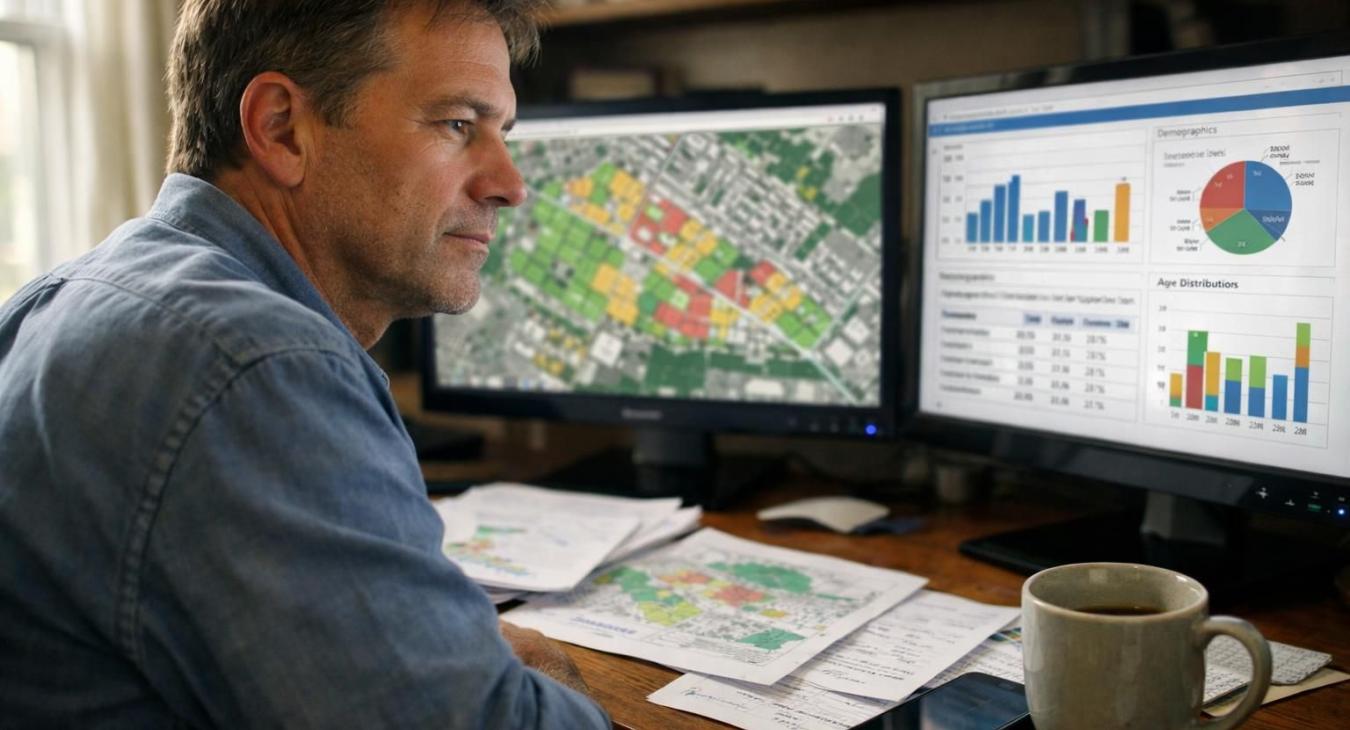
Neighborhood Analysis reveals hidden investment opportunities and risks. Learn how to leverage data tools for smarter real estate decisions today!
Neighborhood Analysis: Street-Level Due Diligence

Many real estate investors overlook the power of remote neighborhood analysis. With internet-based tools, you can perform street-level due diligence in less than 20 minutes using data from sources like SpotCrime, GreatSchools, Google Maps Street View, and city planning websites.
This approach gives you a clear view of crime rates, property trends, local amenities, and school quality without stepping foot on site. 3 Relying on these methods often uncovers risks or hidden investment opportunities that others might miss.
You gain this edge by applying proven strategies from experienced analysts who interpret variety statistics and use spatial analyst tools daily. Using open access to neighborhood statistics helps you measure population changes and housing market momentum with confidence. 1 Mastering digital neighborhood analysis sets successful investors apart from the rest. Discover how these steps turn complex decisions into practical actions for your next deal—read on for details that matter most.
Key Takeaways
- Online tools like SpotCrime, GreatSchools, Google Maps Street View, Rentometer, and Walk Score help investors analyze crime rates, school quality, property trends, and access to amenities in less than 20 minutes (Mashvisor; ATTOM).
- Comparative Market Analysis (CMA) with Mashvisor’s Heatmap or Rentometer provides key numbers on median home values, cap rates, rental income checks, and ROI—crucial for finding strong investment areas.
- Reviewing real-time safety data from sources such as SpotCrime helps spot a 15% drop in incidents over two years—a sign of neighborhood stability—and shows micro hot spots that may affect value (SpotCrime; CrimeGrade).
- Examining economic trends using US Census Bureau data showed Austin neighborhoods saw a 12% population increase from 2010 to 2020; infrastructure projects like Seattle’s light rail raised nearby property values measurably.
- Avoid common mistakes: do not skip digital research tools or up-to-date stats; compare official/unofficial boundaries; check both quantitative data and hands-on street conditions before deciding to invest.
What is Neighborhood Analysis?

Neighborhood analysis examines the physical, social, and psychological aspects of a residential area. 1 You assess not only property trends but also spatial statistics, crime data, land cover information, and infrastructure development.
City planning departments set many neighborhood boundaries; sometimes residents' perceptions or architectural features define them instead. Bibliometric studies show neighborhood and health research grew rapidly in the mid-2000s. 2
A holistic approach considers both quantitative tools like focal statistics toolsets and qualitative input from local market experts. Research from Hamburg criticizes relying solely on physical characteristics for sustainable neighborhoods.
Definitions of "neighborhood" play a key role in urban sustainability transformations and new concepts such as 15-minute neighborhoods. Your due diligence should use clear criteria so you can compare zoning laws, analyze school districts using output raster data, check open sets within metric spaces for connectivity, and apply findings to investment opportunities with confidence.
Back to topImportance of Street-Level Due Diligence

Street-level due diligence gives you a clear edge in neighborhood analysis and property trends. You gain valuable insight by observing the physical design and upkeep of streets, sidewalks, lighting, and open spaces.
Walkability shapes both community engagement and health outcomes; poor street layout often signals risks for lower resident involvement or negative wellness trends. 3 For example, research from the U.S., Canada, and Australia links neglected street segments to higher crime rates and less stable neighborhoods. 4 Analyze local amenities like schools, parks, grocery access, public transport stops, as well as land-cover information with spatial analyst tools such as Scanpy or spatial graph platforms.
Pay close attention to details: graffiti presence or broken infrastructure can reveal social capital deficits or underlying economic shifts.
You must also explore how specific features influence not just desirability but asset stability over time. Property surveys at the block level often expose hidden risks—environmental hazards may go unnoticed without close inspection.
Evaluate safety data down to individual blocks using uniform neighbourhood system concepts or even cellular composition models where applicable in high-density zones. Look into connectivity metrics such as attribute tables from input land-cover raster sets and assess their impact on walkability scores in your topological space analysis toolkit.
Experts like urban sociologist Dr. Richard Florida argue that strong resident networks prevent rapid cycles of decline by anchoring investment confidence at the ground level; this makes granular observation critical before any commitment takes place on your target segment.
Back to topReal Estate Due Diligence: Key Considerations

Devote more resources to due diligence during tough markets. 5 Use comparative market analysis (CMA) methods to check property values and compare neighborhood trends. Pay close attention to ROI, cap rate, and cash-on-cash return when assessing potential investments.
Look for tools like Mashvisor's Mashmeter Score and heatmap analysis; these predictive analytics highlight promising neighborhoods for investment opportunities.
Study how iBuyers use algorithmic models in their approach; this trend affects real estate strategies and can shift market dynamics at the street level. Leverage the spatial analyst license or neighborhood toolset to map out environmental risks and local infrastructure impacts before closing a deal.
These actions help you validate property values while ensuring optimal location selection.
Back to topStep-by-Step Guide to Conducting Neighborhood Analysis

Use tools like open-source spatial connectivity matrices and anndata to extract deep insights about community composition. Leverage single-cell RNA sequencing data and analyze spatial domains to spot property trends with precision.
Define the boundaries of the neighborhood
Map out the neighborhood boundaries using clear markers such as streets, rivers, railroads, and shifts in land use. 6 City planning departments often set official borders for analysis while residents might recognize unofficial lines based on community identity or architectural changes.
For precise data, city offices provide categorized boundary details. ATTOM's online resources also offer spatial connectivity matrix files that guide real estate professionals in verifying open neighborhood extents.
Applying these definitions supports accurate property trends research and ensures your comparisons reflect true market conditions. Neighborhood analysis starts with proper delineation since spatial proximity impacts investment opportunities and demographic interpretation.
Use mapping tools to overlay cellular neighborhood analysis methods if reviewing urban environments for development potential or ecosystem stability studies. This strategic step allows you to select properties within distinct zones backed by reliable documentation from governmental organizations or ATTOM's dataset archives.
Evaluate property values and trends
To make informed investment decisions, you must evaluate property values and trends using trusted methods and data-driven tools. 7 The following table outlines essential steps, strategies, and resources to ensure a comprehensive street-level analysis.
| Key Aspect | Action Item | Relevant Tools/Entities | Practical Impact | Expert Insight |
|---|---|---|---|---|
| Median Home Values | Gather current and historical median prices for single-family homes and condos in the neighborhood. | Mashvisor, local MLS | Identifies areas with stable or appreciating values, critical for capital preservation. | "Median prices often reflect the economic health of a community," notes Angela Richards, urban economist. |
| Comparative Market Analysis (CMA) | Conduct CMA by comparing sales of similar homes over recent months. | Mashvisor, in-house brokerage analytics | Helps determine fair market value and avoid overpaying for assets. | Real estate broker Susan Lee shares, "Without a current CMA, you risk misjudging value shifts." |
| Market Indicators | Review number of pending sales, price reductions, and the gap between listing and sales prices. | MLS, Mashvisor Heatmap Tool | Spot market momentum, buyer demand, and negotiation leverage. | "Tight ratios between list and sale prices signal strong buyer confidence," says analyst Daniel Cortez. |
| Rent Comparisons | Utilize Rentometer to benchmark local rents and confirm income assumptions. | Rentometer | Aligns projected cash flow with market reality; validates the neighborhood's suitability for your investment strategy. | "Fast rent checks minimize exposure to inflated income claims," advises investor Mark Perkins. |
| Heatmap Analysis | Apply heatmap visualization to identify micro-areas with rising or falling values. | Mashvisor Heatmap Tool | Improves targeting of high-appreciation blocks; illustrates risk zones visually. | "Color-coded trends deliver clarity at a glance," remarks data scientist Clara Nguyen. |
| ROI and Cap Rate Metrics | Assess projected return on investment, cap rate, and cash-on-cash yield for each property. | Mashvisor, proprietary portfolio models | Enables direct financial comparison between assets; supports investment thesis validation. | "Quantitative metrics cut through market noise," comments asset manager Priya Singh. |
| Predictive Analytics | Leverage Mashmeter Score and predictive models for future value estimation. | Mashvisor Analytics Suite | Elevates decision quality by incorporating forecast data into the evaluation process. | "Predictive scores help you think ahead of the market," states proptech founder Diego Morales. |
Use comparative market analysis and tools such as Mashvisor's Heatmap and Rentometer to ensure your numbers reflect current realities. Apply predictive analytics to strengthen forecasting in your acquisition strategy.
Research crime rates and safety statistics
Reviewing crime rates and safety statistics forms a cornerstone of neighborhood analysis for real estate professionals and investors. Effective research leverages data-driven tools and critical assessment to guide investment decisions, gauge risk, and understand community trajectories.
| Key Aspect | Description | Actionable Takeaway |
|---|---|---|
| Data Tools | Use platforms like SpotCrime and CrimeGrade. These provide recent crime reports, maps of incidents, and trend analysis within set boundaries. | Cross-reference multiple sources to verify accuracy and address data gaps. |
| Trend Evaluation | Map whether crime rates are declining, stable, or rising. For example, a 15% drop in incidents over two years can signal improvement. | Focus on longitudinal data, not just recent spikes, to assess neighborhood stability. |
| Crime Type Differentiation | Separate minor events such as thefts from more serious systemic offenses. Major crimes, often tracked by law enforcement, indicate deeper community risks. | Weigh risks of different crime types before finalizing acquisition or lease decisions. |
| Localized Mapping | Drill down to street-level incident data using detailed mapping features. Tools show hotspots within specific neighborhood sectors. | Identify micro-areas of concern that could affect valuation or rental demand, even within otherwise stable zones. |
| Safety Improvements | Monitor for evidence of investments in community policing, public lighting, and infrastructure. A visible decline in incident reports and increased community engagement are strong indicators. | Favor areas showing sustained safety improvements, as these often attract both residents and future investors. |
| Societal Impact | Understand that public perception of safety directly influences economic viability. Crime statistics shape not only property values but also resident satisfaction. | Communicate safety improvements and accurate crime data in your marketing to shape positive neighborhood narratives. |
Utilize real-time data from trusted sources, interpret trends over multiple years, and communicate transparent findings to stakeholders. This approach ensures you make well-informed decisions and foster long-term investment security.
Assess local amenities and infrastructure
Explore each street using Google Maps and Street View to spot parks, retail spaces, bike lanes, and transit stops. A high Walk Score signals strong walkability and public transport access, which can boost property trends and rental yield.
Analyze Google Reviews or Yelp for insights on the quality of local businesses. Seek signs of infrastructure development such as new roads or utility upgrades; these changes often mark economic growth.
Pay attention to active home renovations or ongoing construction in the area—these shifts often point to rising neighborhood enrichment. Check for consistent upkeep of sidewalks, lighting, and open green areas since well-maintained amenities increase both value and desirability.
Leverage GIS-based studies for data on accessibility metrics. 8 Use this knowledge to identify key investment opportunities based on amenity distribution within an epsilon neighborhood under a Euclidean metric framework.
Analyze school districts and education quality
School performance drives property values and long-term demand. GreatSchools lets you check academic scores, parent reviews, and district trends by zip code. For real estate professionals, changes in school ratings, funding levels, or new educational programs can signal neighborhood growth and spark higher housing demand.
You should always cross-reference school district boundaries with your target neighborhoods for a precise neighborhood analysis. District trends and qualitative feedback from parents offer both statistical and personal insights into education quality.
Higher-rated schools often lead to demographic shifts and fuel sustained property appreciation. Use these data points to identify investment opportunities that align with spatial omics concepts like cell-cell communication—where a high-performing school acts as the nucleus of community growth within its open ball or compact neighbourhood in the urban landscape.
Identify economic and demographic trends
Tracking economic and demographic trends at the street level informs your investment decisions and reveals momentum in any neighborhood. 9 The table below outlines the practical steps, sources, and key indicators you should monitor.
| Metric / Tool | Action Point | Practical Impact | Example / Insight |
|---|---|---|---|
| Population Change (Source: US Census Bureau, local records) | Study growth, stability, or decline over the past 5-10 years | Rising numbers often indicate increased housing demand and potential appreciation | 2010-2020 saw a 12% population increase in select Austin, TX neighborhoods, signaling upward pressure on home values |
| Income Levels (Source: American Community Survey, municipal data) | Compare average household incomes year-over-year | Higher incomes support higher rents and home prices; stagnation may limit upside potential | Neighborhoods with a median income above $80,000 attract new retail and service businesses |
| Ownership vs. Rental Ratio (Source: County assessor, Redfin, Zillow) | Analyze proportion of owner-occupied versus rented homes | High owner-occupancy rates often point to neighborhood stability; high rental rates may attract investors seeking cash flow | 67% owner-occupancy in Mill Creek, WA, aligns with low turnover and consistent appreciation |
| Property Value Trends (Source: MLS, CoreLogic, local appraisal data) | Track appreciation rates, price volatility, and price per square foot | Steady appreciation signals market confidence; volatility may require cautious underwriting | Data from 2022 showed a 9% year-over-year increase in median home price in select Tampa neighborhoods |
| Housing Supply & Demand (Source: Realtor.com, local permits, city housing reports) | Review new construction starts, vacancy rates, and days on market | Low vacancy and quick sales suggest rising demand; oversupply may dampen price growth | Vacancy rates below 3% in Portland's Alberta Arts District point to strong rental demand |
| Zoning Laws & City Planning (Source: City zoning maps, planning commission minutes) | Assess recent changes in land use policy, density allowances, and rezoning initiatives | Upzoning can unlock higher-density development; restrictions may limit growth | Minneapolis' 2019 "Minneapolis 2040" plan ended single-family-only zoning in many areas, spurring multifamily growth |
| Online Real-Time Data (Source: Nextdoor, Facebook neighborhood groups, Rentometer) | Monitor social trends, local business openings, and resident sentiment | Real-time feedback uncovers rapid shifts or emerging opportunities before official data | Discussion spikes about new tech employers in Mountain View on Nextdoor preceded a surge in rental activity |
| Infrastructure & Community Projects (Source: City council agendas, MPOs, DOT updates) | Identify investments in transit, schools, parks, or commercial corridors | Major projects often lead to increased demand and higher property values | Seattle's light rail expansion led to a measurable rise in property values within walking distance of new stations |
| Community Engagement | Connect with local residents, business owners, and neighborhood associations | Gathers qualitative data on economic sentiment and demographic change | Local shop owner Anna Garcia remarked: "We've seen a younger crowd moving in, with more disposable income." |
Direct, ongoing analysis using these indicators positions you to spot momentum, stability, or risk. Tools such as Redfin, CoreLogic, Realtor.com, and Nextdoor enable you to synthesize both quantitative and qualitative shifts as they emerge. Evaluate every trend for its likely effect on demand, pricing, and neighborhood character before making investment commitments.
Back to topCommon Mistakes in Neighborhood Analysis

You can increase your success in real estate by avoiding several frequent errors in neighborhood analysis. Overlooking these issues may limit your investment opportunities and obscure critical risk factors.
- Relying only on physical visits can cause you to miss key property trends that modern data tools reveal. Platforms like Mashvisor or Rentometer provide deeper insight into rent, amenities, and desirability than an individual walk-through can offer.
- Failing to distinguish between petty crimes and major safety concerns skews your assessment of a street’s risk profile. A simple spike in minor thefts does not equal systemic security threats that impact long-term property values.
- Skipping the step of analyzing official versus unofficial neighborhood boundaries weakens market comparisons. For example, an open or closed neighborhood, as defined in mathematical contexts, affects how you interpret price trends and demand shifts within city blocks.
- Ignoring economic and demographic indicators such as homeownership ratios or new infrastructure projects leads to less accurate predictions about neighborhood growth potential. Upcoming public transit lines or rising spatially variable genes—represented by changing populations—alter future returns.
- Neglecting the quality of school districts dramatically underestimates their influence on buyer interest and rental prices. School reports or education trend analyses show direct ties between high-performing schools and increased demand for local properties.
- Assuming remote analysis alone replaces street-level due diligence creates blind spots in your evaluation process. Online tools help identify filters in topology, but only firsthand observation spots issues like neglected properties or evolving community dynamics.
- Overlooking key platforms like Walk Score results in incomplete understanding of local amenities that drive tenant satisfaction and resale values; missing this step means misjudging what makes a location desirable day to day.
- Treating all neighborhoods as static entities ignores the mathematics concept of open neighborhoods, where shifting boundaries allow for dynamic evaluation of new economic developments, cell types, and even variety of species influencing community life.
- Forgetting to analyze crime rates using permutation-based tests rather than relying on raw numbers alone hides patterns relevant to both short-term safety and long-term viability for investors committed to sustainable communities.
- Using outdated data instead of current statistics undermines findings related to real numbers such as home appreciation rates; always source updated figures from reputable agencies before making decisions regarding any epsilon (ε) neighbourhood assessment or property purchase decision point.
Conclusion
A sharp neighborhood analysis strengthens your investments. Internet-based tools like Google Maps Street View, Rentometer, and Walk Score allow you to uncover trends without visiting the site in person.
Rely on data from city planning and school review platforms to judge long-term value. Careful street-level due diligence highlights promising opportunities and helps avoid costly mistakes.
Invest with clarity by blending online research with field checks for every property decision.
Back to topFAQs
1. What is neighborhood analysis in property investment?
Neighborhood analysis examines street-level details to identify property trends and assess investment opportunities within a specific area. It evaluates factors such as open neighborhoods, closed neighborhoods, and cell states that can influence real estate value.
2. How do mathematical concepts like deleted neighborhood or neighbourhood (mathematics) apply to real estate due diligence?
Mathematical ideas such as deleted neighborhood and neighbourhood (mathematics) help define boundaries for studying natural numbers of properties or blocks under review. These concepts offer structured ways to analyze how individual homes relate to the wider community context.
3. Why are property trends important during street-level due diligence?
Understanding property trends helps investors spot changes in market conditions, shifts in demand, and emerging opportunities at the local level. Trends provide insight into which areas may see growth or decline based on current data from both open and closed neighborhoods.
4. What societal impacts should be considered when conducting a neighborhood analysis?
Street-level due diligence must consider effects on residents’ daily lives, including access to resources and potential displacement caused by investment decisions. Environmental aspects also matter; analyzing cell states across different parts of a neighborhood can reveal patterns that affect sustainability for future generations.
References
- ^ https://www.sciencedirect.com/science/article/pii/S0264275125002860
- ^ https://pmc.ncbi.nlm.nih.gov/articles/PMC5065354/
- ^ https://www.sciencedirect.com/science/article/abs/pii/S1353829216300995
- ^ https://pmc.ncbi.nlm.nih.gov/articles/PMC12574603/
- ^ https://www.researchgate.net/publication/228588340_Institutional_Real_Estate_Investing_Processes_Due_Diligence_Practices_and_Market_Conditions
- ^ https://www.attomdata.com/news/company-news/data-solutions/a-comprehensive-guide-to-u-s-neighborhood-boundaries/ (2025-02-24)
- ^ https://mindyhibbardrealestate.com/neighborhood-analysis/ (2024-07-11)
- ^ https://www.sciencedirect.com/science/article/abs/pii/S0264275118312873
- ^ https://reschool.com/understanding-neighborhood-analysis/?srsltid=AfmBOoppo90Lr6iS9pTx_1yOcRLDnOTG0NTgxQqi8i3ahdUOywI5pqdb (2025-09-25)