


Master real estate taxes in California with our guide to Prop 13, capital gains, and tax strategies to maximize your after-tax returns.
Table of Contents
- How California Property Taxes Are Calculated
- Understanding Proposition 13 in Depth
- Types of California Property Taxes
- Property Tax Exemptions and Deductions
- Payment Schedule and Deadlines
- Reading and Appealing Your Property Tax Bill
- California Capital Gains Tax on Real Estate
- Tax Strategy for California Real Estate Investors
- Documentary Transfer Tax
- Conclusion and Key Takeaways
- Frequently Asked Questions
California's real estate tax system doesn't play by the same rules as everywhere else. Proposition 13 locks your assessed value to just 1% of what you paid, then caps annual increases at 2% per year — a massive advantage if you're holding long-term. But here's where it gets complicated: when you sell, California treats your gain as ordinary income and taxes it at rates up to 13.3%, plus federal capital gains on top. If you're serious about real estate investing in this state, you need to understand how that Prop 13 protection interacts with capital gains taxation, where your timing, deal structure, and sale strategy can swing tens of thousands of dollars in after-tax profit. This guide walks through the full picture: how assessments actually work, which exemptions might apply to your property, the state and federal capital gains hit you'll face, and the tax-reduction strategies that institutional investors are already using.

How California Property Taxes Are Calculated
The Prop 13 Foundation
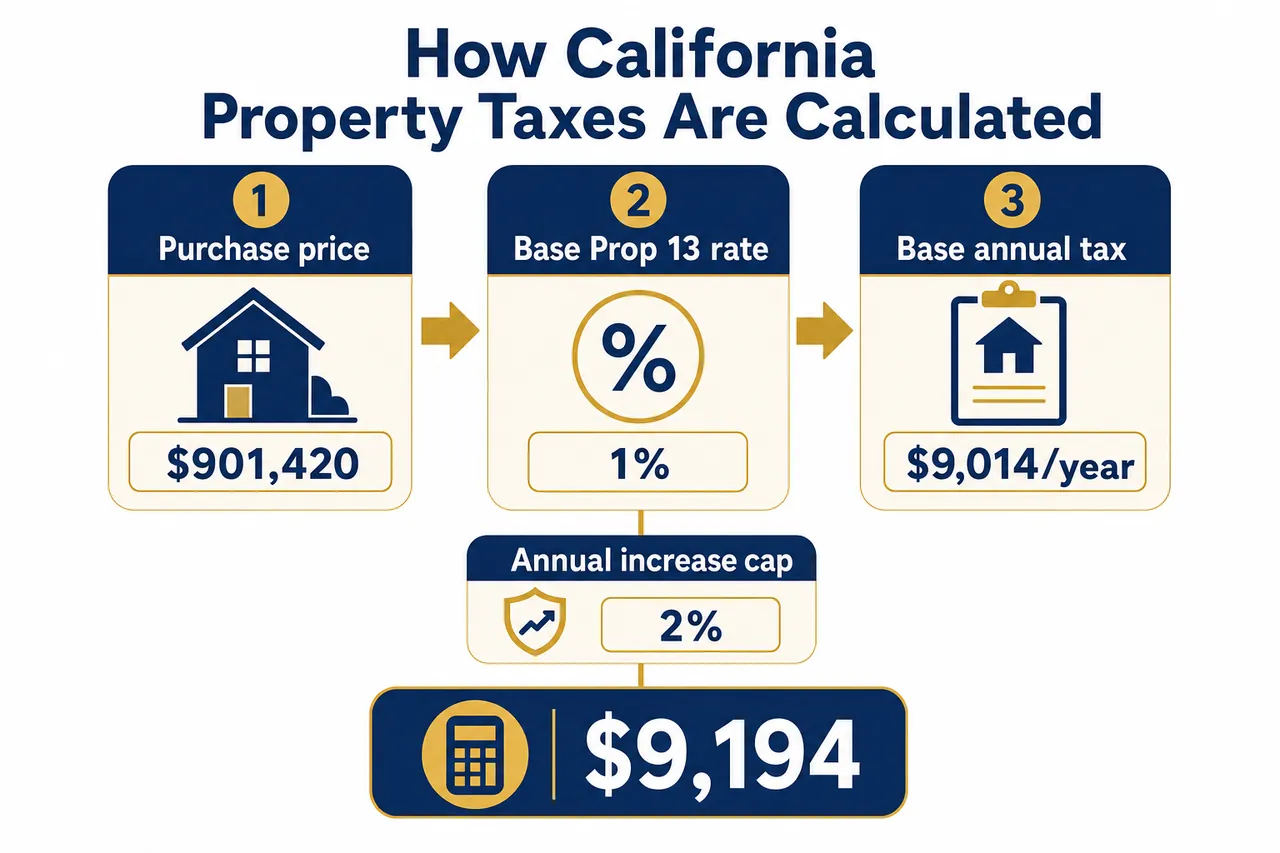
Back in 1978, California voters passed Proposition 13 — and it fundamentally changed how property taxes work in the state. It created a two-part system that still governs residential and commercial property taxes. The base property tax rate caps out at 1% of assessed value. And here's the kicker for long-term holders: the annual increase in assessed value is capped at 2% per year, or the California Consumer Price Index rate, whichever is lower. Only when a property changes ownership or new construction gets completed do these limits reset. When that happens, the county assessor reassesses the property at current market value.
This creates a wild divergence. Someone who bought in 2000 might be paying taxes on an assessed value that's just a fraction of today's market price. Meanwhile, a buyer closing this year starts with today's full purchase price as their assessed base. For investors modeling hold periods, that compounding protection makes California ownership incredibly tax-efficient on the property tax side — even though your capital gains exposure keeps climbing.
The Calculation Formula
At its core: Assessed Value × 1% = Base Property Tax. But you don't pay just that. Additional voter-approved taxes and special assessments layer on top, which is why most owners' effective rate actually exceeds 1% when you add everything up. Since Prop 13 shields long-term owners from full market reassessment, the statewide average blends low assessed values on older holdings with higher assessed values on recent purchases.
The California Association of Realtors reports a median existing single-family home price of $901,420 as of August 2026. Buy at that price today and your assessed value starts at $901,420. Your base annual property tax bill comes in around $9,014 — and that's before special assessments, Mello-Roos charges, or any voter-approved add-ons kick in. Run that annual tax figure through our rental property calculator and see how it impacts your cash flow.
| Component | Amount / Rate | Calculation |
|---|---|---|
| Purchase price (assessed value at acquisition) | $901,420 | Starting base year value |
| Base Prop 13 rate | 1% | $901,420 × 1% = $9,014/year |
| Annual increase cap (Year 2) | 2% | $901,420 × 1.02 = $919,448 assessed; tax = $9,194 |
| Homeowner's exemption (primary residence) | $7,000 off assessed value | $901,420 − $7,000 = $894,420 taxable; saves ~$70/year |
| Supplemental / special taxes (illustrative) | Varies by county and district | Added on top of 1% base |
Statewide Effective Rate and How It Compares Nationally
Prop 13 ties assessed values to purchase price, not current market value. That's why California's statewide effective property tax rate — what people actually pay as a percentage of market value — sits well below the 1% statutory cap, especially for owners who've held long-term. As of 2025 data, California's effective rate is about 0.71%, which beats the national average of roughly 0.9%–1.1% depending on who's measuring. Sounds counterintuitive for a state known as high-tax, right? But it makes perfect sense: older owners pay taxes on assessed values stuck in time, dragging the statewide average down.
Don't get trapped using that 0.71% number to underwrite your new acquisition. That average describes every California property owner blended together — not what you'll actually owe when you buy today. Add Mello-Roos and special assessments to your acquisition-year effective rate and you're hitting close to or above 1%.
County-by-County Variations
Effective tax rates and median tax payments swing significantly across California's 58 counties. The differences come down to local bond measures, special district charges, and Mello-Roos formations — not Prop 13's base rate, which stays uniform statewide. Counties heavy on newer development? They typically carry higher effective rates because recent buyers have higher assessed values and sit in Mello-Roos districts more often. Older, established counties with long-term owners see lower effective rates because assessed values have drifted way below market.
Inland counties and those packed with master-planned subdivisions (think Riverside, San Bernardino, parts of Sacramento) often hit investors with higher total tax burdens than coastal urban counties where housing stock is older and owners turn over slower. Specific county effective rates change year to year as new bond measures pass and district charges shift. Always check your county assessor's office or the California Board of Equalization's latest data before you underwrite. What actually matters is the tax bill on your specific parcel — not the county average. Pull the most recent full tax bill and flag any pending supplemental assessments as part of your due diligence.
Back to topUnderstanding Proposition 13 in Depth

The 1% Rate Limitation
All property taxes in California—whether you're holding residential, commercial, or industrial—get capped at 1% of the property's assessed value under Proposition 13. Local governments can't exceed this. That 1% gets divvied up between counties, cities, schools, and special districts using a state formula. Without a constitutional amendment, there's no way around it.
The 2% Annual Assessment Increase Cap
Year to year, your assessed value can't climb more than 2% annually or the inflation rate on the California Consumer Price Index—whichever's lower. When inflation sits at 1.5%, you're only seeing 1.5% growth. That low-inflation year? You benefit.
But there's a wrinkle. If your property's market value tanks below its assessed value—like what happened across California in 2008–2009—the assessor has to temporarily drop the assessed value to match the market. When things recover, they can bring it back up. Only catch is they're still bound by that 2% annual cap going forward.
How Assessed Value Diverges from Market Value Over Time
Picture this: you bought a duplex in 2005 for $450,000. Fast forward to 2026—that's 21 years of compounding at 2% annually. Your assessed value sits at roughly $672,000. The duplex? Now worth $1.2 million on the open market. You're paying property tax on about 56% of what it's actually worth. That's a massive tax advantage that disappears the moment you sell.
And that matters because a sale triggers full reassessment for the buyer and capital gains exposure for you. This gap between assessed and market value is exactly why California investors need an ironclad exit strategy. The tax bill on day one of ownership versus year 20 isn't even close.
Back to topTypes of California Property Taxes
California's property tax system goes way beyond the basic Prop 13 levy. You've got several distinct categories, each with its own rules for what gets taxed and when the assessment happens.
| Tax Type | What It Applies To | When Assessed | Example |
|---|---|---|---|
| Secured Property Tax | Real property and permanent improvements attached to land | Annually on January 1 lien date | Single-family home, apartment building, commercial office |
| Unsecured Property Tax | Personal property not attached to real estate | Annually; collected by August 31 | Business equipment, boats, aircraft, leasehold improvements |
| Supplemental Tax | Increase in value from change of ownership or new construction | Upon triggering event (sale, construction completion) | New buyer receives supplemental bill for partial-year difference |
| Mello-Roos / CFD Tax | Properties within a Community Facilities District | Annually; added to tax bill | New subdivisions financing schools, roads, utilities |
| Voter-Approved Special Taxes | All parcels within a jurisdiction (varies) | As authorized by local ballot measure | School bonds, library measures, transit districts |
Mello-Roos and Special District Taxes
Mello-Roos assessments aren't a minor line item. You're looking at hundreds or thousands of dollars annually, especially in newer developments. And here's what separates them from your base Prop 13 rate: Mello-Roos taxes are fixed charges tied to Community Facilities District bond financing. They don't compress or cap under Prop 13 like everything else does.
Before you underwrite any deal in a master-planned community, pull the actual tax bill. Don't just plug in the 1% base calculation. Run those real numbers through the cap rate calculator with total tax burden included. Miss this step and you'll overstate returns every time.
State-Assessed Properties
County assessors don't handle everything. California's State Board of Equalization directly assesses properties that cross county lines or fall into regulated industries — public utilities, railroads, pipelines, telecom companies. They handle the valuation centrally, then allocate those values back to each county.
For residential investors? This rarely matters. But if you're looking at industrial or infrastructure-adjacent deals, you need to know about it. State-assessed properties can affect local special tax allocations in your district.
Back to topProperty Tax Exemptions and Deductions
Homeowner's Exemption
California gives owner-occupants a $7,000 exemption on the assessed value of their primary residence. At the 1% base rate, that's at least $70 per year in savings. Not earth-shattering in dollar terms, but it's free money if you file it. You claim it after purchase, and it stays active as long as the property remains your primary residence. Move out, rent it, or change its use? The exemption disappears automatically.

Other Available Exemptions
Disabled veterans, low-income seniors, and certain nonprofits get relief too. These matter for specific buyer profiles. For most investors, though, they're not the real story.
Proposition 19 and Parent-to-Child Transfers
Before Prop 19 kicked in February 2021, you could hand down a primary residence and up to $1 million in other real property to your kids without reassessment hitting you. That's ancient history now. Prop 19 gutted that benefit.
Today it's tighter. A parent-to-child transfer of a primary residence avoids full reassessment only if the child actually lives there and establishes it as their primary residence within one year. And even then, there's a catch: if the market value exceeds the parent's factored base year value by more than $1,044,586 (the Board of Equalization-indexed cap effective February 16, 2025 through February 15, 2027), you get reassessed on the excess.
Investment properties transferred parent-to-child? Fully reassessed at market value. No exceptions.
If you're building a California real estate portfolio to pass down, factor this in now. It changes the numbers.
| Exemption Type | Eligible Properties | Amount / Benefit | How to Claim |
|---|---|---|---|
| Homeowner's Exemption | Owner-occupied primary residence | $7,000 off assessed value (~$70/yr savings) | File with county assessor after purchase; one-time |
| Prop 19 Parent-Child Transfer | Primary residence only; child must occupy within 1 year | Partial reassessment protection; $1,044,586 excess cap | File claim with county assessor at time of transfer |
| Disabled Veteran's Exemption | Primary residence of qualifying disabled veteran | Varies by disability rating | File with county assessor; annual renewal may be required |
| Senior / Low-Income Relief | Owner-occupied primary residence; income and age thresholds apply | Postponement or reduction programs (check county) | Apply through county assessor or state program |
Payment Schedule and Deadlines
California splits property taxes into two payments annually. Miss the delinquency dates and you'll face penalties—especially painful if you're holding property across multiple counties. That's why experienced investors keep these deadlines in every calendar system they use.


| Installment | Due Date | Delinquent After | Covers |
|---|---|---|---|
| First Installment | November 1 | December 10 | July 1 – December 31 of the tax year |
| Second Installment | February 1 | April 10 | January 1 – June 30 of the tax year |
You'll eat a 10% penalty on whatever you owe if you miss either deadline. And if that second installment isn't paid by June 30? Your property goes tax-defaulted, which means redemption fees and interest start stacking on top of your original bill. Most counties now offer online payment, mail, and in-person options. If you're using a property management company, make sure they're submitting these on time—a late fee on a $5M commercial property isn't pocket change. Already got a deal with existing tax liens or delinquencies? Our guide on how to find investment properties walks you through the title and tax due diligence you need to do.
Supplemental Tax Bills
Ownership changes or new construction triggers a supplemental tax bill from the county. It's the difference between the old assessed value and the new one, calculated for whatever's left in the tax year. These arrive separately from your regular installment bills and surprise a lot of new buyers. Escrow documents should estimate the supplemental tax in the closing disclosures, but don't rely on that alone. Call the county assessor's office yourself and confirm the number independently.
Back to topReading and Appealing Your Property Tax Bill
What's on the Bill
Your California property tax bill breaks down into the base 1% general levy—listed separately—plus line items for each voter-approved bond or special assessment. That assessed value? It's the current year's factored base year value, not what your property actually trades for on the market. If the number seems off or you know the market value is lower than what they're showing, you can appeal it.
The Appeals Process
Appealing an assessment in California involves the following steps:
- Review your assessment notice. Your county assessor mails these out in July or August. This notice—not your tax bill—is what you formally contest.
- Gather comparable sales evidence. Arm's-length sales of similar properties with lower per-square-foot or per-unit values are your strongest ammunition. Mass appraisal methods used by county assessors crumble when you bring property-specific data to the table.
- File with the County Assessment Appeals Board. Every county has one. File by September 15 for regular assessments, or within 60 days of a supplemental assessment notice—but verify your specific county's deadline first.
- Prepare for the hearing. You present your evidence to the board; the assessor's office presents theirs. The burden falls on you to prove the assessed value exceeds actual market value.
- Receive the board's determination. Win the appeal? The county cuts you a refund for any overpaid taxes from prior installments.
Running a portfolio of commercial or industrial properties? A property tax consultant who knows assessment appeals inside and out pays for itself fast. Even a small reduction in assessed value compounds hard over a multi-year hold.
Back to topCalifornia Capital Gains Tax on Real Estate
California breaks the mold here. The feds reward long-term holds with preferential capital gains rates—but California taxes capital gains as ordinary income with zero preferential treatment for long-term holdings. Every dollar you make on a real estate sale gets hit with the state's full marginal rate. That's the core problem.
California State Capital Gains Rates
The state's top marginal rate? 12.3%—and that kicks in at roughly $742,953 of income for single filers in 2026, according to the FTB's bracket schedule. But there's more. Add a 1% Mental Health Services surcharge on income above $1,000,000, and you're looking at an effective top rate of 13.3%. That's the highest state capital gains tax in America.
Federal Long-Term Capital Gains Rates for 2026
At the federal level, things look different. Hold property longer than a year, and your gains qualify for preferential rates: 0%, 15%, or 20% depending on how much total income you have. For 2026, here's where those brackets land:
- 0% rate: Taxable income up to $49,450 (single) / $98,900 (married filing jointly)
- 15% rate: Taxable income from $49,451 to $545,500 (single) / $98,901 to $613,700 (married filing jointly)
- 20% rate: Taxable income above $545,500 (single) / $613,700 (married filing jointly)
Net Investment Income Tax
That federal rate isn't the whole picture. Most California investors will also owe the Net Investment Income Tax—an additional 3.8%—when selling appreciated property. The trigger is $200,000 for single filers or $250,000 for married couples. These thresholds don't adjust for inflation, so more of your deals get caught in this net every year.
Combined Tax Burden on California Real Estate Gains
Stack it all together, and the top-bracket investor faces a brutal reality. Federal long-term capital gains (20%) + NIIT (3.8%) + California state tax (13.3%) = approximately 37.1% combined. Before you sign anything, run the numbers with our capital gains tax calculator for real estate (2026).
Depreciation Recapture
Then comes depreciation recapture. If you've written off depreciation on a rental or commercial property, that deduction recaptures at up to 25% federally under Section 1250. California treats recaptured depreciation as ordinary income at full state rates. A long-held rental with years of accumulated depreciation can get crushed here—this layer needs modeling before you decide to sell or hold.
Primary Residence Exclusion (IRC §121)
Selling your primary residence is different. You can exclude $250,000 of gain (single) or $500,000 (married filing jointly) from both federal and California taxes—but only if you've owned and lived in the property for at least 2 of the 5 years before the sale. The exclusion amount never increases, so its worth shrinks as California real estate values climb. And it doesn't cover investment properties, vacation homes, or anything that wasn't your primary residence.
Back to topTax Strategy for California Real Estate Investors
1031 Exchanges: The Primary Deferral Tool
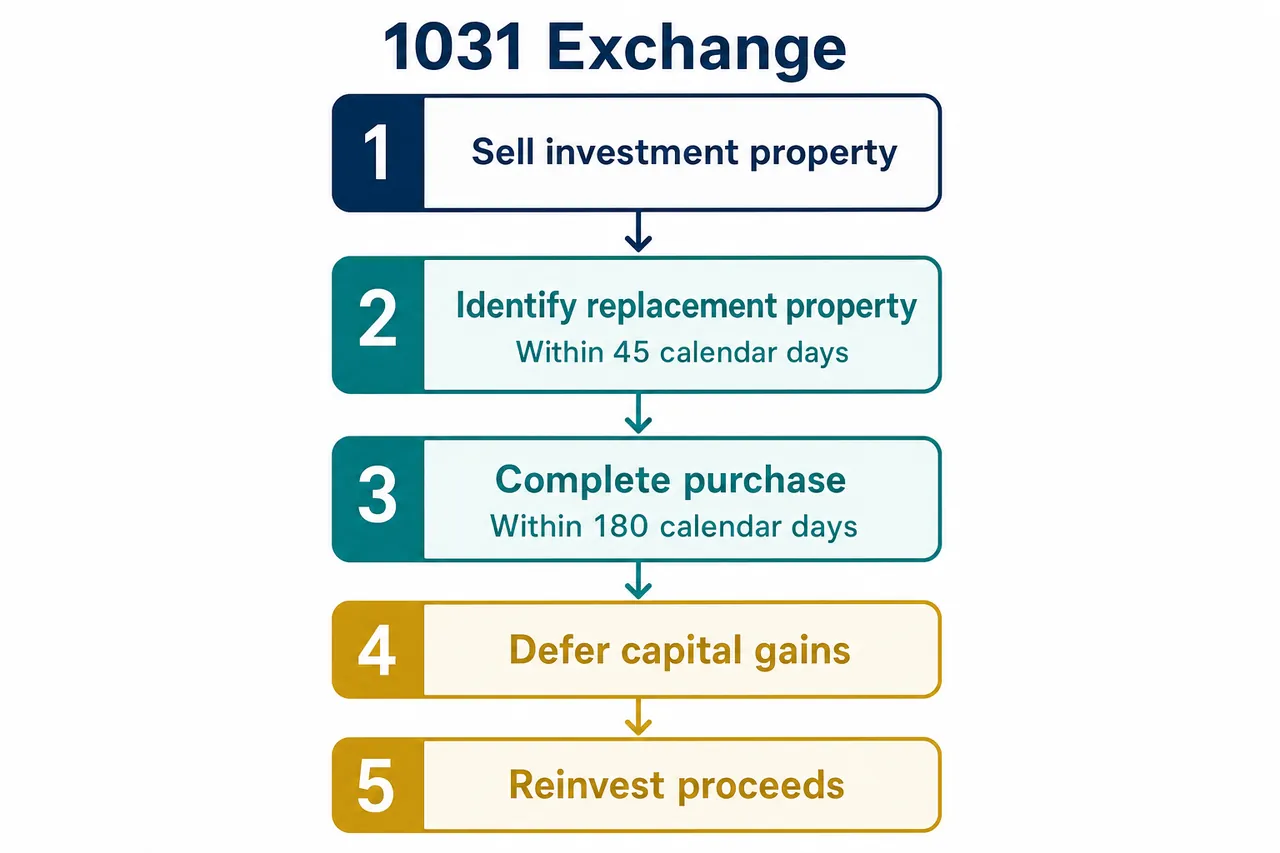
Want to defer capital gains, NIIT, and depreciation recapture all at once? A 1031 like-kind exchange is your answer. You sell one investment property and roll the proceeds into another qualifying replacement property — and the IRS lets you skip the federal and California tax hit, at least for now. The catch is timing. You've got exactly 45 calendar days to identify a replacement property after closing, then 180 calendar days (or your tax return due date with extensions, whichever comes first) to actually close on it. Miss either deadline and you're stuck with the full tax bill.
Use our 1031 exchange calculator to run the numbers on your deferred liability. And if you want the full playbook, our detailed guide to 1031 exchange rules walks through every mechanic.
2. Installment Sales
Not every deal works as a 1031. But if your buyer's willing to finance the purchase, an installment sale spreads your gain recognition over multiple tax years. The real benefit? You can structure payments to keep your annual taxable income below the threshold for that brutal 20% federal rate or California's 13.3% top bracket. That's how you chip away at your blended effective rate on the total gain.
Our seller financing calculator handles the payment structuring — it optimizes both what the buyer can afford and what gets you the best tax deferral.
3. Hold for Long-Term Prop 13 Protection
Prop 13 is California's gift to buy-and-hold investors. Every year you own a property, the gap between your assessed value and actual market value gets wider. That means your property tax bill stays effectively frozen while market rents climb — you're capturing all the upside.
The BRRRR strategy fits this perfectly in California. Refinancing pulls equity without triggering reassessment, and Prop 13 keeps your ongoing tax burden locked to your original purchase price. You need positive cash flow to make this work, but if you've got it, the structural advantage compounds year after year. Run your numbers with our BRRRR calculator to see the full acquisition-to-refinance picture.
4. Estate Planning and Step-Up in Basis
Inheritance changes everything. Your heirs step into a basis equal to fair market value at death — which means that accrued capital gain? Gone. That's the step-up in basis, and it's one of the few tax breaks the IRS actually hands you.
But Prop 19 added a wrinkle. The full reassessment exemption only applies if the heir actually occupies the property as a primary residence. So heirs need to decide fast: occupy it, sell it, or rent it out. If your property's market value sits within the $1,044,586 excess cap above the parent's factored base year value, it can still pass with minimal reassessment and zero capital gains on inherited appreciation. Looking to acquire inherited properties? Probate real estate investing connects you directly with heirs navigating these exact decisions — and they're often highly motivated sellers.
5. Opportunity Zone and Cost Segregation Strategies
California doesn't conform to all federal tax rules, and Opportunity Zones are a perfect example. Historically, California hasn't recognized the federal deferral benefit for state tax purposes on QOZ investments — but conformity changes. Talk to a California-licensed tax advisor before you structure a deal around this.
Cost segregation, though? That's real money. It accelerates depreciation deductions under federal rules and generates genuine cash-flow benefits. The flip side is higher recapture exposure down the road. You need to model the net benefit by stacking your accelerated deduction value against the eventual recapture cost at 25% federal rates plus California ordinary income rates. The math matters.
Back to topDocumentary Transfer Tax
California investors miss this one all the time — the documentary transfer tax (DTT). It's a county-level (and sometimes city-level) hit on every property sale. The state charges $1.10 per $1,000 of consideration, or based on the mortgage amount in some cases. But San Francisco? They'll charge you way more, with tiered mansion tax rates kicking in on higher-priced deals. When you're underwriting a California acquisition or exit, you need to know your specific county and city DTT rate. It directly impacts your net proceeds and your numbers on both buy and sell sides. And remember — this is completely separate from property taxes.
Back to topConclusion and Key Takeaways
California real estate taxes run on two separate tracks. Miss one, and your returns suffer. Property tax is where Prop 13 actually works in your favor — that 1% base rate combined with the 2% annual assessment cap means your tax bill crawls upward while market values jump. A long-term holder benefits enormously from this compression. Right now the statewide effective rate sits around 0.71% (2025 numbers), but that's the advantage for someone who's owned for a while. A new buyer stepping in? They'll face a meaningfully higher effective rate once you layer in all the add-ons. Then there's the exit — and this is where California gets brutal. Capital gains get taxed as ordinary income at rates up to 13.3%, stack that against federal capital gains at 20% and the 3.8% NIIT, and you're looking at combined federal-state rates approaching 37.1% if you're in the top bracket. That's brutal.
So what do you actually do with this? Buy smart. That means underwriting every angle — Mello-Roos, supplemental assessments, the full picture. Hold long. The math rewards patience in California more than almost anywhere else. When you do exit, use a 1031 exchange or structure an installment sale if the numbers work. Inter-generational wealth transfers? That's where Prop 19 rules matter — don't get caught off guard. Run your specific scenario using the capital gains tax calculator and 1031 exchange calculator before you commit to anything. And this matters: bring in a California-licensed CPA or tax attorney when depreciation recapture, estate planning, or complex entity structures come into play. Your portfolio's too valuable for a one-size-fits-all national approach.
Back to topFrequently Asked Questions
What's the base property tax rate in California under Proposition 13?
Proposition 13 caps the general property tax rate at 1% of a property's assessed value. But that 1% isn't your final number. Additional voter-approved bonds, Mello-Roos assessments, and special district taxes stack on top. Your actual effective rate? Could be meaningfully higher once you add everything together.
What's California's effective property tax rate compared to the national average?
California's statewide effective property tax rate sits at approximately 0.71% of market value as of 2025. That's actually below the national average of roughly 0.9%–1.1%, which sounds great on paper. But Prop 13 anchors assessed values to your purchase price. Long-term owners pay taxes on values that might be decades old compared to what the property's actually worth. A new buyer? You're paying significantly higher than 0.71% once special assessments and Mello-Roos charges come due. Don't underwrit an acquisition using that statewide average.
How often can California increase my property's assessed value?
Your county assessor can increase your assessed value annually, but only up to a limit. That cap is 2% per year or the California Consumer Price Index rate, whichever is lower. Two situations blow past this cap: a change of ownership or new construction. Either one triggers a full reassessment at current market value.
How is capital gains taxed in California when I sell a rental property?
California taxes capital gains as ordinary income with no break for long-term holdings. The top state rate is 13.3% (12.3% plus a 1% Mental Health Services surcharge on income above $1,000,000). Stack that with the federal 20% rate and the 3.8% NIIT, and you're looking at a combined rate of approximately 37.1% for top-bracket investors. That's why deal structuring matters.
What are the California property tax payment deadlines?
You've got two shots to pay. First installment is due November 1, delinquent after December 10. Second installment due February 1, delinquent after April 10. Miss either deadline and you're facing a 10% penalty on what you owe.
Can I avoid capital gains tax when selling a California investment property?
You can't eliminate it. But you can defer it. A properly structured 1031 like-kind exchange lets you roll proceeds into a replacement property and push off all capital gains, recapture, and NIIT to another day. And the $250,000/$500,000 IRC §121 exclusion? That only works on a primary residence you've owned and lived in for at least 2 of the 5 years before closing—not on investment properties.
Back to top