


Find trusted commercial real estate agents near me. Learn what credentials to look for, how to vet agents, and avoid costly mistakes on your next deal.
Products and Tools Mentioned in this Post

Luxury Presence
Luxury Presence offers premium website design, IDX integration, and digital marketing tools for luxury real estate agents. Elevate your brand with custom solutions.
Table of Contents
- Agent vs. Broker vs. Commercial Realty Firm: What's the Difference?
- How to Find Commercial Real Estate Agents in Your Area
- Key Services Commercial Agents Provide
- How Commercial Agent Commissions Work
- How to Evaluate Commercial Real Estate Agents
- The Evaluation Checklist: What to Look For and What to Avoid
- Steps to Connect With Local Commercial Agents
- Geographic Considerations and Market Differences
- Conclusion
- Frequently Asked Questions
Your commercial real estate agent can make or break your deal — the difference between closing fast at fair value versus overpaying and getting tangled in unfavorable terms. Commercial transactions aren't like residential sales. You're dealing with triple-net leases, zoning overlays, entitlements, environmental reports, and cap rate calculations that require more than a sales license to understand properly. The agent you pick needs real credentials, boots-on-the-ground knowledge of your local market, and a portfolio of closed deals you can verify. This guide shows you how to find, vet, and hire the right commercial agent for your market.

Agent vs. Broker vs. Commercial Realty Firm: What's the Difference?
You need to know who you're actually talking to before you start your search. These terms get thrown around like they're the same thing, but legally and practically? They're not.


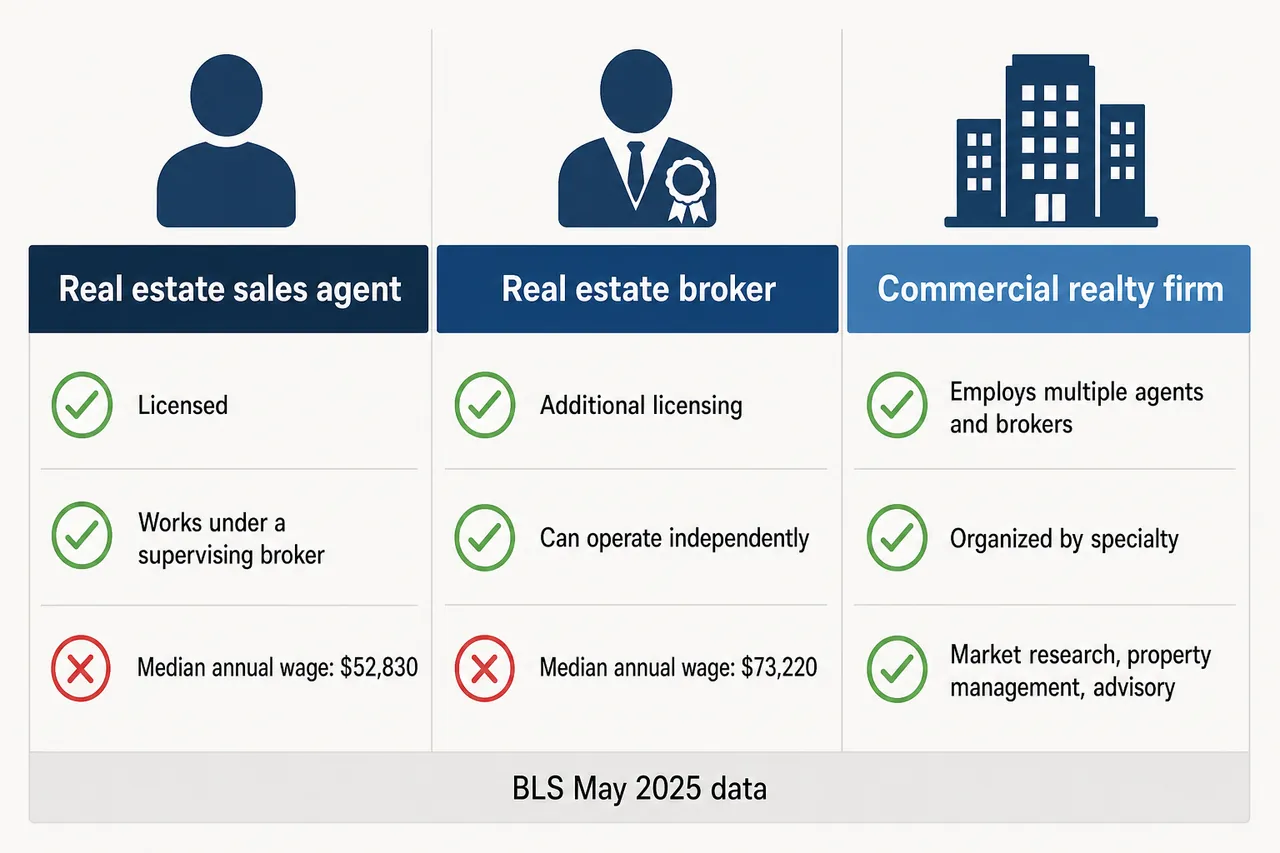
- Real estate sales agent: A licensed professional who works under a licensed broker's supervision — no way around it. BLS May 2025 data shows the median annual wage hits $52,830.
- Real estate broker: This person cleared additional licensing hurdles and can operate solo or run their own brokerage. The upside? BLS May 2025 median wage for brokers is $73,220, and the top earners crack $143,300.
- Commercial realty firm: A full-service brokerage with multiple agents and brokers on staff, often split by specialty (office, industrial, retail, investment). They bring market research, property management, and advisory services all under one roof.
Most commercial deals go through an agent or broker who works at a commercial realty firm. The firm backs them up with institutional firepower — market data, deal pipelines, legal templates ready to go. The individual agent? That's your relationship, your negotiator, your boots on the ground. And if you're just getting into commercial real estate, our commercial real estate investing for beginners guide walks you through how these partnerships actually play out.
Back to topHow to Find Commercial Real Estate Agents in Your Area

Define Your Location and Search Radius
Commercial real estate is hyper-local. That broker crushing it in downtown office leasing? They might have zero relationships in the suburban industrial parks five miles away. Before you start hunting, nail down specifics: which submarket (zip codes, neighborhoods, corridor), what property type, and what you're actually doing (acquisition, disposition, or lease). Get granular here. It stops you from accidentally hiring a generalist when you need someone who eats, sleeps, and breathes your specific asset class.
Use the Right Search Tools and Directories
Start with these platforms—they're where the deals live:
- CoStar and LoopNet: Both tie agent profiles directly to active listings, so you see who's actually moving deals in your submarket right now.
- CCIM Institute directory: Search Certified Commercial Investment Members by zip code. These aren't just licensees—they've completed four core curriculum courses plus a portfolio of at least 10 qualifying transactions totaling $5 million or more.
- SIOR member locator: The Society of Industrial and Office Realtors keeps a searchable directory of members who bring a minimum of five years of documented industrial and/or office brokerage experience to the table.
- Google search + Maps: Try "commercial real estate brokers [city/neighborhood]" and sort by reviews, activity date, and stated specializations. You'll spot patterns quick.
- LinkedIn: Filter by Real Estate industry, Commercial Real Estate Broker title, and your location. Endorsements and transaction history live right there in their profiles.
- Local commercial real estate associations: Most metros have NAIOP (commercial development) or BOMA (building owners) chapters. Check their member directories.
Identify Agent Specializations Relevant to Your Needs
Commercial real estate isn't one market. It's several—and each one demands different expertise. The table below shows which specializations fit which investors and tenants.
| Specialization | Best For | What to Expect |
|---|---|---|
| Office Leasing / Sales | Businesses seeking office space; investors buying office buildings | Lease comps, tenant improvement allowance negotiation, sublease market knowledge |
| Industrial / Logistics | Manufacturers, e-commerce fulfillment, cold storage operators | Clear height specs, dock door counts, zoning compliance, rail/highway access |
| Retail | Retail tenants seeking storefronts; developers building shopping centers | Foot traffic analysis, co-tenancy clauses, exclusivity provisions |
| Multifamily Investment | Investors buying apartment buildings (5+ units) | Cap rate analysis, rent roll review, value-add underwriting |
| Land / Development | Developers, builders, land speculators | Entitlement risk assessment, highest-and-best-use analysis, infrastructure capacity |
| Investment Sales (Net Lease / NNN) | 1031 exchange buyers, passive income investors | Cap rate benchmarks, credit tenant profiles, lease term analysis |
| Property Management | Landlords who want third-party management | Tenant relations, maintenance coordination, monthly reporting |
Once you know your specialization, you can eliminate agents fast. Forget the marketing language—look at their actual transaction history. Want the full picture on how different commercial assets pencil out? Check our complete 2026 commercial real estate investing guide.
Back to topKey Services Commercial Agents Provide
Investment Property Analysis and Acquisition
A qualified commercial investment agent pulls rent rolls, analyzes lease abstracts, identifies deferred maintenance, and stress-tests your assumptions. They're not just showing you listings — they're helping you underwrite deals properly. After your agent runs the numbers, you should verify cap rates and cash-on-cash returns yourself using our cap rate calculator and cash-on-cash return calculator. Planning a BRRRR-style acquisition? Our BRRRR calculator models the refinance phase so you know exactly where you stand.
Landlord Representation and Lease Negotiation
Leasing up vacant space. Renewing existing tenants. Maximizing NOI. That's what landlord reps do. They bring lease comps, model concession packages (tenant improvement allowances, free rent periods), and negotiate directly with tenant reps — that's a completely different skill set than investment sales. Make sure the agent you hire has actually executed leases, not just sold buildings.
Tenant Representation
Tenant reps work exclusively for occupiers — companies or individuals looking to lease space. And here's what matters: they're typically paid from the landlord's commission, so there's no out-of-pocket cost to you in most cases. The good ones know which landlords will negotiate, where off-market availability exists, and how to structure a letter of intent that actually protects your operational needs.
Development and Land Advisory
These agents advise on site selection, entitlement risk, and highest-and-best-use analysis. They typically have deep relationships with municipal planning departments, civil engineers, and environmental consultants — relationships you need on your side. Acquiring raw land? Use our land price per acre calculator to benchmark pricing before you make an offer.
Multi-Property Portfolio Management
Got multiple commercial assets? You need an agent who manages the entire portfolio relationship, not just individual deals. They coordinate renewals, recommend dispositions, identify 1031 exchange opportunities, and track performance across properties. If a 1031 exchange is part of your strategy, our 1031 exchange calculator models the tax deferral benefit before you engage counsel.
Back to topHow Commercial Agent Commissions Work
Before you sign anything, you need to understand how commissions work. Miss this step, and you'll get blindsided. More importantly, you'll miss red flags about whether your agent's incentives actually align with yours.
Sales transactions run 4%–8% of purchase price, but here's what actually matters: the bigger the deal, the lower your rate. According to 2026 market data, deals under $1M typically carry 5–6%; $1M–$3M runs 4–5%; $3M–$5M drops to 3–4%; and anything above $5M generally lands in the 1.5–3% range. This sliding scale is why a $500K property hits you harder than a $10M one.
Lease deals work differently. You're looking at 4%–6% of total lease value, paid upfront at signing. Run the numbers: a 5-year lease at $5,000/month equals $300,000 total value. That means your agent pockets $12,000–$18,000 on day one, whether the tenant lasts six months or the full term.
And here's the critical part: the seller or landlord covers the entire commission. It comes straight out of closing proceeds or gets baked into lease economics. Buyers and tenants don't write separate checks—but don't confuse that with "free." The cost gets priced in. You're paying it either way.
Commission alignment is everything. If your buyer's agent is getting paid by the seller, get it in writing that they're representing you alone. Dual agency happens in commercial real estate more often than most people realize, and it needs to be disclosed—clearly.
Back to topHow to Evaluate Commercial Real Estate Agents
Check Credentials and Designations
Two designations separate the serious players from everyone else:
- CCIM (Certified Commercial Investment Member): You're looking at four core courses (CI 101–104), an online ethics course, 8 hours of negotiation training, elective credits, and a portfolio of qualifying experience. The price tag? Around $7,695 at 2026 member pricing. Agents who've dropped that kind of money aren't playing around.
- SIOR (Society of Industrial and Office Realtors): This one's brutal. You need five years of documented industrial and/or office brokerage experience, hit a gross fee income production threshold that varies by chapter (typically meaning at least 70% of your transactions are industrial or office), and get formal recommendations from two active SIOR members. You can't buy your way in. It's production-based, full stop.
Don't take their word for it. Verify credentials directly on the CCIM and SIOR websites.
Assess Local Market Knowledge
Knowing which tenants are expanding, which landlords are distressed, which submarkets have unreported vacancy, and what deals are trading off-market—that's local knowledge. This isn't geography trivia. During your interview, ask the agent to walk you through three recent comparable transactions in your target submarket. Can they do it fluently, without looking things up? Then their local knowledge is real. If they're vague, that's a red flag. For a broader framework on what market data actually matters, see our article on real estate market indicators to track.
Review Ratings, Awards, and Digital Presence
Google reviews, CoStar Power Broker awards, and local business journal "top brokers" lists aren't perfect. But they're useful. The CoStar Power Broker designation, for instance, is based on verified transaction volume in a given market—it's hard to fake. And awards from industry organizations like NAIOP or BOMA? Those show someone's engaged with the professional community.
What's on their website and LinkedIn matters. A broker publishing current market reports, transaction announcements, and actual thought leadership is demonstrably engaged in their market. For context on where brokerages are headed with technology, our article on Luxury Presence's $37M Series C shows what forward-thinking firms are building.
Verify Years of Experience
The market is crowded. There are approximately 530,600 real estate brokers and sales agents in the U.S. as of 2025. And 1,438,569 NAR members as of June 2026. The median Realtor has 13 years of experience per the 2026 NAR Member Profile. Commercial specialists need longer. For a complex investment acquisition, don't settle for less than five to seven years of verified commercial experience—total real estate years don't cut it.
Back to topThe Evaluation Checklist: What to Look For and What to Avoid
| Evaluation Criteria | What to Look For | Red Flags |
|---|---|---|
| Specialization | Transaction history in your exact property type and submarket | Claims to specialize in everything; residential background with minimal CRE deals |
| Credentials | CCIM, SIOR, or verifiable production-based recognition (CoStar Power Broker) | Only general NAR membership; credentials that can't be verified on issuing organization's site |
| Market Data Access | Active CoStar / CBRE EA subscription; can produce comp reports on request | Relies solely on public listing sites; no proprietary data access |
| References | Two to three verifiable client references in similar deal types | Refuses to provide references; references are from many years ago or unrelated asset types |
| Representation Clarity | Clear written disclosure of who they represent and commission structure | Vague about dual agency; avoids putting representation in writing |
| Responsiveness | Returns calls/emails within 24 hours; proactively sends relevant listings or intel | Hard to reach during due diligence phase; communication drops after the engagement letter is signed |
| Network Depth | Relationships with lenders, attorneys, title companies, and local developers | Can't refer you to a qualified commercial lender or RE attorney when asked |
That last one matters most. Your commercial agent should act as a true hub—connected deeply enough to pull strings when you need them. When financing becomes critical, they've got relationships with lenders who know SBA 504s, CMBS structures, and bridge products inside and out. Our article on commercial real estate financing options gives you the language to have those conversations confidently. And tax structuring? Don't skip it. Our guide to finding a real estate tax CPA walks you through vetting that part of your team too.
Back to topSteps to Connect With Local Commercial Agents
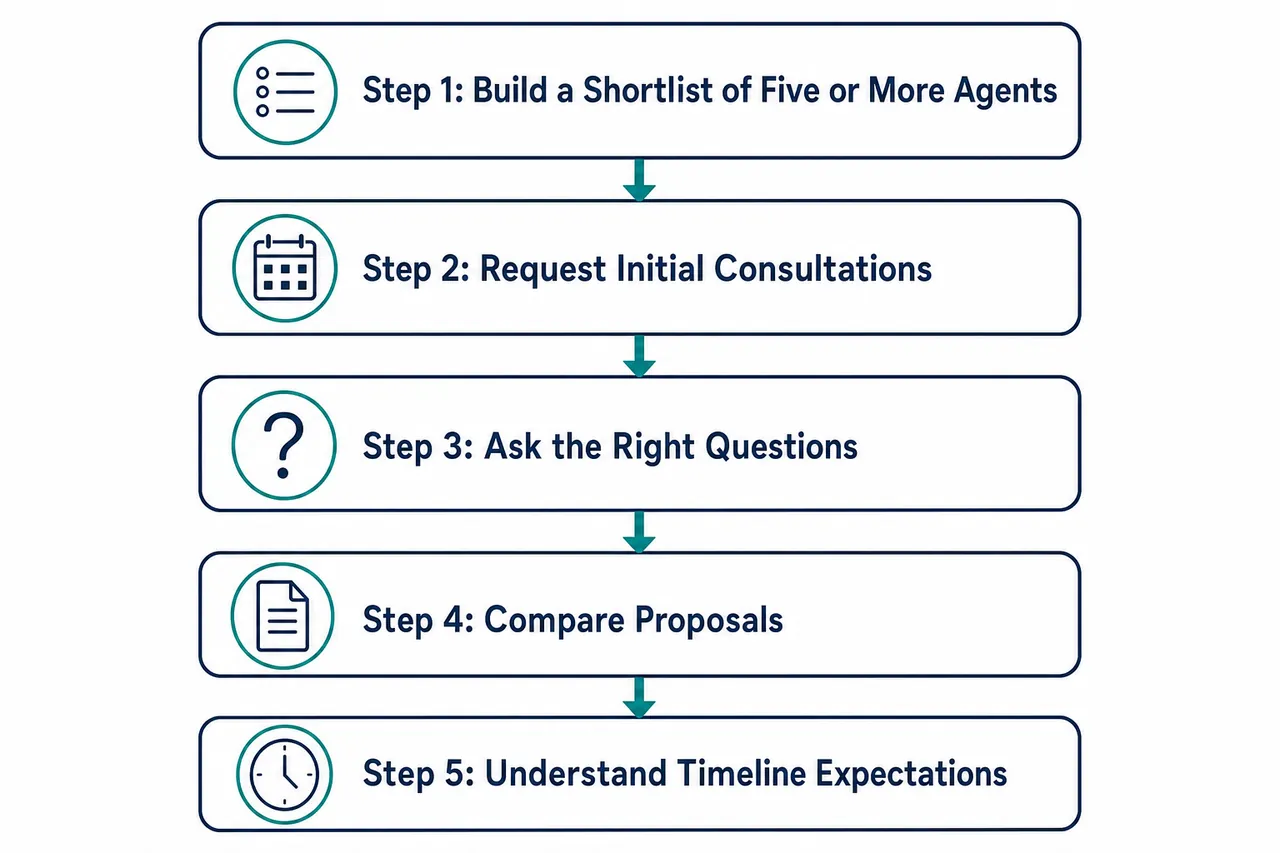

Step 1: Build a Shortlist of Five or More Agents
Start with the directory and search tools mentioned above, but don't settle on whoever pops up first. Cross-reference at least two platforms. An agent who shows up on CoStar, has solid Google reviews, and holds a CCIM or SIOR credential? That's your safer play. Someone who only appears in one place? Pass.
Step 2: Request Initial Consultations
Free initial consultations are standard in commercial real estate. Treat it like a job interview, not coffee talk. Walk in with your property criteria, budget, and timeline already written down. Watch how they respond. The best agents ask clarifying questions first—they listen before they pitch.
Step 3: Ask the Right Questions
| Question Category | Specific Questions to Ask | Why It Matters |
|---|---|---|
| Transaction History | "How many deals have you closed in this submarket in the past 24 months? What was the average transaction size?" | Confirms they're active in your specific market, not just nearby |
| Market Data | "What data sources do you use? Can you pull a comp report for this submarket right now?" | Tests real data access vs. surface-level familiarity |
| Representation | "Will you represent only me, or do you sometimes represent the other side? How is your commission structured?" | Clarifies conflicts of interest before you're committed |
| Timeline | "What's a realistic timeline for a transaction like this in the current market?" | Calibrates expectations; exposes agents who overpromise |
| Network | "Who are the lenders, attorneys, and title companies you work with regularly on deals like this?" | Reveals depth of professional network and deal infrastructure |
Step 4: Compare Proposals
After you've talked to three to five agents, have your top two or three submit a formal proposal or marketing plan. For a lease or acquisition, insist on a submarket overview, comparable transactions, their proposed strategy, and transparent commission disclosure. Put those proposals side by side. Don't just look at the commission percentage—dig into the quality of their market analysis and how specific they get about your deal.
Step 5: Understand Timeline Expectations
Commercial deals aren't like residential. A straightforward office lease typically takes 60–120 days from initial search to signed contract. Investment acquisitions are different—especially if environmental review, zoning confirmation, or complex financing is in play. Those can easily run six months to a year. Any agent promising faster timelines without pointing to a specific reason (distressed seller, off-market opportunity already locked in) is either green or overselling. Build your own realistic deal timeline and run your financial model early through our DSCR calculator. Stress-test that DSCR before you go to contract and confirm debt service coverage actually pencils.
Back to topGeographic Considerations and Market Differences
Industrial vacancy rates in a port-adjacent market like Los Angeles differ dramatically from those in a secondary Midwest market. Office dynamics in a tech-heavy submarket are nothing like a government-driven CBD. The same property type behaves very differently depending on geography. Retail metrics in a Sun Belt growth market don't apply to a Rust Belt city center.
This is why you're often better off with a nationally branded brokerage that's got real local boots on the ground. Pure local boutiques miss the data infrastructure and capital markets relationships. Pure national platforms can't match submarket intelligence or the landlord/tenant relationships that actually close deals. The best firms combine both. But here's what matters: ask specifically which office and which individual broker will handle your account day-to-day. Big-name firms sometimes assign junior agents to smaller deals while the senior producers chase trophy assets. You don't want to be in that second bucket.
Back to topConclusion
Finding the right commercial real estate agent isn't a quick Google search followed by a phone call. You need a structured process. Start by nailing down your submarket and property type—be specific. Then pull data from multiple directories (CoStar, CCIM, SIOR, Google) to build a solid shortlist of agents who actually have verified credentials and real transaction histories in your niche.
Commission structures matter. Understand them before you sign anything. Ask the tough questions during consultations. Compare written proposals side by side. The agent you're looking for does more than hand you a listing database you could've found yourself—they bring market data, deal relationships, and a professional network that includes lenders, attorneys, and title companies.
And if you're building out your full investment team in parallel, we've got guides on finding a real estate syndication attorney and real estate team building for agents that walk you through those hiring decisions the same systematic way.
Back to topFrequently Asked Questions
What's the difference between a commercial real estate agent and a commercial real estate broker?
An agent holds a license but works under a broker's supervision. A broker has jumped through additional state hoops and can operate solo or run their own shop. When you're doing a deal, you'll probably work with an agent employed by a brokerage — that firm's broker-of-record is the licensed principal handling compliance while the agent moves the transaction forward. On larger or messier deals, it pays to dig deeper. Does your point of contact actually have broker-level experience, or are they just executing orders?
Who pays the commercial real estate agent's commission?
The seller or landlord foots the entire bill in virtually every commercial transaction. Sales commissions typically land at 4%–8% of purchase price, scaling down on larger deals. For leases, you're looking at 4%–6% of total lease value, paid at signing. Buyers and tenants don't write checks. But don't fool yourself — those costs get baked into the deal price anyway.
What credentials should I look for in a commercial real estate agent?
CCIM and SIOR are the gold standards. The CCIM requires four core courses plus a portfolio showing at least $5 million in closed deals or 20 transactions. SIOR is tougher on the experience side: five years of documented industrial or office brokerage experience plus documented production numbers. Both are verifiable straight from the source organization's website.
How long does a typical commercial real estate transaction take?
It depends entirely on the deal type. Lease negotiations usually run 60–120 days from first search to signed docs. Investment purchases get complicated fast — throw in financing, environmental reviews, and serious due diligence and you're looking at six months, maybe a year. Someone selling you a faster timeline? Push back hard. Ask exactly why. Real speed comes from off-market inventory or a distressed seller, not from skipping the work that matters.
How do I verify that a commercial real estate agent actually knows my local market?
Request closed comparable transactions. Not listings — actual closed deals in your submarket and property type from the past 24 months. A sharp agent will pull this from CoStar or CBRE EA while you're sitting there. Then ask about off-market activity. Who's actually buying and selling in this submarket right now? How connected is this agent to those players? Vague answers mean shallow knowledge, no matter what their branding says.
Back to top