


Get real estate tax help: deductions, relief programs, 1031 exchanges & expert strategies to lower your tax bill and avoid costly penalties in 2026.
Table of Contents
- What Real Estate Tax Help Actually Covers
- Federal Tax Deductions Every Real Estate Owner Should Know
- Property Tax Relief Programs: What's Available and Who Qualifies
- Special Programs for Vulnerable Populations
- What Happens If You Ignore Delinquent Property Taxes
- Steps to Get Real Estate Tax Help
- Finding Real Estate Tax Help in Your Area
- Tax Strategies Specific to Real Estate Investors
- Conclusion: Take Action Before the Problem Grows
- Frequently Asked Questions
Federal deductions and state relief programs are your two biggest levers for cutting real estate tax bills. But most investors focus only on depreciation and 1031 exchanges—missing the high-impact plays: property tax assistance programs, penalty stacking strategies, and knowing which advisors actually understand your portfolio. That's the gap between staying ahead and getting blindsided by compound liabilities. This guide covers every major option in 2026 with real numbers, comparison tables, and the exact steps you need to take.

What Real Estate Tax Help Actually Covers
"Real estate tax help" covers way more ground than people think. You're looking at four distinct buckets: federal income tax deductions and strategies for owning, operating, or selling property; property tax relief programs run by counties and states; delinquency resolution tools like payment plans and property tax loans; and professional advisory services from CPAs, tax attorneys, and nonprofit counselors. Most investors need help across multiple categories at once.
What creates the need? Rising home values. Your assessed value climbs, your tax bill climbs, and suddenly it doesn't fit the budget anymore. A job loss or medical emergency can flip an affordable bill into a crisis overnight. And if you're an investor who sells an appreciated property without tax planning? You're looking at a tax event that'll shock you. The key is figuring out which of these four categories actually solves your problem.
Back to topFederal Tax Deductions Every Real Estate Owner Should Know
Mortgage Interest and the Standard Deduction Threshold
For property owners who itemize, the mortgage interest deduction is still one of your best moves. Post-December 15, 2017 loans cap out at $750,000 in deductible interest ($375,000 married filing separately). Older loans get the better deal: $1,000,000 ($500,000 MFS). And starting in 2026, you can deduct PMI premiums as mortgage interest again — but it phases out above $75,000 AGI ($150,000 for joint filers).

But here's what actually matters: itemizing only wins if your deductible expenses beat the standard deduction. For 2026, that's $32,200 for married filing jointly, $16,100 for single filers, and $24,150 for head of household. Mortgage interest alone probably won't get you there. Add property taxes (see SALT below) and other deductions? Now you're making a real calculation.
The SALT Deduction in 2026
State and local taxes—property taxes mostly, plus income or sales tax—now cap at $40,400 for single filers and married filing jointly, and $20,200 for married filing separately for 2026. That's a jump from the $10,000 cap. Don't get too comfortable though. The cap begins phasing down at a MAGI of $505,000 (single or MFJ) — dropping 30 cents for every dollar you go over — and bottoms out at $10,000 ($5,000 MFS). And it all expires January 1, 2030, reverting back to $10,000.
If you own high-value properties in New York, California, or New Jersey? This expanded cap changes everything. You need to run your mortgage interest, property tax, and other deductible expenses against the standard deduction before you assume itemizing doesn't make sense.
Depreciation: The Investor's Quiet Powerhouse
Depreciation is where rental property owners build real tax shields. You deduct your building's cost (not the land) over its useful life — 27.5 years for residential rental property and 39 years for commercial real estate. Take a $400,000 residential building. That's roughly $14,545 in annual deductions that offset your rental income—zero cash out of pocket.
Want to see how this impacts your after-tax returns? Use our rental property calculator.
But the bill comes due at sale. Depreciation you've claimed gets "recaptured" and taxed at a maximum of 25% (unrecaptured §1250 gain). This sits separately from your capital gains tax on appreciation. Most investors don't see this coming—which is exactly why you need an exit plan. Our guide on real estate tax strategies to keep more of your profits walks through depreciation recapture in detail.
Capital Gains: Rates, Exclusions, and the NIIT
Hold property longer than a year and long-term capital gains rates kick in. For 2026, they look like this:
| Filing Status | 0% Rate (up to) | 15% Rate | 20% Rate (above) |
|---|---|---|---|
| Single | $49,450 | $49,451–$545,500 | $545,500 |
| Married Filing Jointly | $98,900 | $98,901–$613,700 | $613,700 |
Flip that hold period—sell within a year—and you're taxed as ordinary income at up to 37%. And if your modified adjusted gross income tops $200,000 (single) or $250,000 (MFJ), tack on an extra 3.8% Net Investment Income Tax (NIIT). High-income sellers can hit 23.8% on long-term gains—even higher when depreciation recapture enters the picture.
Your primary residence gets a break. The §121 exclusion shields $250,000 for single filers and $500,000 for married filing jointly, as long as you've owned and lived there for at least 2 of the 5 years before selling. Before you sign a sales contract, run your numbers through our capital gains tax calculator for real estate.
Planning to reinvest into another property? A 1031 exchange defers the entire capital gains hit. Model that scenario with our 1031 exchange calculator. For the bigger picture on when to sell versus hold, check out our guide on real estate exit strategies.
Back to topProperty Tax Relief Programs: What's Available and Who Qualifies
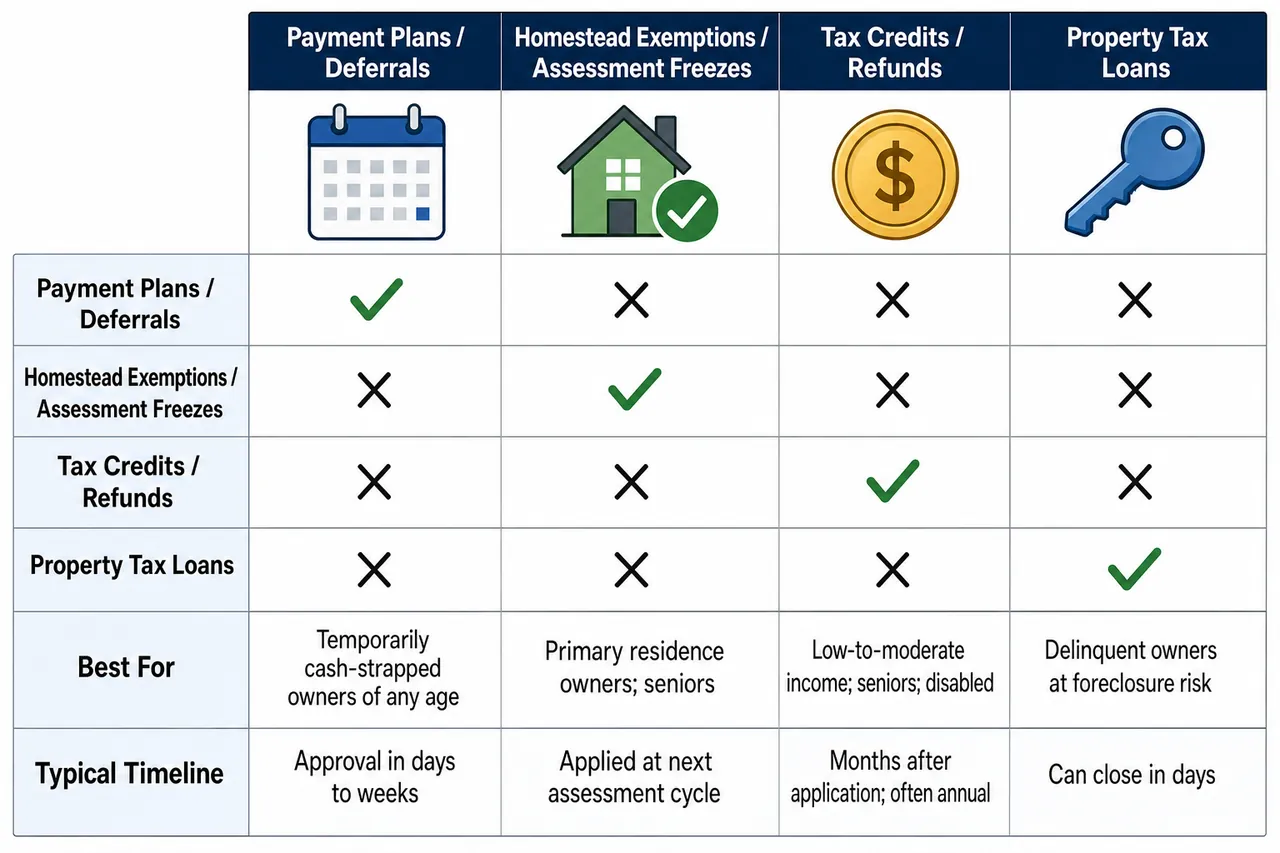
Federal deductions are just the opening act. If you're drowning in annual property tax bills, state and county relief programs exist to actually reduce what you owe—not just offset it on your tax return. These programs vary wildly by jurisdiction, but they cluster into four main buckets.
| Relief Type | Best For | Typical Timeline | Key Drawbacks | Income Limits |
|---|---|---|---|---|
| Payment Plans / Deferrals | Temporarily cash-strapped owners of any age | Approval in days to weeks | Interest may still accrue; full balance eventually due | Varies by county; often none for installment plans |
| Homestead Exemptions / Assessment Freezes | Primary residence owners; seniors | Applied at next assessment cycle | Reduces assessed value, not tax rate; savings vary | Often none for basic homestead; income limits for freezes |
| Tax Credits / Refunds | Low-to-moderate income; seniors; disabled | Months after application; often annual | Requires annual re-application; income verification | Yes — typically tied to household income vs. tax burden |
| Property Tax Loans | Delinquent owners at foreclosure risk | Can close in days | Third-party lender holds lien; interest cost adds up | Generally none; credit and equity based |
Municipal vs. County Program Variations
Here's where most people miss money: property tax relief isn't uniform, even within a single state. Some programs run at the state level and hit every corner of that state. Others get authorized by the state but funded and run by individual counties. Then you've got cities and municipalities stacking their own supplemental programs on top of whatever the county already offers. New York City runs its own exemption and abatement programs—like the Enhanced STAR and Senior Citizen Homeowner Exemption—completely separate from what New York State handles. Cook County, Illinois does the same thing with homestead exemptions. They operate under state law but handle everything independently, with their own deadlines and processing offices.
In real practice? Searching your state's relief programs online gets you half the story. You need to contact both your county assessor or tax collector and your city or municipal finance office (if you're in an incorporated city) for programs specific to your jurisdiction. Eligibility rules shift. Income caps shift. Exemption amounts differ. Application deadlines move. And in some cases, you can stack multiple programs and qualify for both simultaneously. Call both offices directly and ask whether any municipal-level programs exist on top of county and state offerings.
Payment Plans and Deferrals
Most county tax collectors offer installment plans. Can't pay in full by the due date? They've got you covered—usually. Terms swing all over the place: some counties let you split the bill into four equal quarterly payments with zero added cost; others tack on administrative fees or interest. The critical move is calling your county tax collector's office before your bill goes delinquent. Once you're late, your options shrivel and what you'll pay to fix it climbs fast. Working-age homeowners without senior or disability status typically find a standard payment plan fits best.
Homestead Exemptions and Assessment Freezes
Most states offer a homestead exemption. It reduces the taxable assessed value on your primary residence. Some take it further and offer assessment freeze programs—mainly for seniors or disabled homeowners—that lock the assessed value in place regardless of what your home's market value does. This matters enormously in hot markets where rising home values would otherwise spike your tax bill every single year. Owner-occupancy is standard. Residency is standard. For freeze programs, expect an age threshold (usually 65-plus) and an income cap.
Tax Credits, Refunds, and Income-Based Programs
Several states run what's called a circuit-breaker program. The math is simple: when property taxes eat up too much of your household income, the state cuts you a check or credits your taxes. Maryland's Homeowners Property Tax Credit exemplifies this approach. South Dakota runs a sales and property tax refund program aimed at seniors and disabled residents. All of these demand annual applications plus income documentation, ownership proof, and residency verification.
What do these eligibility criteria typically look like?
- Age requirements: Most senior programs start at 65; some allow 62.
- Disability verification: Programs for disabled residents need documentation from Social Security, the VA, or a licensed physician.
- Widow/widower status: Many programs extend senior benefits to surviving spouses who hit an age or income threshold.
- Household income limits: These vary dramatically by state and program; some exclude certain assets or income sources from their calculations.
- Residency and ownership: Almost universally required—you own and occupy the property as your primary residence.
Property Tax Loans
Property tax loans aren't government help. They're a private market play. A third-party lender pays your delinquent tax bill straight to the county—penalties stop accruing, foreclosure risk disappears—and you repay them monthly at their rate and term. They grab a lien on the property. Speed's the upside. The downside is a new debt obligation with interest attached. Use these when you've got solid equity, you're facing imminent tax sale, and government relief either won't work or won't move fast enough.


Before you commit to this debt service, run the numbers through our DSCR calculator for rental property loans. Know what you can actually carry.
Back to topSpecial Programs for Vulnerable Populations

Seniors, disabled homeowners, and surviving spouses often unlock the deepest relief programs available. Income and asset limits shift every year by state—so don't rely on last year's numbers. Verify current thresholds directly with your county assessor or state revenue department before you file.


| Qualification Type | Typical Age/Status | Income Threshold | Asset Limit | Residency Requirement |
|---|---|---|---|---|
| Senior Homeowner | 65+ (some programs: 62+) | Varies by state; often $30,000–$60,000 household income | Varies; primary residence often excluded | Owner-occupied primary residence; often 1+ year |
| Disabled Homeowner | Any age with qualifying disability | Often same as senior program in that jurisdiction | Varies; retirement accounts often excluded | Owner-occupied primary residence |
| Widow/Widower | Often 50+ or matching deceased spouse's eligibility | Same as senior/disability program | Same as senior/disability program | Owner-occupied primary residence |
| Low-Income Working-Age | Any age | Circuit-breaker programs; ratio of tax to income | Rarely an issue; income-focused | Owner-occupied primary residence |
Your primary residence doesn't count against asset limits in most programs. Retirement accounts often get excluded too. Social Security income? Many jurisdictions discount it partially or exclude it entirely when calculating your household income—that's a huge advantage if you're living mostly on benefits.
The application process forces you to document everything. That's actually useful. You'll figure out fast whether you qualify.
Back to topWhat Happens If You Ignore Delinquent Property Taxes
Unpaid property taxes compound fast. Penalties and interest start the day after the due date passes, and the math gets ugly quickly. A 12-month delinquent bill can balloon to 20–30% above the original balance when you factor in penalties, interest, and admin fees — but rates vary by jurisdiction, so check your county's specific numbers. The escalation follows a predictable pattern:
| Stage | What Happens | Penalties Applied | Options Remaining |
|---|---|---|---|
| Due Date Passes | Bill becomes delinquent; penalty clock starts | Initial penalty (varies by county) | Payment in full, payment plan, relief application |
| 30–90 Days | Additional interest accrues; notices issued | Monthly interest added to balance | Payment plan, property tax loan, relief program |
| 6–12 Months | Account referred for collection; lien may be sold | Collection fees added; compounding continues | Property tax loan, negotiation, nonprofit assistance |
| 1–3 Years | Tax sale or foreclosure proceedings initiated | All prior penalties plus legal costs | Redemption period (varies by state), loan, legal aid |
| Post-Tax Sale | Third party holds tax certificate or deed | High redemption cost or loss of property | Redemption if within statutory window; legal challenge |
Seniors on fixed incomes and long-term homeowners in appreciating markets get hit hardest by tax-driven displacement — losing a property over unpaid taxes rather than mortgage default. The sooner you act, the more paths forward you have. As an investor, you should know this too: delinquent tax properties can be goldmines or landmines depending on your due diligence. Title complications are real, but so is the opportunity.
Back to topSteps to Get Real Estate Tax Help
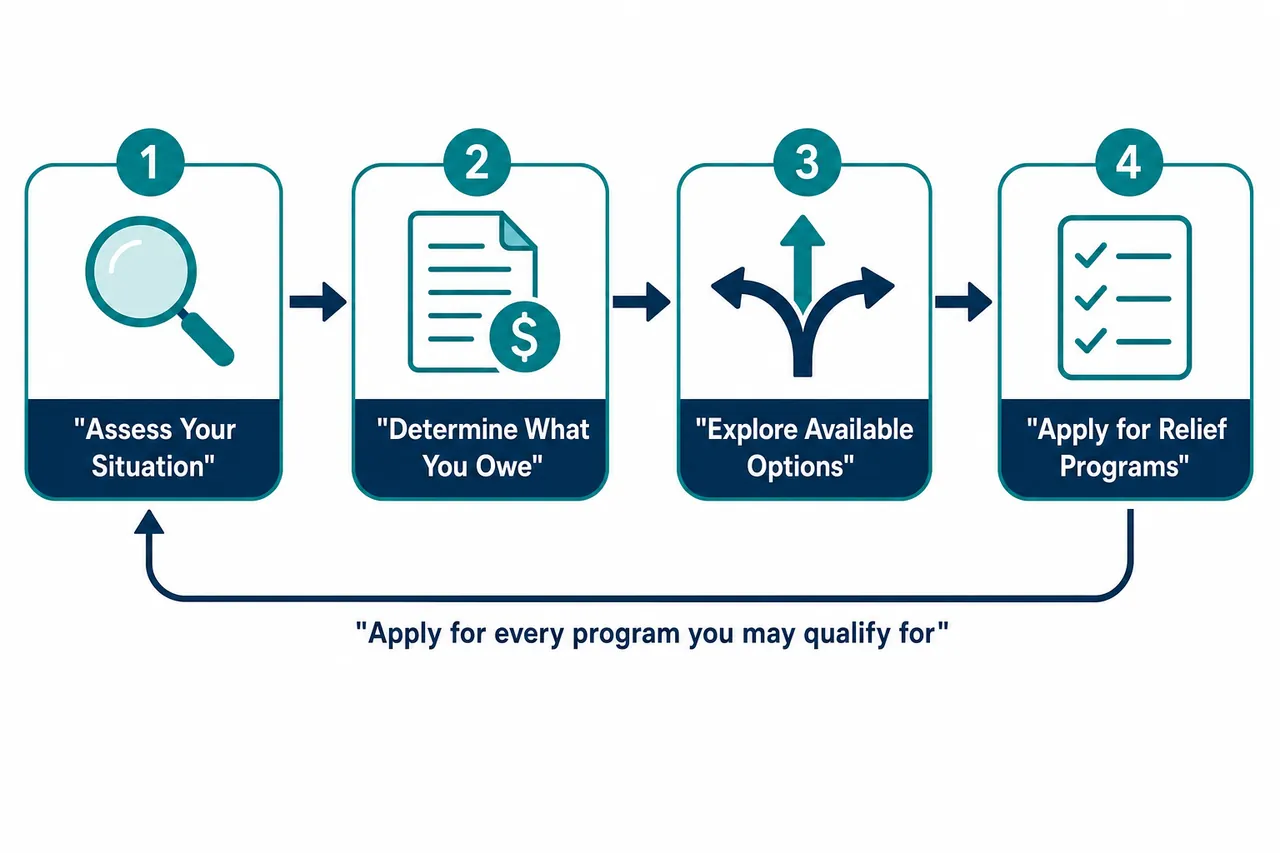
You've got a property sale triggering a federal tax bill, or maybe a delinquent county notice just landed on your desk. Either way, you'll follow the same playbook:
- Confirm exactly what you owe. Don't just glance at the original tax amount. Request a full payoff statement from your county tax collector that includes penalties, interest, and administrative fees. For federal obligations, pull your IRS account transcript and review it line by line.
- Understand your delinquency status. Are you past due? Has a lien been filed against the property? Is a tax sale already scheduled? These answers tell you how much time you actually have and which options remain on the table.
- Contact your county assessor or tax collector directly. Most counties run hardship programs that don't show up in a Google search. A direct phone call or in-person visit beats searching online every time. Ask about payment plans, deferral programs, and any relief options specific to your situation.
- Gather your documentation. Relief applications almost always require: recent property tax bills, proof of income (last two years of tax returns or current benefit statements), proof of ownership (deed or mortgage statement), proof of residency (utility bills, driver's license), and documentation for disability or senior programs if you're applying for those.
- Apply for every program you may qualify for. These programs overlap. You could qualify for a homestead exemption and a senior freeze at the same time. Miss an application deadline and you're waiting a full year for the next cycle.
- If you need professional help, choose the right type. CPAs and real estate tax attorneys handle federal planning and complex transactions. Nonprofit housing counselors and legal aid attorneys handle property tax delinquency and foreclosure prevention. AARP Foundation's Property Tax-Aide program offers free eligibility screening and application assistance in many states.
Finding Real Estate Tax Help in Your Area
Government and County Resources
Your county assessor's office handles valuations and exemptions. Your county tax collector's office handles billing, payment plans, and delinquency — that's where the real action is. Most have websites, but here's what works: call directly. You'll find options that aren't splashed across their homepage. State department of revenue or taxation websites list statewide relief programs with current income limits and application deadlines. And don't skip the local finance or revenue office if you're in a city or municipality. Municipal programs often exist independently of county offerings and won't show up in county or state databases.
Nonprofits and Legal Services
The AARP Foundation Property Tax-Aide program isn't just for seniors—it helps low-to-moderate income homeowners of any age navigate property tax relief applications. Their screening tool identifies programs you qualify for in minutes. Local legal aid organizations provide free or low-cost representation for homeowners facing tax foreclosure; search the Legal Services Corporation directory for your area. Many cities and counties also run HUD-approved housing counseling agencies that can walk you through your options.
Professional Tax Advisors for Investors
Managing multiple properties or handling a complex transaction? A real estate CPA isn't a cost—it's an investment. The right advisor structures depreciation correctly, times sales to minimize capital gains exposure, and uncovers deductions you're missing. If you're an agent, understanding these mechanics makes you significantly more valuable to investor clients. See our guide on how to manage a real estate investment business for more on building the right professional team.
Creative financing arrangements get complicated fast. Seller carrybacks, subject-to purchases, lease-options—the tax treatment varies by structure and can trap you if you're not careful. Our creative financing strategies guide covers the mechanics. But before you close on any non-standard structure, have a tax professional review it.
Back to topTax Strategies Specific to Real Estate Investors
Standard deductions and relief programs are table stakes. The real money moves? They're buried in strategies that active investors use to slash their effective tax rate down to single digits. Let's talk about what actually works:
- Cost segregation studies — these accelerate depreciation on pieces of your commercial or residential property, dumping deductions into year one instead of spreading them over decades.
- Passive activity loss rules determine whether your rental losses can shelter other income. Hit the IRS hour thresholds as a real estate professional, and you unlock full deductibility. Miss them, and you're stuck.
- 1031 exchanges defer capital gains taxes by moving proceeds into a like-kind property. Want to know the actual after-tax difference between selling and exchanging? Run the numbers with our 1031 exchange calculator.
- Opportunity Zone investments defer capital gains on qualified reinvestments—and can even reduce what you owe if you hold long enough.
- Entity structuring (LLCs, S-corps, partnerships) changes everything: how income gets taxed, whether self-employment taxes kick in, how losses flow to your return.
Timing is everything with these moves. You implement them proactively—before closing, before year-end—not afterward when it's too late. Want to see how different investment approaches impact your tax bill? Check our breakdown of real estate investing strategies compared. And if you're building a portfolio and wondering how diversification plays into both risk and tax exposure, our guide on how to diversify your real estate portfolio picks up where this leaves off.
Back to topConclusion: Take Action Before the Problem Grows
Real estate tax help isn't one thing. It's federal deductions, state and county relief programs, professional advisors, and nonprofits all working together. The pattern that shows up everywhere? Acting early beats waiting every single time. A delinquent property tax bill compounds. You can't undo a capital gain from an unplanned sale after closing. The deductions and programs in this guide only work if you actually apply for them before the deadline hits.
What's your situation? Figure out which bucket you're in first—federal tax strategy, annual property tax relief, delinquency resolution, or professional advisory support. Use the calculators throughout this article to actually know your exposure before you sit down with a tax pro. That's when you'll make smarter decisions.
And here's the differentiator if you're an agent or advisor: knowing this full landscape—not just mortgage interest and depreciation—is what your clients won't find anywhere else.
Back to topFrequently Asked Questions
What's the difference between a property tax exemption and a property tax credit?
An exemption reduces your property's assessed value before the tax rate even touches it — so your taxable base shrinks right out of the gate. A credit? That hits your actual tax bill directly, dollar for dollar (or by whatever percentage applies). Homestead exemptions and assessment freezes work the first way. Income-based circuit-breaker programs usually operate as credits or refunds. Both matter, and the real win is stacking them when your state allows it.
Can working-age homeowners who aren't seniors or disabled get property tax help?
Absolutely. County payment plans are basically everywhere — age and income don't matter. Some states run income-based circuit-breaker programs that aren't locked down to seniors only; if you qualify by income, you're in. Property tax loans are another option if you've got equity in the property. And here's what most people miss: call your county tax collector if job loss or medical hardship hit you. The doors that open aren't always on the website.
How do I estimate my capital gains tax before selling an investment property?
You need four numbers. Your adjusted basis (what you paid plus improvements you made, minus any depreciation you've claimed). Your net proceeds from the sale. Your taxable income bracket for that year. And the total depreciation recapture sitting on the books. Plug those into our capital gains tax calculator for real estate. Don't forget to account for the 2026 long-term rates and that 3.8% NIIT if your MAGI crosses the threshold.
What documentation do I need to apply for property tax relief?
Most programs want the same core stack: your latest property tax bill, proof you own it (deed, mortgage statement, title), proof it's your primary residence (utility bill, voter registration, driver's license with the address), last year's income docs (tax return, Social Security letter, pension statements), and for senior or disability programs, verification like a birth certificate or passport. Collect everything upfront. It kills delays.
When should I hire a real estate tax professional versus using free resources?
Free resources handle the basics beautifully. County assessor offices, AARP Property Tax-Aide, legal aid — they're solid for relief applications, exemption filings, and resolving county-level delinquency issues. You need a paid CPA or real estate tax attorney when you're liquidating a property with serious gains, running multiple rentals with intricate depreciation schedules, structuring a 1031 exchange, or redesigning your portfolio's entity structure. The fee is deductible and pays for itself many times over in tax savings when real money's on the line.
Back to top