


Master your real estate investing buy box strategy to close deals faster, avoid emotional mistakes, and build winning portfolios. Learn step-by-step.
Products and Tools Mentioned in this Post

Table of Contents
- What's a Buy Box in Real Estate Investing?
- Essential Components of a Buy Box
- How to Build Your Buy Box Framework
- The Strategic Advantages of a Tight Buy Box
- Aligning Your Buy Box with Investment Strategy
- Green Flags vs. Red Flags: Buy Box Discipline in Practice
- Managing Multiple Buy Boxes
- Conclusion
- Frequently Asked Questions
A real estate investing buy box strategy is your written rulebook—the exact criteria a deal must hit before you waste time on it. Investors who nail their buy box close deals faster, dodge emotional decisions, and build portfolios on purpose instead of by accident. You'll learn how to construct one from the ground up in this guide, plus tackle the stuff most buy box articles gloss over: calculating a real price ceiling that works, owning a geographic pocket, and staying locked in when a flashy deal tries to pull you off track.

What's a Buy Box in Real Estate Investing?

Definition and Core Purpose
Your buy box isn't a mental note. It's a written document that lays out every single requirement a property must hit before you waste another hour on it. Think filter, not wish list. What's your price ceiling? What property types do you actually want to manage? Which zip codes make sense for your market? What's the minimum cash-on-cash return that justifies your capital? How much deferred maintenance can you stomach? And critically—what's your Plan B if the numbers don't work for the primary strategy?

Written is the operative word here. Keep your criteria in your head and you'll talk yourself into anything the moment a broker dangles a "can't miss" opportunity in front of you. Put it on paper and suddenly you've got accountability. Your wholesalers, agents, and lenders know exactly what you're hunting for too—they stop flooding your inbox with garbage and start bringing you deals worth pulling comps on. New to investing? Start with the Real Estate Investing 101 guide to build your foundation before you lock in your criteria.
Buy Box vs. Wishful Thinking
There's a chasm between investors who have a plan and investors who browse. Browsers scroll everything, make offers based on vibes, and can't figure out why deals never close. The serious operators? They've already decided what a deal needs to accomplish—before they even open Zillow. A property hits the MLS and they know the answer in minutes, not days.
Most people get the buy box wrong right from the start. They think it restricts you. It doesn't.
By cutting out 90% of the market instantly, you're spending your analysis time on the legitimate 10%. And you're moving on those deals faster than competitors who are still figuring out what they want. That speed advantage alone moves money.
Back to topEssential Components of a Buy Box

Price Range and Financing Constraints
Your price ceiling isn't a lifestyle preference—it's a math problem. Three inputs: available cash, what you can actually finance, and what cash flow the property needs to generate after debt service kicks in.


Start with financing reality. The 30-year fixed mortgage rate on a primary residence as of November 19, 2026 is 7.28% (Freddie Mac PMMS). Investment properties? Conventional lenders will charge you roughly 0.50%–0.75% more than that, sometimes up to 1.5% extra depending on credit and LTV. Run your expected blended rate through our rental property calculator using realistic rent comps from your target neighborhood. Do this before you lock in a price ceiling, not after.
Down payments matter just as much. Fannie Mae and Freddie Mac require 15% down on a conventional single-unit investment property and 25% down on a 2–4 unit investment property, per their August 2026 Eligibility Matrix. The 2026 conforming loan limit for a single-unit property in most U.S. counties sits at $832,750, and climbs to $1,249,125 in high-cost areas. Four-unit properties? You're looking at $1,601,750 as your baseline.
Work backward from what you've actually got. Say you have $60,000 liquid and want to hold 10% in reserve—that's $54,000 for a down payment on a single-unit deal. At 15% down, your price ceiling is $360,000, and that's before closing costs even hit. Write that number in your buy box. It doesn't change until your capital changes.
And don't forget Fannie Mae's property count limit. Conventional financing allows a maximum of 10 financed properties per borrower. If you're bumping against that ceiling, your financing options narrow fast—and your buy box needs to reflect that.
Property Type and Location Criteria
Property type isn't an aesthetic choice. It determines who your tenants will be, your vacancy risk, management headaches, and what lenders will touch. Single-family homes are the easiest jump-in point for most investors. Small multifamily (2–4 units) throws off better cash flow but demands bigger down payments and hands-on management. Commercial properties operate under completely different underwriting rules, as we cover in our commercial real estate investing guide.
Geographic focus is where most new investors blow their first major buy box decision. They leave location blank. "Anywhere in the metro" isn't a location criterion—that's surrender. Pick two or three specific zip codes or sub-neighborhoods and lock in. Know every street, every rental rate, every landlord complaint, every school district boundary. That ground-truth intelligence is what your out-of-state competitors don't have. Use our Gross Rent Multiplier calculator to compare pockets side by side. Once you know the GRM benchmarks for a neighborhood, any deal that falls way outside them jumps out immediately.
Mastering a geographic pocket takes real work. Drive every block, talk to property managers working there, pull six months of comparable sales and rental comps, and figure out what the dominant tenant demographic actually wants. Four to six weeks of legwork per pocket. Do it once and you'll underwrite deals faster than anyone else competing in your market.
Condition and Property Requirements
Condition tolerance runs on a spectrum. Where do you land? Turnkey only—move-in ready with cosmetic touch-ups at most? Light value-add like paint, flooring, and appliances? Moderate value-add with kitchen and bath refreshes, or a roof or HVAC nearing the end of life? Heavy rehab with structural issues and full gut jobs? Each level demands different capital reserves, different contractor relationships, different timelines. If you don't have a trusted general contractor locked in, don't write "heavy rehab" into your buy box. You'll hemorrhage money on overruns.
Minimum Return Thresholds
Returns enforcement your buy box. Without a floor, optimism makes every deal look passable. Different strategies have different minimums, but the discipline stays the same: nail yours down before you look at a single property. Run every candidate through our cash-on-cash return calculator and our cap rate calculator. Screen them before they move further down your pipeline.
Exit Strategy Definition
Every buy box needs at least two exits locked in before you buy: your primary plan and a backup. Long-term rental as your primary? A sell-and-1031 as your exit B. BRRRR as your primary? Holding it straight as a rental if the refi doesn't work pencils. Define your exits upfront. It keeps you from getting trapped in a deal that stopped serving your actual strategy.
Back to topHow to Build Your Buy Box Framework
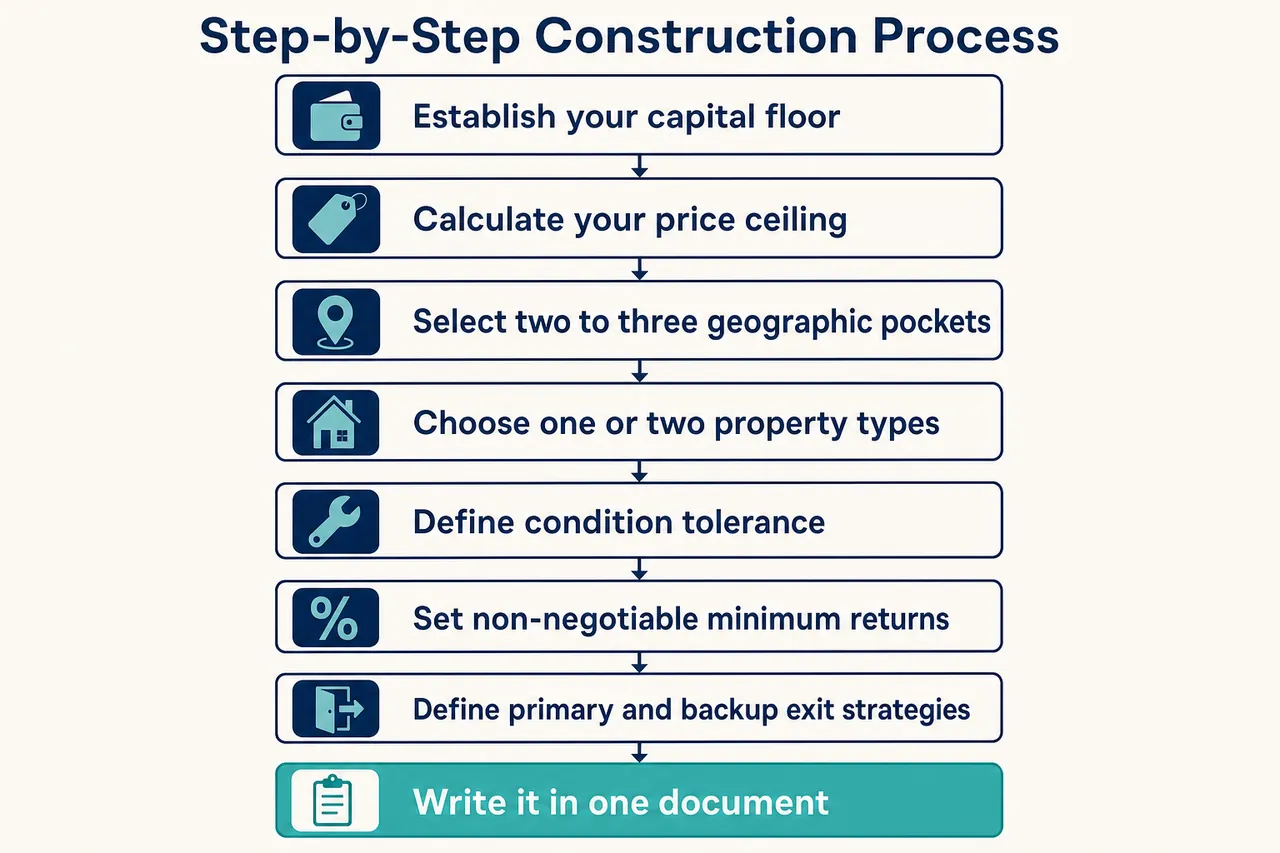
Step-by-Step Construction Process
- Establish your capital floor. Count what you've actually got in liquid capital. Now subtract your personal reserve—and don't skimp; that's at least 3–6 months of personal expenses. Everything left over? That's deployable capital. Split it 80/20: 80% goes toward acquisition and your down payment, 20% stays in reserves to cover carrying costs.
- Calculate your price ceiling. Take your deployable acquisition capital and divide it by your target down payment percentage (15% for single-unit, 25% for 2–4 unit conventional properties). Subtract estimated closing costs from that number. That's your ceiling—not your target, your actual ceiling.
- Select two to three geographic pockets. Drive them. Actually drive them. Pull comps. Get a feel for what rent ranges look like on the ground. And if you're investing while holding a day job, stick close—managing a property 90 minutes out with a full-time W-2 schedule is how you end up with deferred maintenance and tenant headaches you never see coming.
- Choose one or two property types. Match them to what you actually have: capital, time, and your real risk tolerance. Single-family, multifamily, and short-term rentals all at once? That's a beginner trap. Don't take that bait.
- Define condition tolerance. Be honest about two things: your contractor network and how much time you're willing to spend on a rehab. Write a maximum renovation budget into your buy box and treat it like gospel.
- Set non-negotiable minimum returns. You need a minimum cash-on-cash return, a minimum cap rate, or both. These aren't aspirational—they're floors. Any deal that falls below them gets rejected immediately. No exceptions.
- Define primary and backup exit strategies. What happens if your primary plan fails inside 24 months? You need to know. Write it down now, before emotion makes you creative.
- Write it in one document. One page. Share it with every agent, wholesaler, and lender you work with. Review it every quarter and actually update it if something changes.
Buy Box Building Worksheet
| Component | Your Criteria | Example (Long-Term Rental Investor) |
|---|---|---|
| Price ceiling | $___________ | $300,000 (based on $45K down at 15%, reserves retained) |
| Target property types | ___________ | Single-family 3BR/2BA, duplex |
| Target zip codes / neighborhoods | ___________ | ZIP 37206, ZIP 37216 (East Nashville) |
| Maximum condition/rehab budget | $___________ | Light value-add; max $20K in repairs |
| Minimum cash-on-cash return | ___________% | 8% after all expenses |
| Minimum cap rate | ___________% | 6% (use as quick filter before deep analysis) |
| Primary exit strategy | ___________ | Hold as long-term rental 5–10 years, then 1031 |
| Backup exit strategy | ___________ | Sell on retail market if vacancy exceeds 90 days |
| Financing type | ___________ | Conventional 30-year fixed; DSCR loan as fallback |
Common Mistakes When Building Criteria
- Ego-driven price points. You set your maximum price too high because you want prettier properties. The spreadsheet doesn't care how the place looks—only the cash flow math matters.
- Geographic ambiguity. "The southeast side" isn't a location. Name the actual zip codes. Vague neighborhoods kill deal discipline.
- Missing a minimum return floor. Without one locked in, you'll rationalize garbage deals when dry spells hit and deal flow slows down.
- No written document. A buy box you keep in your head changes every time the market shifts. Put it on paper and it stays put.
- Wanting to look at everything. This is probably the most common beginner mistake. If a deal doesn't meet your criteria in the first 60 seconds, it fails. Move on. Spend two minutes max and walk away.
The Strategic Advantages of a Tight Buy Box

Speed and Decision-Making
Good deals vanish. In competitive markets, they're under contract in days—sometimes hours. An investor with a locked-in buy box underrites a property in 20 minutes flat because the hard thinking's already done. You've got your price ceiling nailed down. Your financing's decided. You know your return floor and your exit strategy. The only question left is whether this actual property hits your benchmarks.
That's competitive advantage money can't buy.
Without a buy box, you're doing that entire analysis under pressure, in a room with a motivated seller watching you sweat, with deal momentum working against rational thinking. Decisiveness isn't hustle. It's preparation.
Protection from Emotional Purchases
The worst deals always feel brilliant in the moment. A seller who's motivated, a property that photographs well, or a slow month in your pipeline—any of these can tank your judgment before you know it's happening. That's where a written buy box becomes your best friend. It's a pre-commitment device. It forces the actual decision to happen when you were clearheaded, before this specific deal existed, before emotion entered the room.
Numbers don't hit your floor? The buy box says no. Even when your gut's screaming yes.
Call it discipline. I call it protection. That buy box isn't limiting your upside—it's protecting your downside. Investors who honor their criteria outperform those who make "just this once" exceptions. Every exception either works (reinforcing sloppy process) or fails (and damages the portfolio). Neither scenario justifies abandoning what actually works.
Team Efficiency and Resource Management
Your buy box doesn't just filter deals. It multiplies what your entire team can accomplish. Agents stop flooding you with junk listings because they know exactly what you buy. Wholesalers learn your criteria and self-filter before they even call. Lenders understand your loan structure targets. Property managers know which neighborhoods you're in. Everyone operates from the same playbook, which saves everyone time—and your time's the most expensive resource you've got. For more on structuring this right, see our guide on building a real estate investing team.
Your buy box also drives your entire CRM and prospecting strategy. With documented criteria, you automate MLS alerts, build targeted direct mail campaigns in specific neighborhoods, and measure deal flow by tracking how many properties actually pass your filter month to month.
Market Adaptation with Discipline
A buy box evolves. It's not set in stone. When conditions shift meaningfully—interest rates spike, a neighborhood's fundamentals crack, or a major employer moves into your target area—you review and adjust deliberately. Not reactively. Not in the heat of a deal because you're desperate for it to pencil. Schedule a quarterly review. Update the document. Brief your team on what changed and why.
What matters is the process.
In a soft market where properties sit and sellers are motivated, you might tighten your return floor because better deals are actually available. In a tight market with minimal inventory and aggressive competition, you might expand geographically rather than compress your return requirements. That's the trade-off to make. Geographic expansion is a healthier move than lowering your return floor just to stay busy.
Back to topAligning Your Buy Box with Investment Strategy
Your buy box must reflect your actual strategy—not some vague aspiration to "invest in real estate." Different strategies have fundamentally different capital requirements, time commitments, and risk profiles. If you haven't nailed down your strategy yet, start with our guide on how to pick your real estate business strategy.
Buy Box Components by Investment Strategy
| Strategy | Typical Price Focus | Property Type | Minimum Return Target | Condition Tolerance | Key Risk Factor |
|---|---|---|---|---|---|
| Long-Term Rental | Below median; cash flows at current rates | SFR, duplex, small multifamily | 8%+ cash-on-cash | Light to moderate value-add | Vacancy and maintenance reserves |
| BRRRR | Distressed; well below ARV | SFR, 2–4 unit | Refi must return 70–75%+ of all-in cost | Moderate to heavy rehab | Rehab overruns; appraisal risk |
| House Hack | Owner-occupied conforming limit | 2–4 unit; SFR with ADU | Rent covers 75%+ of PITI | Move-in ready preferred | Living with tenants; lifestyle fit |
| Short-Term Rental | Market-dependent; STR premium areas | SFR, condo (verify HOA), small multi | Gross revenue 2×+ long-term rent equivalent | Turnkey or light cosmetic | Regulatory changes; seasonality |
| Fix and Flip | 70% rule or below on ARV minus repairs | SFR primary; small multi secondary | Minimum $30K–$40K net profit or 20% of ARV | Moderate to heavy rehab | Carrying costs; market timing on exit |
Buy Box for Long-Term Rentals
Positive cash flow after debt service, vacancy, maintenance, and management—that's the core of a long-term rental buy box. At today's rates, finding deals that actually cash flow means buying below the local median, targeting higher-rent markets, or using significant equity through BRRRR. Test every deal using our rental property calculator at 90% occupancy, not the fantasy 100%.
And don't overlook the tax side. If you actively participate in managing your rental and your modified adjusted gross income sits at or below $100,000, you can deduct up to $25,000 in passive losses against non-passive income. That phaseout hits $150,000 MAGI and disappears completely. Residential rental property depreciation over 27.5 years (straight-line MACRS) also boosts your total return. These tax advantages matter—they're part of your numbers, so factor them into your return floor.
Buy Box for BRRRR Strategy
BRRRR is brutal to get right because you've two separate underwriting targets to hit simultaneously. First, acquisition plus rehab must land below the refinanced value. Second, stabilized rents need to support the new loan's debt service. We've got the full refinance mechanics in our article on how a cash-out refinance works in the BRRRR strategy, plus a step-by-step deal-finding guide in how to find BRRRR properties. Run every candidate through our BRRRR calculator before you commit to a price.
Your BRRRR buy box should lock in a maximum all-in cost as a percentage of ARV (70–75% is typical), a minimum post-rehab rent-to-value ratio, and a minimum DSCR for refi. Use our DSCR calculator to verify thresholds—most lenders want 1.20–1.25x on investment property refinances.
Buy Box for Fix and Flip
The 70% rule drives the fix-and-flip buy box. Your max offer equals 70% of after-repair value minus estimated repair costs. Start with our 70% rule calculator to filter deals fast, then run full pro forma analysis with our fix and flip calculator. Your buy box should also specify a maximum hold period (usually 6 months), a minimum gross profit floor, and a geographic focus tight enough that you've reliable comparable sales data.
Buy Box for House Hacking
House hacking buy boxes work differently because the property must also be your primary residence. That access to owner-occupied financing with lower down payments changes everything. The 2026 median existing-home sale price was $417,500 as of September 2026 (NAR data). As a house hacker, you're typically targeting a 2–4 unit property priced so tenant income covers most of your PITI. This strategy works especially well if you're starting with limited capital.
Back to topGreen Flags vs. Red Flags: Buy Box Discipline in Practice
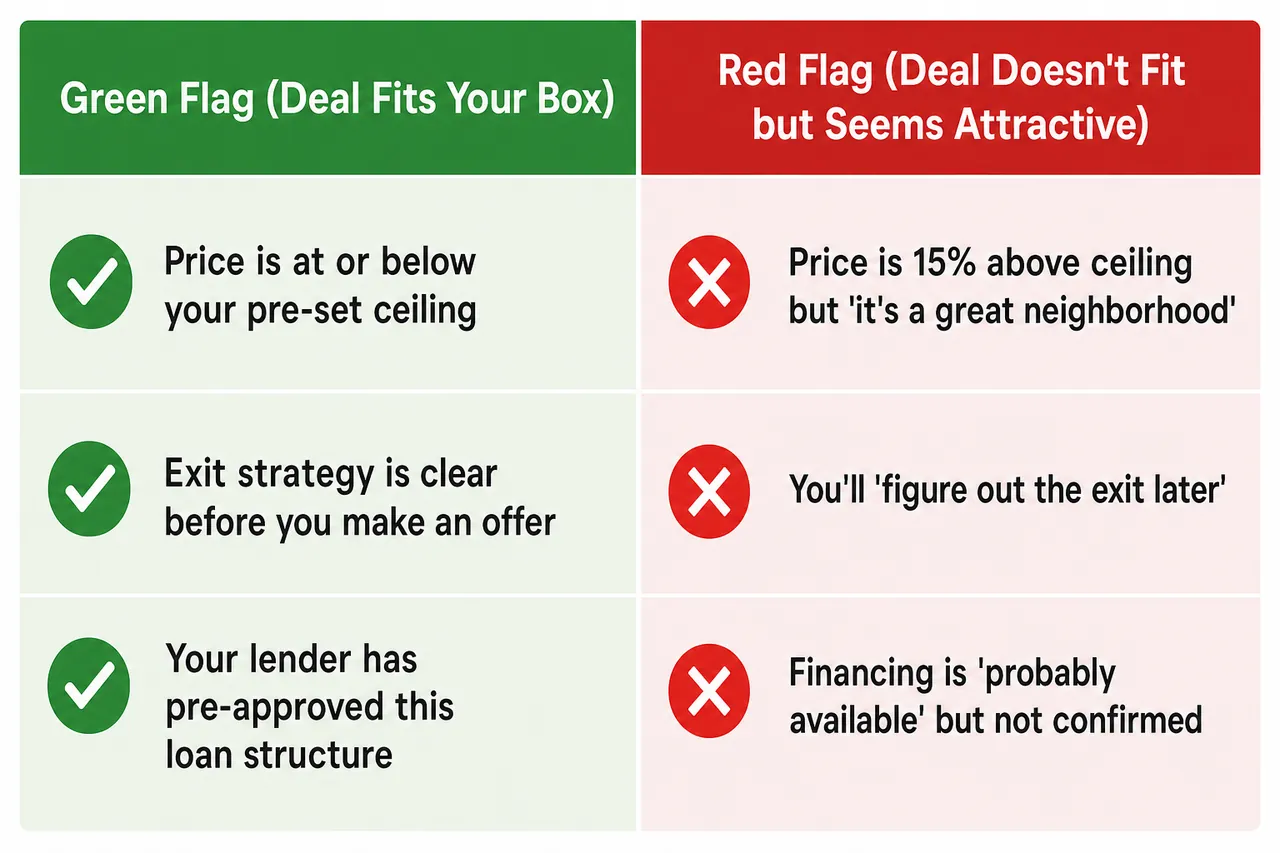
Your buy box exists for a reason. Stick to it, and deals work. Drift from it, and you're chasing stories instead of returns.
| Green Flag (Deal Fits Your Box) | Red Flag (Deal Doesn't Fit but Seems Attractive) |
|---|---|
| Price is at or below your pre-set ceiling | Price is 15% above ceiling but "it's a great neighborhood" |
| Property is in one of your two target zip codes | Property is in a new area you've never analyzed |
| Cash-on-cash return hits your minimum floor at conservative rents | Return only works at optimistic rent projections |
| Condition matches your stated tolerance level | Rehab scope is 2× your maximum budget but "the ARV is there" |
| Exit strategy is clear before you make an offer | You'll "figure out the exit later" |
| Passes quick filter in under 10 minutes | Requires creative math and multiple optimistic assumptions to pencil |
| Your lender has pre-approved this loan structure | Financing is "probably available" but not confirmed |
When a deal requires you to bend your numbers or ignore a red flag, that's your signal to walk. And most deals that don't fit your box end up costing you more than they ever make you.
Back to topManaging Multiple Buy Boxes
Running two or more strategies at once? You need a separate written buy box for each one. Keep them in separate documents—not shared files, not tabs in the same spreadsheet. This matters more than it sounds.
The trap is bleeding criteria across strategies. A BRRRR deal that bombs on the refi numbers might technically work as a straight rental. So you buy it. Then you buy another one. Next thing you know, you're sitting on a buy-and-hold portfolio you never budgeted for, funded with capital you earmarked for recycling. Your cap rates are underwater. Your cash flow doesn't cover the mortgage.
Keep your strategies isolated. That means your LLC and business structure should be organized to match too. Different strategies get different entities. Different accounting. This separation isn't just paperwork—it makes your buy box adherence auditable and forces you to actually stick to it when the pressure's on.
Back to topConclusion
A real estate investing buy box strategy separates investors who build portfolios intentionally from those who just accumulate properties randomly. It's not a constraint—it's the tool that makes opportunity visible. Build yours with real numbers. Price ceiling rooted in your actual capital and financing terms. Return floor that reflects your strategy. Specific zip codes you've actually studied. And two exits defined before you ever make an offer. Write it down. Share it with your team. Review it quarterly. When a deal makes you want to bend the rules, your buy box has done exactly what it should.
Just getting started? Our complete beginner's blueprint for real estate investing covers the foundational knowledge you need before your first buy box is worth writing.
Back to topFrequently Asked Questions
When should I adjust my buy box?
Don't adjust your buy box on impulse. Schedule a formal quarterly review and stick to it. A material shift in interest rates? That changes your price ceiling math—adjust. Your capital position improved or shrunk? Legitimate reason to revisit. You're entering a new market after real due diligence, or you've got solid data showing your target neighborhood's rental demand has fundamentally changed? Those warrant an update. But you haven't found a deal in two months and you're getting antsy? That's not a legitimate reason. Deal scarcity means you need to work your network harder, not lower your standards.
What if I don't have enough clarity yet to build a buy box?
Start there anyway. Lock in what you actually know: your capital, your financing capacity, your available time. Those three things alone eliminate most of the market immediately. Everything else—property type, strategy, geography—needs 30 days of real research before you start running deal numbers. Drive the neighborhoods you're considering. Use our calculators on hypothetical deals. Call two property managers in each market and ask real questions. Clarity doesn't come from looking at deals you're not ready to evaluate. A buy box built on incomplete information beats no buy box at all.
Can a buy box be too restrictive?
Yes. But honestly, this happens far less often than the opposite problem. If you're seeing fewer than 5 properties per month in your target market over a 60+ day stretch, you might be over-constrained. Ask yourself this: are deals actually out there at your price point that cash flow to your floor, but you're just not seeing them? If the answer's yes, your sourcing network is broken, not your criteria. If no deals exist anywhere in your market at your required returns, then your return floor doesn't match current market conditions—and that's worth an honest conversation, especially in today's rate environment.
How do I communicate my buy box to wholesalers and agents?
Give them the written one-pager. Single page, bullet points only: price ceiling, property types, specific zip codes, maximum rehab budget, minimum return requirement. Then follow up every 30 days. Wholesalers and agents work dozens of buyers simultaneously. The ones they call first? The ones who are crystal clear, credible, and fast to close. Your buy box document proves you're a serious buyer, not a browser. Integrate it into your CRM prospecting workflow so every outreach reinforces your criteria consistently.
Should my buy box include a maximum days-on-market or other timing criteria?
For fix-and-flip? Maybe. Carrying costs climb every single day. For rentals, days on market matters less as a hard cutoff—but it's a useful red flag. Properties sitting way above the neighborhood average usually have undisclosed problems. Don't make it a black-and-white criterion. Use it as a trigger instead. When you see that warning sign, dig deeper: inspect harder, pull permits, verify rent history, check everything before you run it through your normal buy box filter.
Back to top