


Discover 3 proven methods to get equity out of your home without selling. HELOCs, home equity loans & more for real estate investors.
Table of Contents
- Understanding Home Equity and Why It Matters to Investors
- Method 1: Home Equity Line of Credit (HELOC)
- Method 2: Home Equity Loan
- HELOC vs. Home Equity Loan: Side-by-Side Comparison
- Method 3: Alternative Methods to Access Equity
- Why Cash-Out Refinancing Often Isn't the Right Move in 2026
- Risks and Considerations Before Tapping Equity
- Eligibility Requirements Across Methods
- Application Process and Timeline
- How to Maximize Your Borrowing Power
- Deploying Equity Capital: Investor-Specific Considerations
- Conclusion
- Frequently Asked Questions
You can tap your home's equity without selling it using three main methods: a Home Equity Line of Credit (HELOC), a home equity loan, or alternatives like a reverse mortgage or shared equity agreement. Each one converts the gap between your home's current market value and what you still owe into actual cash—your existing first mortgage stays untouched. For investors, picking the wrong tool kills deal flow. Pick the right one, and you fund your next acquisition without torching a low-rate first mortgage.

Understanding Home Equity and Why It Matters to Investors

What's Home Equity?
Home equity is the portion of your property you actually own. Your home's worth $500,000. You owe $300,000 on the mortgage. That leaves $200,000 in equity—your number. But here's what matters: that equity isn't frozen in place. Every mortgage payment you make chips away at principal and builds it up. The market pushes your property value higher, and that equity grows too. For investors juggling multiple properties, that accumulated equity is capital waiting to work harder than it currently is.
Why Access Your Equity Instead of Selling?
Selling means you're done—the property's gone, the asset's liquidated, and you've triggered a taxable event that hurts your bottom line. Tapping equity? That's different. You keep the property. You preserve whatever favorable financing you've already locked in. And you unlock capital to deploy into the next deal without blowing up your portfolio.
What can you actually do with that money? Fund a down payment on an investment property. Cover renovation costs on a fix-and-flip. Consolidate higher-interest debt. Build a liquid emergency reserve that doesn't sit in a checking account earning nothing. If you're mapping out how equity extraction fits into your broader real estate business strategy, you need to understand the cost and risk profile of each method first.
Back to topMethod 1: Home Equity Line of Credit (HELOC)

How HELOCs Work
Think of a HELOC as a credit card backed by your home's equity. You get a revolving line of credit with a limit tied to how much equity you've built. The structure breaks into two distinct phases:

- Draw period — typically 5–10 years. You can borrow, repay, and reborrow as much as you want up to your limit. Most lenders let you pay interest-only during this phase, which keeps your monthly obligations manageable.
- Repayment period — typically 10–20 years. The line closes. Now you're paying down principal plus interest on whatever balance remains outstanding.
HELOC rates move with the market. As of November 18, 2026, Bankrate's survey showed 7.47%. Curinos reported 7.80% for the same month, and MRC's national average (80% LTV, 620+ FICO) hit 8.100% as of November 20, 2026. Your actual rate depends on your credit score, combined loan-to-value, and which lender you're working with—the spread matters.
Rate Structure: Variable vs. Fixed
Most HELOCs float on a variable rate indexed to the prime rate. Your payment can shift month to month once repayment starts—or even during the draw phase if you're paying interest-only. Some lenders will let you lock in a fixed rate on part or all of your drawn balance, essentially converting it to a fixed home equity loan within your line. This strategy works when you've pulled a chunk of capital and want payment certainty before repayment kicks in. Before you sign, ask the lender if they offer rate-lock and what conversion fees apply.
Best Use Cases for HELOCs
The revolving redraw feature makes HELOCs a sharp tool for:
- Staged renovation projects where you're writing checks over months as work progresses
- An emergency reserve — open it, don't touch it, and have dry powder sitting there ready if a deal lands
- Acquisition deposits on back-to-back deals. Draw, deploy, recycle the capital from your sale or refi, and draw again
- Bridge financing between buying your next property and closing on the one you're selling
HELOC rates sit well below unsecured personal loans or credit cards, which can hit the teens or higher. For short-term capital needs, home equity is almost always your cheapest move—if you're comfortable using your home as collateral.
HELOC Eligibility Requirements
Most lenders will ask for:
- Real equity in the property—combined LTV limits vary, so verify the exact threshold with each lender
- A credit score of at least 620, though you'll see better rates above 700
- Documented income and a debt-to-income ratio below 43–45%
- An appraisal or automated valuation showing what your property's actually worth
Method 2: Home Equity Loan
How Home Equity Loans Work
You get one lump sum at closing. It's secured by your property, locked in at a fixed rate, with fixed monthly payments that run anywhere from 5 to 30 years. Once funded, that's it—no redraw option like you'd get with a HELOC. What you borrow is what you get. That predictability? It's the whole point.


As of November 20, 2026, the MRC national average for a 10-year home equity loan (80% LTV, 620+ FICO) sat at 8.324%. The 15-year version? 8.345%. And Curinos reported the average at 7.98% for November 2026. Home equity loans are running slightly above the lower end of HELOC pricing right now. That gap exists because fixed-rate products carry a certainty premium.
Rate Lock Mechanics
The rate locks in at closing. Period. No conversion, no renegotiation after funding. For investors modeling cash flows on a renovation or trying to pin down exact capital costs over a multi-year hold, this is gold. You know the number. HELOCs force you to scenario-plan around rate movement—home equity loans eliminate that entirely.
Best Use Cases for Home Equity Loans
- A specific, fully-scoped renovation with a known budget (kitchen addition, roof replacement, ADU construction)
- A down payment on a purchase where you know the exact amount required at closing
- Debt consolidation — paying off a fixed list of higher-rate obligations with a known payoff amount
- Business capital for a one-time investment where you need the full sum upfront
Home Equity Loan Eligibility Requirements
Same baseline as a HELOC: enough equity in the property, credit score typically north of 620 (700+ gets better pricing), acceptable DTI, and a home value assessment. Some lenders tighten their CLTV caps on home equity loans compared to HELOCs, so shop multiple offers before you commit. Don't assume rates and terms are the same across the board.
Back to topHELOC vs. Home Equity Loan: Side-by-Side Comparison
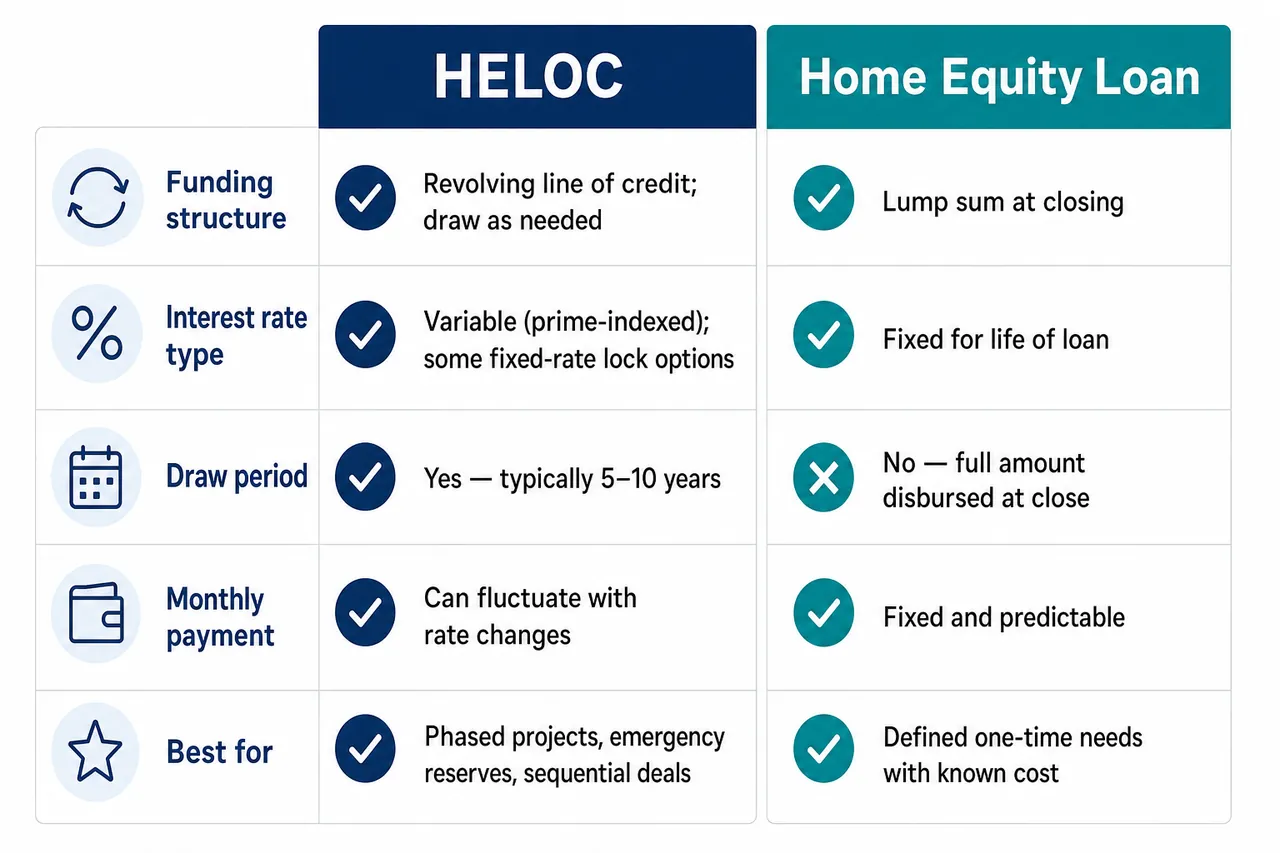
| Feature | HELOC | Home Equity Loan |
|---|---|---|
| Funding structure | Revolving line of credit — you draw what you need, when you need it | One lump sum handed to you at closing |
| Interest rate type | Variable, tied to prime; some lenders let you lock in fixed rates | Fixed. Stays the same for the entire loan |
| Draw period | Yes — typically 5–10 years to pull funds | Nope — you get it all upfront |
| Repayment period | Usually 10–20 years after the draw period closes | Typically 5–30 years from the funding date |
| Monthly payment variability | Your payment bounces around as rates move | Same payment every month. No surprises |
| Interest-only payments | Most HELOCs let you do interest-only during the draw phase | You're paying principal + interest from day one |
| Best for | Staged rehabs, keeping cash on standby, stacking multiple deals back-to-back | One-off expenses where you know the exact number upfront |
| Avg. rate (Nov. 2026) | 7.47%–8.10% | 7.98%–8.35% |
Method 3: Alternative Methods to Access Equity
Reverse Mortgages (Age 62+)
At 62 or older, you can convert home equity into cash via reverse mortgage without touching monthly cash flow. The loan balance grows over time and comes due when you sell, move, or pass away. The FHA-insured Home Equity Conversion Mortgage (HECM) is the most common product you'll see. For investors near retirement who want liquidity without selling their primary residence, it works—but it erodes equity over time. That makes it poor for anyone still building a portfolio.
Shared Equity / Home Equity Investment Agreements
A third-party investor gives you a lump sum. In return, they get a slice of your property's future appreciation. No monthly payments. You settle when you sell or at a predetermined date. This keeps your cash flow clean during the holding period. The real cost? You're giving away upside. If the property appreciates 40%, that settlement bill can dwarf what a conventional loan would've cost you. If you've already maxed out debt capacity but you're sitting on serious equity, this deserves a spreadsheet analysis. Run multiple appreciation scenarios before you commit.
Personal Loans as a Non-Secured Alternative
Unsecured personal loans don't require collateral. Your home stays out of the picture. But you pay for that safety with rate. Personal loan rates typically run 2-3x higher than HELOC rates, and loan caps are tight—usually $20K to $50K. Use them for small, urgent needs where you don't want to pledge real estate. For the five-figure capital most investors need? The rate math doesn't work.
Selling Your Home: Full Equity Access
Selling unlocks 100% of your equity minus closing costs. But you're out of the asset entirely. Hold the property for at least two of the five years before sale, and the IRC §121 exclusion protects you: $250,000 capital gains tax-free for single filers, $500,000 for married filing jointly. Those numbers haven't moved since 1997 and they're still active in 2026. You can use this exclusion once every two years. Any gains above those thresholds get taxed as ordinary income. Don't assume the sale is tax-free—model it first with our capital gains tax calculator and compare the tax hit against what a loan would cost you.
Back to topWhy Cash-Out Refinancing Often Isn't the Right Move in 2026
You take out a bigger mortgage, pay off the old one, and pocket the difference. That's cash-out refinancing. But here's what matters: Fannie Mae's August 5, 2026 rules cap you at 80% LTV on a 1-unit primary residence. Drop to 75% for 2–4 unit primaries or single-unit investment properties. And 70% for 2–4 unit investment properties. Meanwhile, the average 30-year conventional refi hit 7.416% on November 18, 2026—and cash-out pricing adds a spread on top of that, depending on your FICO and LTV.
Got a 3% or 4% mortgage from 2020 or 2021? Cashing out means refinancing that entire balance at today's rates. You're essentially doubling your first-mortgage rate across your whole loan balance. A HELOC or home equity loan does something completely different. It leaves your first mortgage alone and stacks a second lien on top—only for the equity you actually draw. This is the key difference. For most investors sitting on sub-5% first mortgages, a second-lien product wins nearly every time right now.
Cash-out refis also hit you with full closing costs—usually 2–5% of the new loan amount—and they restart your amortization schedule from zero. Home equity loans and HELOCs? Way cheaper. Sometimes zero on promos, though you'll typically see $500–$2,000 in appraisal and origination fees. And your first mortgage never changes.
Fannie Mae also requires the existing loan to be at least 12 months old from the note date, and you need to have been on title for at least 6 months. These seasoning requirements can lock out newer buyers. A HELOC? Often faster to close.
Back to topRisks and Considerations Before Tapping Equity

Your Home Is the Collateral
Pay attention here. Both a HELOC and a home equity loan put your property on the line—if you miss payments, the lender forecloses. For rental investors, that's catastrophic. You lose the asset and the income stream in one move. Before you pull equity for anything remotely speculative, stress-test your cash flow. Can you service the new debt through a 6-month vacancy? A $50K renovation overrun? A 20% market correction? If the answer isn't a clear yes, you're overleveraged.
HELOC Freeze Risk During Economic Downturns
Lenders can freeze or reduce your HELOC if home values drop. It happened to thousands of investors in 2008–2009 when banks just shut lines down overnight. The worst part? They typically pull access exactly when you need liquidity most. Don't treat a HELOC as your emergency fund. Keep separate cash reserves. That's real risk management.
Variable Rate Exposure
HELOC rates move with prime. Draw $200K at 6% today, then rates hit 8% before you've paid it down—your cost of capital jumped 200 basis points. Lock in rates if your lender offers it, and do it now, not later.
Impact on Total Debt Load and Future Borrowing
Every dollar you borrow against your home counts against your DTI when you apply for the next acquisition loan. And your DSCR gets tighter. Use our DSCR calculator to run the numbers before you close the equity line. If you're using that equity to fund a rental purchase, plug the whole deal into our rental property calculator. Make sure the deal still pencils at your actual cost of capital. If the cap rate barely beats your borrowing rate, it's not worth the risk.
Tax Implications
This one trips people up. Interest on home equity debt is deductible only if you use the proceeds to buy, build, or substantially improve that same home. That's the Tax Cuts and Jobs Act rule, and it's strict. Use HELOC money to buy an investment property? That interest typically isn't deductible under mortgage interest rules, though it might qualify as a business expense against rental income depending on your structure. It's nuanced. Talk to a tax advisor before you assume you're getting a deduction. The difference in effective cost can be 2–3% annually—material enough to kill a deal.
Back to topEligibility Requirements Across Methods
| Requirement | HELOC | Home Equity Loan |
|---|---|---|
| Minimum equity / LTV | It varies. You'll need to confirm the CLTV limit with each lender before you apply. | It varies. You'll need to confirm the CLTV limit with each lender before you apply. |
| Minimum credit score | 620 is the floor, but you're really competing at 700+. That's where the best rates live. | 620 is the floor, but you're really competing at 700+. That's where the best rates live. |
| Debt-to-income ratio | Most lenders cap you at 43–45%. Don't exceed that. | Most lenders cap you at 43–45%. Don't exceed that. |
| Home value assessment | Required. You're looking at either a full appraisal or an AVM. | Required. You're looking at either a full appraisal or an AVM. |
| Income verification | Yes. Bring W-2s, tax returns, or bank statements—pick your strongest proof. | Yes. Bring W-2s, tax returns, or bank statements—pick your strongest proof. |
Application Process and Timeline
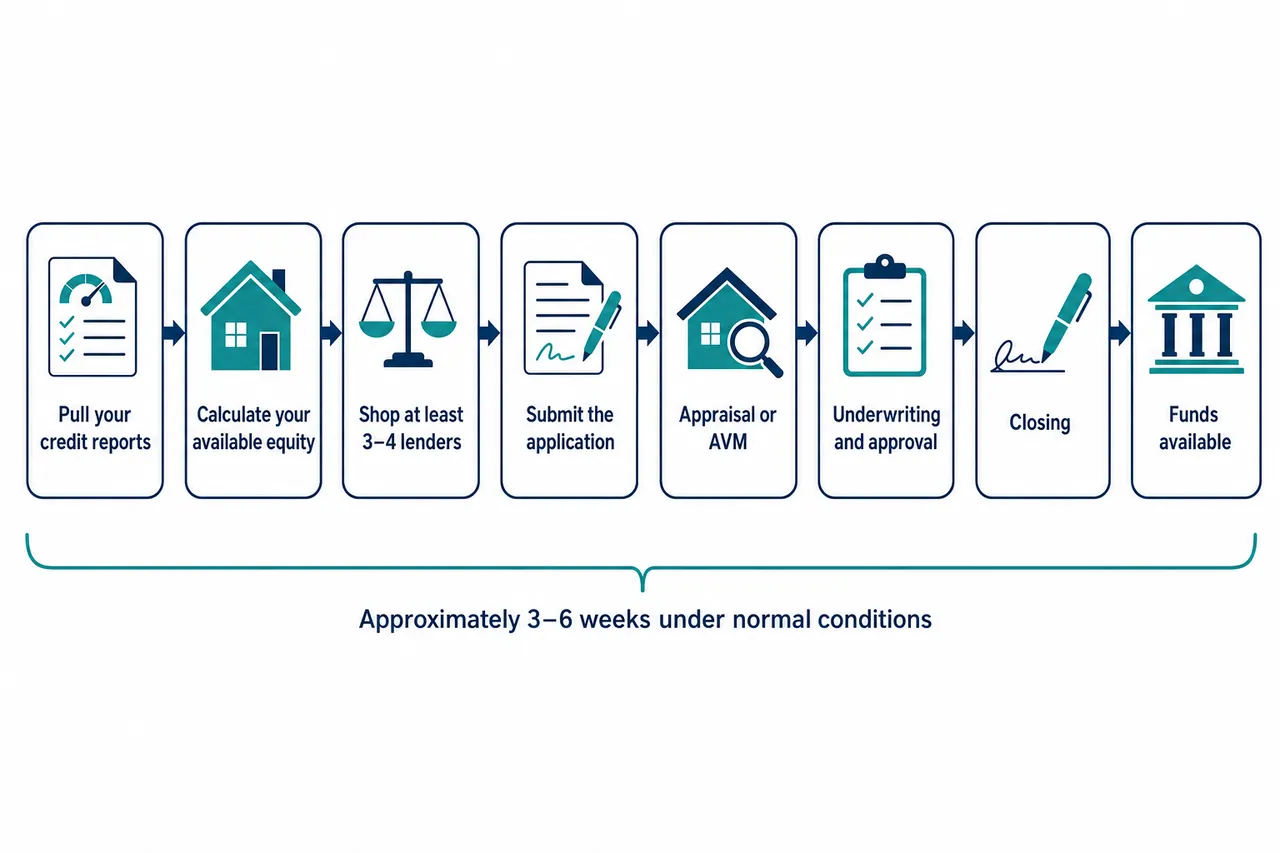
Getting a HELOC or home equity loan isn't complicated, but it follows a strict sequence:
- Pull your credit reports — Before you apply, dig into those reports and fix any errors you find. Even a 20-point credit score bump can move your rate down meaningfully.
- Calculate your available equity — Get a broker price opinion or run an automated valuation on your property. Subtract what you owe on the mortgage. That's your equity pool. Know what CLTV thresholds your target lenders will actually fund.
- Shop at least 3–4 lenders — Contact your current mortgage servicer (relationship pricing happens), a credit union, and an online lender. You'll see half-a-percent or bigger rate spreads between them.
- Submit the application — Have these ready: two years of tax returns, 60 days of bank statements, proof of income, your current mortgage statement, and homeowners insurance docs.
- Appraisal or AVM — Your lender orders a valuation. Full appraisals run 1–2 weeks. Some lenders skip that and use automated valuations instead—instant turnaround.
- Underwriting and approval — This takes 2–6 weeks. It depends on how busy the lender is and whether your paperwork is complete.
- Closing — Sign the loan docs. If it's your primary residence, you get a 3-day right of rescission. Home equity loans fund 3–5 business days after closing. A HELOC line? You can access it right after that rescission period ends.
From application to cash in hand: 3–6 weeks if everything runs smoothly.
Back to topHow to Maximize Your Borrowing Power
Build Equity Faster
Even small extra principal payments add up fast. They knock down your LTV ratio and push you into better rate tiers—both of which unlock more borrowing capacity. Strategic renovations work too. They bump your appraised value, which means more equity sitting there ready to borrow against. Not sure if a renovation's worth the spend? Run the numbers through our fix and flip calculator or use our cap rate calculator to check the returns on a rental.
Protect and Improve Your Credit Profile
Keep your revolving balances under 30%. Pay everything on time. And don't open new credit accounts in the 6–12 months before you apply for a HELOC or home equity loan. Your credit score isn't just a yes-or-no gate—it determines your rate tier. On a $100,000 draw, that difference can easily cost you thousands in annual interest.
Time Your Application Strategically
Apply when your property's at a local valuation peak, not during a downturn. Lenders lock in your credit limit based on the appraisal value at application. If the market's softened recently, your available line shrinks. Want to diversify your portfolio using equity extraction? Time your draw against your acquisition targets—not just your property's cycle.
Back to topDeploying Equity Capital: Investor-Specific Considerations
Extracted equity isn't free money. It's a cost of capital equal to your HELOC or home equity loan rate. Any deal you fund with it needs to clear that hurdle rate. So if your HELOC is sitting at 7.80%, and you're pouring that capital into a rental property, that property has to generate returns well above 7.80% after all expenses to create real positive spread. That's the math that matters. Use our cash-on-cash return calculator to verify the spread before you commit capital.
The BRRRR strategy (Buy, Rehab, Rent, Refinance, Repeat) is built for HELOC funding. You pull equity to acquire and rehab, then refinance once the property stabilizes at its improved value and appraisal reflects that bump. The critical question: will your refinance proceeds actually cover the HELOC draw at stabilization? Run your numbers through our BRRRR calculator to confirm. If you're still unsure which model fits your capital situation, we've got an article breaking down five proven real estate business strategies with their specific capital requirements laid out.
And here's another angle: equity crowdfunding. Some investors layer it in alongside direct property ownership funded by home equity, or use it as an alternative entirely. If that's on your radar, our guide to the best equity crowdfunding sites for real estate investors in 2026 breaks down what's actually out there.
Back to topConclusion
Pick the right tool for your capital need. That's what this comes down to. A HELOC floats at variable rates—currently 7.47% to 8.10% (November 2026)—and it's your move when you need it. Phased rehabs, emergency reserves, deal funding in waves—this is where HELOCs shine because you're not drawing it all at once. A home equity loan hands you a fixed lump sum at 7.98% to 8.35%. You know your payment. You know your rate. It's the right call when you've got one defined purchase and you want certainty. Alternative methods—reverse mortgages, shared equity agreements, personal loans—work in specific situations. Just understand what you're trading away. Usually it's higher costs, lost equity, or both.
And here's what matters in 2026: if you're holding a first mortgage at 3% or 4%, don't blow that up with a cash-out refi. A second lien keeps your existing rate intact while you access only what you need. Run the numbers before you commit. Can you service this debt if deals slow down or rates climb higher? Talk to your CPA about tax treatment—it changes depending on how you deploy the capital. Most important: does the investment you're funding actually beat your cost of capital? If the answer's no, you're just borrowing expensive money to lose it.
Back to topFrequently Asked Questions
How much equity do I need to qualify for a HELOC or home equity loan?
It depends on the lender. Most want you to keep meaningful equity in the property after they fund the new credit line. Combined loan-to-value (CLTV) limits vary—you'll need to call around and confirm what each institution actually requires. Credit scores of 620+ work, but you'll get better rates above 700.
Can I deduct the interest on a HELOC or home equity loan?
Yes, but only if you used the money to buy, build, or substantially improve the home that secures the debt. Draw that equity to buy a rental property or pay down credit cards? The interest doesn't qualify under home mortgage interest rules. It might work as a deductible business expense against rental income depending on your structure, but that's the exception, not the rule. Talk to your tax pro before you assume anything.
What happens to my HELOC if my home value drops?
Lenders can freeze or slash your available credit limit if the collateral value tanks enough. And they will. We saw this play out in 2008–2009 when institutions pulled credit lines on investors overnight. Don't treat a HELOC as your emergency fund. Keep separate liquid savings ready because if that line disappears, you need cash on hand to cover obligations.
Should I use a HELOC or a cash-out refinance to access equity in 2026?
For most investors with first mortgages locked in before 2023, go with the HELOC or home equity loan. Cash-out refi replaces your entire first mortgage at today's rates—the 30-year conventional rate sat at 7.416% as of November 18, 2026—and that crushes your monthly payment on the whole balance. A second lien keeps your existing mortgage untouched and only charges interest on the equity you actually use.
How long does it take to get a HELOC or home equity loan funded?
Three to six weeks from application to cash in your account under normal conditions. Speed depends on how fast you get docs to them, whether they order a full appraisal or use an automated valuation model, and how backed up their underwriting team is. And remember: primary residences get a 3-business-day right of rescission after closing. Factor that into your timeline if you're planning to deploy capital fast.
Back to top