


Find accurate real estate comps near me to determine true property values. Learn how buyers, sellers & investors use comparables for better decisions.
Products and Tools Mentioned in this Post

Table of Contents
- What Are Real Estate Comps?
- How to Find Real Estate Comps in Your Area (Step-by-Step)
- What Makes a Good Comparable Property?
- How to Adjust Comps for Differences
- Free Tools to Pull Comps for Any Address
- How Many Comps Do You Need?
- Comps vs. Appraisals: What's the Difference?
- Common Mistakes When Pulling Comps
- Using Comps to Price Your Home Strategically
- Conclusion
- Frequently Asked Questions
Real estate comps — short for comparables — are recently sold properties that share key characteristics with a subject property. When you're hunting for real estate comps near me, you're really looking for hard proof of what buyers will actually fork over for a home like yours in your market right now. Every serious valuation starts here: agent CMAs, lender appraisals, iBuyer algorithms. They all dig through the same data — comparable sales, recent closes, same neighborhood.
This guide shows you how to hunt down comps, strip away the noise, and make the adjustments that matter. Whether you're bidding on a property, pricing your listing, or running underwriting on an investment deal, you need this process locked down.

What Are Real Estate Comps?

A comp is a closed, arms-length sale of a property that resembles the subject home in location, size, type, age, and condition. The operative word? Sold. Active listings show what sellers are asking for. Pending sales give you a leading indicator of where the market's headed. But only closed sales tell you what buyers actually paid—and that distinction matters enormously when you're negotiating.
Nearly everyone in a real estate transaction leans on comps:
- Sellers and listing agents run CMAs to set a competitive asking price without leaving money on the table or pricing themselves out of the market.
- Buyers and buyer's agents use comps to construct defensible offers and to push back during negotiations.
- Licensed appraisers are required by lenders to support their opinion of value with closed comparable sales. Per Fannie Mae's Selling Guide (B4-1.3-08), an appraisal must include a minimum of three closed comparables.
- iBuyers and algorithmic platforms (Opendoor, Offerpad, etc.) build automated valuation models on pools of comp data. They then apply machine-learning adjustments to generate instant offers.
- Investors running fix-and-flip or BRRRR analyses need a reliable after-repair value (ARV). Your ARV comes directly from comps. Once you've got your comp-based value dialed in, run your numbers through our fix and flip calculator.
Want to understand the theory behind it? Check out our primer on real estate comps meaning: how comparable sales determine property value.
Back to topHow to Find Real Estate Comps in Your Area (Step-by-Step)
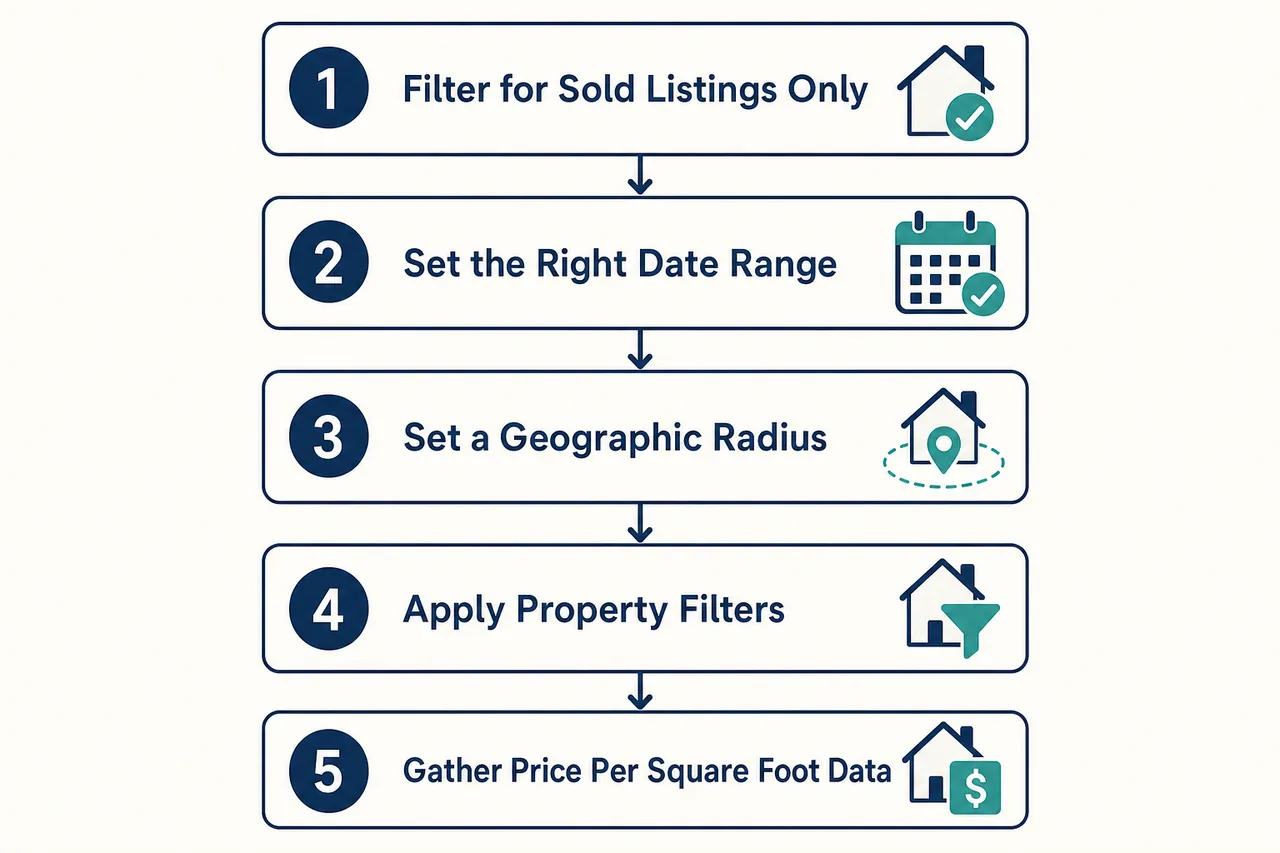
The comp-pulling process stays the same no matter what platform you're using. What changes is data freshness, geographic coverage, and how much heavy lifting the tool does for you versus how much falls on your shoulders.
Step 1 — Filter for Sold Listings Only
Every platform shows active listings by default. That's not what you need. Switch to "sold" or "recently sold" before you do anything else. On Zillow, go into search filters and pick "Sold" under listing status. Redfin? Click "Filter" and check "Sold." Realtor.com has a "Recently Sold" dropdown. Skip this step and you've already made the most common beginner mistake.
Step 2 — Set the Right Date Range
Normal to active market? Stick to the past 90 days. Anything older than that and you're looking at market conditions that don't exist anymore. But in slow markets, rural areas, or niche property types, you might need to push it to six months. Go beyond that without adjusting for market shifts and you're introducing real valuation risk. FHA appraisal guidelines—laid out in HUD Mortgagee Letter 2025-18—actually require a minimum of two comparable sales closed within 90 days of the appraisal date in changing markets, plus at least two active listings or pending sales as backup support.
Step 3 — Set a Geographic Radius
Dense urban or suburban? Use a one-mile radius. Rural or low-density? Expand to five miles. The real question is this: would buyers and sellers actually consider these properties as alternatives to yours? A sale a mile away that crosses a school district line or a major highway is weaker than one two miles out in the same subdivision.
Step 4 — Apply Property Filters
Narrow down to property type (single-family, condo, townhouse), bed and bath count, and a square footage band of roughly ±20% around your subject. Garage, basement, and pool differences should be noted for adjustment—not used as hard filters. You'll often find stronger comps with one-bath differences than you will if you exclude everything that doesn't match exactly.
Step 5 — Gather Price Per Square Foot Data
Price per square foot is straightforward: sale price ÷ above-grade finished square footage. It's the universal adjustment metric appraisers use. And it normalizes everything across different-sized homes instantly. Dump each comp's PPSF into a spreadsheet before any adjustments.
For a deeper walk-through organized by market type, check out finding real estate comps in your area: complete local analysis guide.
Back to topWhat Makes a Good Comparable Property?
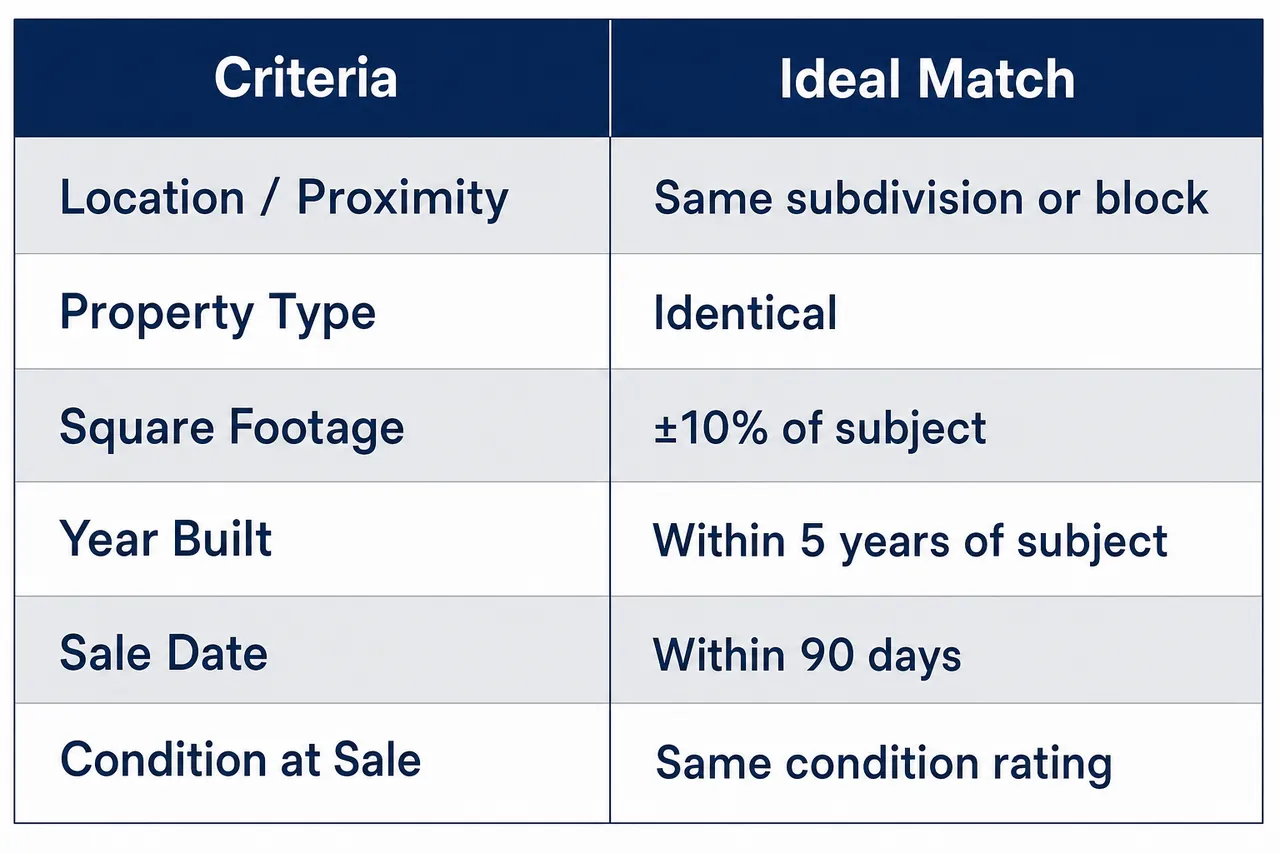
Just because a home sold nearby doesn't make it a comp. Your job is to minimize adjustments—the fewer differences between your subject and the comp, the more reliable your valuation. Every mismatch you have to account for introduces uncertainty and reduces how much weight that comp deserves in your analysis.


| Criteria | Ideal Match | Acceptable Range | Impact on Value if Different |
|---|---|---|---|
| Location / Proximity | Same subdivision or block | Same neighborhood; 1-mile urban / 5-mile rural | High — neighborhood quality drives value |
| Property Type | Identical (SFR to SFR, condo to condo) | No acceptable range — type must match | Very high — different types price differently |
| Square Footage | ±10% of subject | ±20% with size adjustment | Medium-high — adjust by price per sq ft |
| Bedrooms / Bathrooms | Exact match | ±1 bedroom with adjustment | Medium — market-dependent premium |
| Year Built | Within 5 years of subject | Within 10-15 years with condition adjustment | Medium — older homes may carry deferred maintenance |
| Condition at Sale | Same condition rating | One condition grade with adjustment | High — distressed sales skew values down significantly |
| Recent Upgrades | Similar renovation level | Partial upgrade; adjust for cost difference | Medium — kitchen/bath renos carry premium |
| Sale Date | Within 90 days | Up to 6 months (slow markets) | Medium — market shift risk beyond 90 days |
Neighborhood features matter more than you might think. School district, transit access, parks, waterfront—these factors create serious value differences that raw proximity can't tell you. A comp across a major highway or railroad line? Probably useless, even if it's geographically close. For investors building systematic analysis of property tiers, our guide on Class A, B, C, D real estate breaks down exactly why location hierarchy affects whether a comp counts.
Back to topHow to Adjust Comps for Differences

Your comp data won't be perfect. Ever. That's why the adjustment process exists—it bridges the gap between what a comp actually sold for and what your subject property would realistically fetch. Appraisers use paired sales analysis and market-extracted adjustments to formalize this. Investors and agents work from the same playbook, just faster.
One principle ties everything together: comps that outperform your subject get downward adjustments. Comps that underperform get adjusted up. You're recalibrating each comp to match your subject property.
| Difference Factor | Example Scenario | Adjustment Direction | Example Adjustment Logic |
|---|---|---|---|
| Square Footage | Comp is 200 sq ft larger than subject; market price/sq ft is $200 | Subtract from comp | −$40,000 from comp's sale price |
| Condition | Comp was fully renovated; subject needs new kitchen | Subtract from comp | Subtract estimated renovation cost premium (market-dependent) |
| Age / Year Built | Comp is 10 years newer than subject | Subtract from comp | Adjust based on observed market depreciation for older homes |
| Lot Size | Comp has 0.5-acre lot; subject has 0.25-acre lot | Subtract from comp | Use land value differential from paired land sales |
| Garage | Comp has 2-car garage; subject has none | Add to comp | Add market value of garage addition |
| Extra Bathroom | Comp has 3 baths; subject has 2 baths | Subtract from comp | Subtract market value attributed to additional bath |
But where do the actual adjustment numbers come from? The market itself. Appraisers pull these figures from paired sales—two homes that differ on only one feature—regression analysis, or cost approaches. There's no universal $X adjustment; it moves with local conditions and demand.
Need deeper guidance on extraction methodology? Read our breakdown at real estate comp analysis: running comps like a pro.
Running BRRRR deals? Your ARV estimates need teeth. Plug your adjusted comp values into our BRRRR calculator and stress-test the entire return stack.
Back to topFree Tools to Pull Comps for Any Address
You've got free access to sold data across multiple platforms. They're not all built the same. Each one has real strengths and blind spots, and mixing them keeps you from trusting one source too much.
| Platform | Data Coverage | Accuracy Strength | Accuracy Weakness | Best For |
|---|---|---|---|---|
| Zillow (Zestimate) | National; broad coverage including off-market | High breadth; good for initial screening | Algorithmic estimates carry a median error of approximately 2–7% for on-market homes; worse for off-market and unique properties | Quick first-pass comp screening; sold history lookup |
| Redfin | MLS-sourced in markets where Redfin operates | Tightest algorithmic accuracy for on-market homes; direct MLS feed | Coverage gaps in markets where Redfin doesn't have brokerage presence | Urban and suburban markets; side-by-side comp maps |
| Realtor.com | MLS-sourced nationally via NAR data agreements | Broad MLS coverage; reliable sold data | Less granular comp filtering UI compared to Redfin | Cross-checking Zillow and Redfin; MLS verification |
| County Recorder / Assessor | All recorded deeds in that county; 100% coverage of closed sales | Authoritative — legal record of sale prices | No filtering UI; must manually cross-reference property details | Verifying sale prices; off-market transactions; investor research |
| Opendoor / iBuyer Estimates | Markets where iBuyer operates | Instant offer reflects real willingness to pay | iBuyer pricing includes service fee and risk discount; not pure market value | Sanity-checking your comp analysis in iBuyer-active markets |
That 2–7% error? It only applies when you're looking at on-market homes with fresh MLS data behind them. Pull comps on an off-market rural property or anything unusual, and you're looking at substantially larger swings. For a full breakdown of paid platforms and free tools—including API-accessible data sources—check out our guide to best comparables websites for real estate investors and appraisers.
Most investors sleep on county recorder offices. Every single arms-length sale generates a public deed record. Search your county assessor's website by address, parcel number, or neighborhood and you'll pull exact sale prices. No algorithm. No guesswork. This matters most when you're chasing off-market deals, foreclosures, or probate sales that slip through MLS-based tools.
Working across multiple markets or need to pull comp data at scale? Our article on real estate comps API tools and integration for investors walks through the technical options.
Back to topHow Many Comps Do You Need?
Three to five strong comps is your minimum credible set. That's not made up — it's what Fannie Mae requires. Per Fannie Mae's Selling Guide (B4-1.3-08), appraisals must include at least three closed comparables, ideally within the past 12 months. FHA tightens it further: HUD Mortgagee Letter 2025-18 requires at least three settled sales plus two active listings or pending sales when markets are shifting fast.
Three comps is the floor. Five gives you breathing room — you can drop an outlier (distressed sale, personal property included, related-party deal) and still hold up under scrutiny. In tight suburban markets, most investors shoot for five to seven before they start adjusting.
When to Expand Your Search
Three comps won't always exist. Here's the sequence when they don't:
- Push your date range from 90 days to six months.
- Widen your geographic radius by 50% — that's 1 mile to 1.5 miles in urban areas.
- Loosen the square footage band from ±10% to ±20%, and increase your size adjustment to match.
- Pull a comp from a similar (but not identical) neighborhood and document the location adjustment.
Pending sales? Watch them in markets running hot. They haven't closed, so they're not comps. But if three pending contracts in your target neighborhood sit 5% above the most recent closed price, that's your signal. That's where offers are landing today. Use them for directional context — not valuation anchors.
Seasonal Considerations
Winter comp pools are thin. A 90-day window in January might hold 50% of what June delivers. When seasonal dryness forces you back in time or wider geographically, document it. And think about whether you need a market condition adjustment — especially when prices are moving. As of September 2026, the NAR reported the median existing single-family home at $422,700, up just 1.3% year over year from September 2025. That slow pace means a six-month-old comp needs only a minor time adjustment in most markets. But higher-velocity submarkets? That adjustment gets bigger fast.
Back to topComps vs. Appraisals: What's the Difference?

Both start with the same thing: closed sales of comparable properties. But that's where the similarities end. What matters is who's doing the work, how rigorous they are, and who actually cares about the result.
A licensed appraiser has credentials, formal adjustment protocols — often paired sales analysis and regression — and they produce a legally binding report that lenders will accept for underwriting. That appraiser is neutral. The report belongs to the lender, not you. When financing a purchase or refinance, lenders demand an independent appraisal. They don't care what your agent thinks or what Zillow says.
Your comp analysis serves a different purpose entirely. It's your tool for pricing, structuring offers, negotiating, and underwriting deals. It won't hold up in court, but if you do it right, your numbers will track closely with what the appraiser finds. Most gaps come from lazy adjustments, picking weak comps, or ignoring market condition shifts between the comp sale date and your subject property.
And here's the real risk: offer too high above your own comp-based value and you'll walk straight into an appraisal gap. The lender's appraiser comes in low. Contract price is suddenly worthless. You either renegotiate or bring more cash.
Run your comps before you make the offer.
Back to topCommon Mistakes When Pulling Comps
You'll wreck your valuation fast by making these mistakes. They're all fixable once you know what to look for.
Using Active Listings Instead of Closed Sales
Asking prices are just opening negotiating positions. Most homes sell below list price in almost every market. When you use active listings as comps, you're inflating your valuation automatically. Filter for sold data first. Everything else comes after.
Ignoring Neighborhood Boundaries
Two blocks away feels close on a map. It doesn't feel that way in real estate. A comp on the other side of a school district boundary, across a commercial corridor, or in a neighborhood with a different crime profile or HOA structure is basically useless to you. Proximity doesn't equal market equivalence. Your comps need to share the same fundamental neighborhood characteristics as your subject property—full stop.
Overextending the Time Window Without Adjustment
An eighteen-month-old sale won't tell you today's value. Not without work, anyway. If you're digging back for older data, you need a market condition (time) adjustment based on how much the submarket has appreciated or depreciated since then. Otherwise you're just guessing.
Failing to Adjust for Differences
Your subject's 1,800 square feet. Your comp's 2,400. That's 600 square feet you haven't accounted for—and that's where most DIY investors blow it. Every material difference between a comp and your subject needs to be quantified and adjusted. Skip this step and your valuation's already wrong.
Treating Distressed Sales as Arms-Length Comps
Foreclosures, short sales, estate sales—they close at a discount because the seller's circumstances aren't normal. You can either exclude them from your comp pool or apply an upward adjustment to account for that motivation discount. Ignore this and you're understating your property's actual market value.
Relying on a Single Source
No platform has perfect data. Not one. Cross-reference at least two sources before you lock in your comp set—typically an MLS-based tool like Redfin or Realtor.com, plus county public records. That overlap catches errors.
Back to topUsing Comps to Price Your Home Strategically

Emotional pricing kills deals. Most sellers price based on what they need rather than what the market actually pays. When that happens? The listing sits. Days on market stack up. And when it finally moves, it goes for less than it would've commanded if you'd priced it right from day one.
Comps fix this. They give you a defensible range — the floor from your weakest comparable, the ceiling from your strongest, and a sharp recommended list price built around your specific condition, upgrades, and position relative to competing inventory. In a balanced market, the midpoint of your adjusted comp range is your starting line. But if you're in a seller's market with tight inventory? Price at the top of that range. Pending sales climbing? You might even justify going above it.
What about buyers? Comps turn offer negotiations from guesswork into evidence.
If the listing sits above every adjusted comp you've pulled, you've got documented ammunition for a lower offer. The inverse is true too — when comps match or exceed the asking price, you know you're probably going to need to bid aggressively to win it.
Professional agents build CMAs with three to five comps, adjustments applied to each, a reconciled value range, and a recommended list price. It's not an appraisal, but it delivers the same value to the client. Want to run comp analysis yourself using a calculator approach? Our real estate comps calculator guide and our deep dive on real estate comparables calculator tools and methods walk through it step by step.
Operating in Canada? The methodology doesn't change, but data access differs by jurisdiction. Check our guide to real estate comps in Canada for region-specific details.
For rental investors, here's where it gets interesting: comps establish your ARV. But ARV isn't the investment thesis — rental income is. Once you've locked in your comp-based value, plug the numbers into our rental property calculator to verify the deal actually pencils out at that price.
Back to topConclusion
Four disciplines separate good comp work from garbage. Use sold data only. Pick the right time window and geographic radius. Find properties that actually look like your subject. Adjust honestly for every material difference. That's it.
Zillow and Redfin speed things up. But they carry algorithmic error rates—typically 2–7% for on-market homes—that'll bite you if you don't verify against county records and MLS data. Cross-verification isn't optional; it's how you catch mistakes before they cost you.
And you need at least three to five strong closed sales in your comp set. The Fannie Mae appraisal standard of three minimums? That's not generous. It's the actual floor of statistical credibility. Below that you're just guessing.
Build your comps this way and they'll work whether you're setting a list price, constructing a buyer's offer, underwriting a flip, or stress-testing an appraisal.
Need the full breakdown on how comps work across different deal types? Read our investor-focused guide on how do real estate comps work: complete guide for investors.
Back to topFrequently Asked Questions
How many comps do I need to value a property accurately?
Three is the floor. That's what Fannie Mae requires for appraisals. But if you're serious about accuracy, you're aiming for five to seven comps in a liquid market. Five lets you throw out the garbage — the distressed fire sale or the deal with weird terms — and still have solid data to work with. In thin markets where five solid comps don't exist? Document why you expanded your search radius and flag the uncertainty in your valuation. Your report's only as credible as your comp selection.
What's the difference between a CMA and an appraisal?
A CMA is what an agent puts together to price your listing or evaluate an offer. It's based on comps and adjustments, but it's not binding. An appraisal comes from a licensed professional who follows USPAP rules and produces a certified opinion of value. Lenders accept it. The law recognizes it. Both pull from comp data, but an appraisal has teeth. A CMA doesn't.
Can I use pending sales as comps?
Not as your primary anchor. Pending sales haven't closed yet, so you don't know the actual final price. What they're good for? Market direction. If three properties in your target neighborhood went under contract in a week at or above asking, that tells you something real about price momentum. FHA actually requires appraisers to include at least two active listings or pending sales alongside settled comps precisely because they signal current market conditions. Use them as supporting evidence, not your foundation.
How old can a comparable sale be?
In a hot market, 90 days. In a slow one, six months. Fannie Mae prefers comps from the past 12 months, but they'll let you go older if the market's dead and nothing recent exists — with adjustments applied. For you as an investor or agent? Anything beyond six months needs serious skepticism. Unless your market's completely flat, old data creates blind spots.
Why do Zillow's estimates sometimes differ so much from actual sale prices?
Zillow's Zestimate runs on algorithms trained on public data. For active listings with fresh MLS feed? It's solid — median error around 2–7%. Everything else falls apart. Off-market homes. Unique properties with thin comp pools. Rural areas. Recently renovated places where the upgrades haven't hit the data yet. The model doesn't see what it doesn't have. Start with Zestimate as a sanity check, sure. But pull actual sold comps from your MLS or county records before you make any real decision. That's your ground truth.
Back to top