


Real estate investing motivation tips to overcome obstacles, stay focused, and build lasting wealth. Push through challenges and reach financial freedom.
Table of Contents
- Why Motivation Is the Engine Behind Real Estate Success
- Understand the Real Benefits — and Let Them Fuel You
- Set Goals That Are Specific Enough to Actually Drive Action
- Build a Network That Holds You Accountable
- Develop Emotional Resilience — Because the Market Will Test You
- Motivation Strategy Comparison
- Invest Continuously in Your Own Education
- Build Action Into Your Schedule — Not Just Your Intentions
- Visualize Specifically, Not Vaguely
- Draw on Wisdom From Those Who Came Before You
- Avoid the Costly Mistakes That Kill Momentum
- Conclusion: Motivation Without Action Is Just Entertainment
- Frequently Asked Questions
Motivation is what separates real estate investors who actually build wealth from those who quit after their first deal dies on the vine. Markets tank. Tenants ghost you. Your contractor disappears mid-renovation. Self-doubt? It hits hardest when you're already down. We've put together these real estate investing motivation tips to give you a system for pushing through those brutal stretches, keeping your eyes on what matters, and actually getting to financial freedom instead of just talking about it.

Why Motivation Is the Engine Behind Real Estate Success
Real estate investing will test you in ways that buying index funds never will. You're not setting it and forgetting it. You're negotiating with sellers who play hardball, managing contractors who miss deadlines, taking 2 a.m. calls about burst pipes, and grinding through slow markets that last months. Most investors hit one of these walls and walk away before they ever close their first deal. Without real motivation—not the Instagram kind, but actual drive—you won't survive long enough to see returns.
Motivation isn't some soft skill you workshop away. It's literally the difference between understanding a 7% cap rate and actually making an offer on a property that hits it. You can read every real estate book ever written, pay for every course, memorize underwriting formulas—and still never take action. Knowledge doesn't produce cash flow. Action does. Motivation is what gets you to submit that first offer, then the second, then the tenth, even after a few fall apart.
The wealth builders aren't the smartest analysts.
They're the ones who keep showing up. That's it. The difference between a six-figure portfolio and a spreadsheet full of "what-ifs" is showing up consistently—and that takes deliberate work, not inspiration striking you at the right moment.
Back to topUnderstand the Real Benefits — and Let Them Fuel You

"Being rich someday" won't get you through a difficult rehab. That's why crystal-clear understanding of what you're actually building matters. You need specific, concrete benefits to point to when things get tough.
Long-Term Wealth Through Capital Appreciation
Property values climb. It's not glamorous, but it's relentless. As of Q3 2026, the median existing single-family home price reached $432,900, up 1.7% year-over-year, and home prices rose in 78% of the approximately 235 metro areas NAR tracks. That broad-based appreciation across most markets shows why Mark Twain's advice still holds: "Buy land — they're not making any more of it." Real estate builds wealth while you sleep.
Passive Income and Financial Freedom
Rental income replaces your salary. Few cash flows can claim that. With the national rental vacancy rate at 7.6% in Q3 2026, demand for quality rental housing stays strong. Well-located properties with solid management stay occupied — and occupied properties cut you a check every single month. That recurring income buys you something most people never get: options. Quit your job earlier. Fund your next deal. Or just buy back your time.
Still working full-time while you build? Our guide on part-time real estate investing shows the exact playbook for making that transition happen.
Tax Advantages as a Quiet Multiplier
The IRS doesn't typically hand out free money. Real estate is the exception. You can depreciate residential rental property over 27.5 years using straight-line MACRS depreciation, which works out to a 3.636% annual deduction against your rental income — without touching your pocket. On a $400,000 building, you're looking at roughly $14,500 in annual paper losses that shelter real cash flow from tax. And then when you sell? A properly structured 1031 exchange gives you 45 days to identify a replacement property and 180 days to close. Capital gains defer indefinitely. Run your numbers through our 1031 exchange calculator to see exactly how much tax you'd defer on your next sale.
A Tangible Asset You Can Control
Stocks sit in an account somewhere. Real estate? You walk through it. You improve it. You manage it directly. That matters psychologically and financially. A new kitchen. An added unit. Better tenant screening. Your effort moves the needle on value in ways you can actually see. Anthony Trollope got it right: "Land can't fly away." It's yours tomorrow, next year, and when you eventually pass it down.
Portfolio Diversification and Inflation Protection
Real estate marches to its own beat. It doesn't follow stocks and bonds the way everything else does, which makes it genuinely valuable for diversification. But here's what matters more: rents and property values rise with inflation. Real estate is one of the few assets that naturally hedges against purchasing power erosion. When economic uncertainty hits, tangible income-producing assets become even more essential.
Back to topSet Goals That Are Specific Enough to Actually Drive Action
Vague goals produce vague results. "I want to invest in real estate" isn't a goal — it's a wish. The goals that actually motivate you? They're specific, measurable, time-bound, and tied to something you genuinely care about.

Create Measurable Benchmarks
Forget "build a rental portfolio." Instead, say this: "Acquire two single-family rental properties generating $1,500/month net cash flow by December 31, 2027." Now you've got teeth. You know exactly what success looks like, when you need to close, and what number to reverse-engineer from. Run those specific properties through our rental property calculator before you commit a dime.
Break Large Goals into Manageable Milestones
"Own ten properties" without a roadmap? That's paralyzing. Chop it into quarterly milestones instead: analyze 20 properties, submit 10 offers, close one deal, stabilize it. Each milestone you hit builds real momentum. And momentum keeps you moving when the work gets tough.
Celebrate those wins.
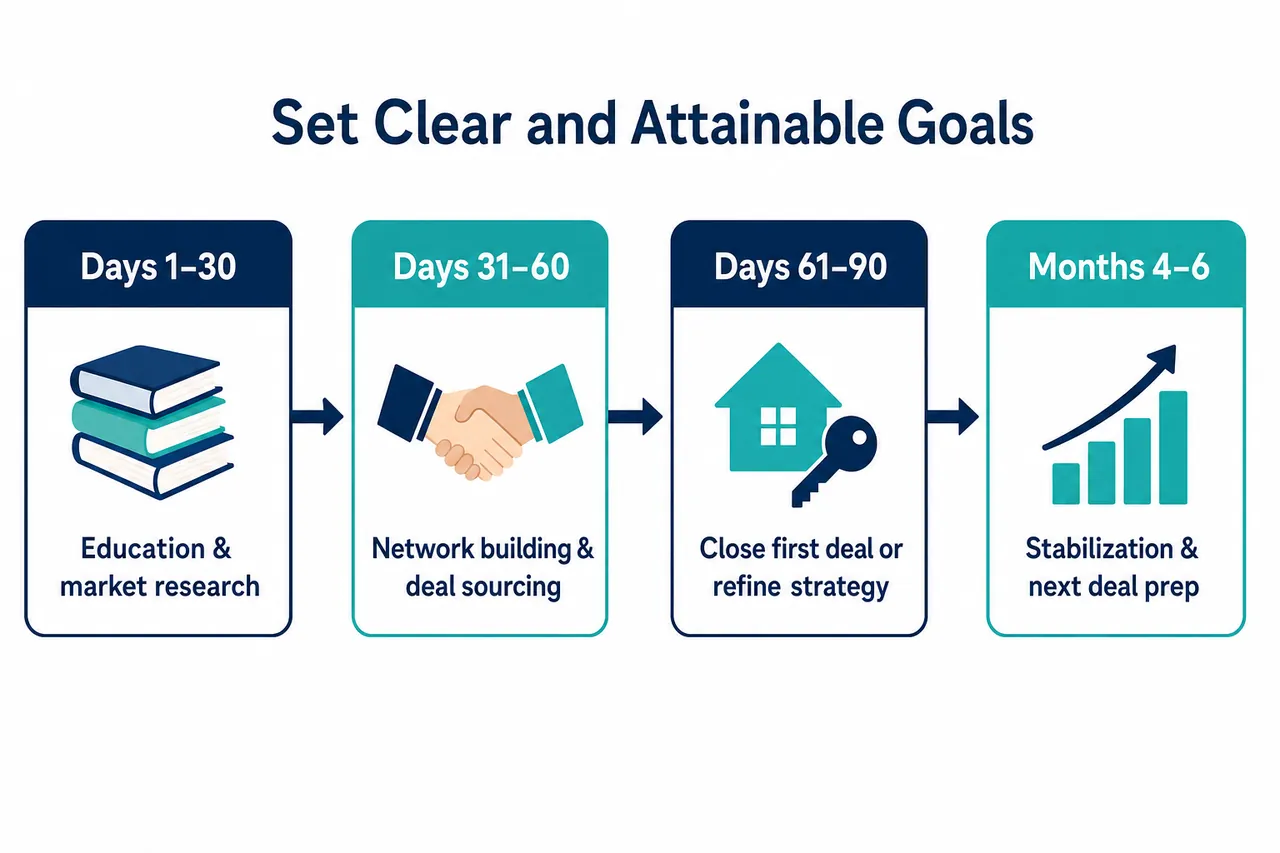
| Timeframe | Focus Area | Specific Actions | Success Metric |
|---|---|---|---|
| Days 1–30 | Education & market research | Complete one investing course; analyze 15 local properties; attend one REIA meeting | Underwrite 15 deals; identify target submarket |
| Days 31–60 | Network building & deal sourcing | Meet 3 agents, 2 lenders, 1 contractor; make 5 offers; set up deal alerts | 5 offers submitted; at least 1 LOI accepted |
| Days 61–90 | Close first deal or refine strategy | Complete due diligence; secure financing; set up property management | Property under contract or strategy pivot documented |
| Months 4–6 | Stabilization & next deal prep | Tenant placed; review performance; underwrite 10 more properties | Positive cash flow confirmed; second deal pipeline active |
Track Progress and Adjust Regularly
Block 30 minutes every month to stack your actual progress against your plan. Where'd you land? If you're behind, don't guess. Dig into it. Are you sourcing enough deals? Not making enough offers? The investors who win do this monthly review without fail — it's the difference between staying sharp and drifting into inaction.
A solid real estate investing business plan gives you the framework to track this. Without one, those monthly check-ins turn into wandering thoughts that go nowhere.
Back to topBuild a Network That Holds You Accountable
Your network either accelerates your progress or enables your excuses. Motivation is contagious. So is complacency. The people around you matter more than your business plan. Deliberately building a network of serious investors and professionals is legitimately one of the highest-ROI things you can do with your time.
Connect With Other Investors and Professionals
Local REIAs, meetups, and online communities are where serious investors congregate. You'll find deal leads, contractor referrals, and current market intel—the stuff you can't glean from blog posts. Those conversations move faster than research. And they validate your strategy against real-world conditions in your market. For specifics on assembling your core team, check out our guide on building a real estate investing team.
Find an Accountability Partner or Investment Partner
Startup research is brutal about solo founders: they quit way more often than co-founders. Real estate follows the same pattern. When someone else is waiting for your weekly call, expecting you to analyze deals, counting on you to close—you show up. You make the calls. You don't punt on Tuesday because you're tired. A partner also brings capital, complementary skills, and a sober second opinion when a deal smells off but you want to believe in it anyway.
Use Social Pressure as a Positive Force
Tell people. Your spouse, your best friend, your colleague over coffee. Not to brag. Tell them because external accountability fills the gaps when your internal drive falters at 6 p.m. on a Wednesday. You've committed to closing your first rental property by mid-next year? Now you've got a reason to actually do it. That's not weakness. That's leverage.
Back to topDevelop Emotional Resilience — Because the Market Will Test You
Real estate investing will mess with your head. You'll spend weeks underwriting a deal only to watch it collapse three days before closing. Properties surprise you with six-figure repair bills. Markets stall. Tenants disappear. If you're banking on smooth sailing, you won't make it past year one.
Understand Your Motivational Psychology
Psychologists split motivation into two buckets: intrinsic motivation — doing something because you genuinely care about it — and extrinsic motivation — doing something for the paycheck or status. The investors who last combine both. They love the craft itself — analyzing deals, reading markets, squeezing efficiency from operations — and they've tied concrete rewards to specific milestones. One without the other won't carry you far.
Which one drives you? If external rewards matter most, build a system that celebrates each win — your first rental, your first 10-unit, hitting 20% cash-on-cash return. If you're wired for the work itself, make sure you're actually doing the parts you enjoy, not drowning in spreadsheets and tenant complaints that kill your enthusiasm.
Recognize and Dismantle Common Motivation Killers
The real killers aren't dramatic failures. They're the small, persistent ones: endlessly underwriting without ever submitting an offer, stalking other investors' portfolios on social media, convincing yourself you need another course before you're "ready." Sound familiar?
- Analysis paralysis: Set a 48-hour offer deadline. If a deal hits your criteria after underwriting, you move. No exceptions.
- Comparison spiral: Stop measuring yourself against someone else's highlight reel. Track your own numbers instead — your cap rates, your cash-on-cash returns, your year-over-year growth. That 20-unit player you admire? They started with one property too.
- Imposter syndrome: Competence kills doubt. Run the numbers until they're muscle memory. Practice cap rates and DSCR calculations until you can do them in your sleep. Use our cap rate calculator and cash-on-cash return calculator so often they become second nature. Fluency breeds confidence.
Manage Emotions During Market Downturns
Slow markets feel depressing. But they're also where you find your best deals. When everyone else pulls back and the headlines turn ugly, that's when patient money wins. Most investors panic and sit on the sidelines — that's your edge. Anchor yourself to your long-term playbook, not to this month's activity. Run your numbers again. If a deal's fundamentals work now, they'll look fantastic when the market recovers.


Reignite Motivation After a Failed Deal
You'll blow a deal. Every serious investor does. The difference between people who quit and people who build real portfolios? They treat failures as tuition. It costs money, but you learn something worth ten times more. After a deal implodes or underperforms, run a postmortem. What was your original thesis? Where'd it fall apart? What do you do differently next time? Write it down. That document becomes gold — your personal playbook for what not to repeat. Give yourself a week to process it, then move to your next opportunity.
Back to topMotivation Strategy Comparison
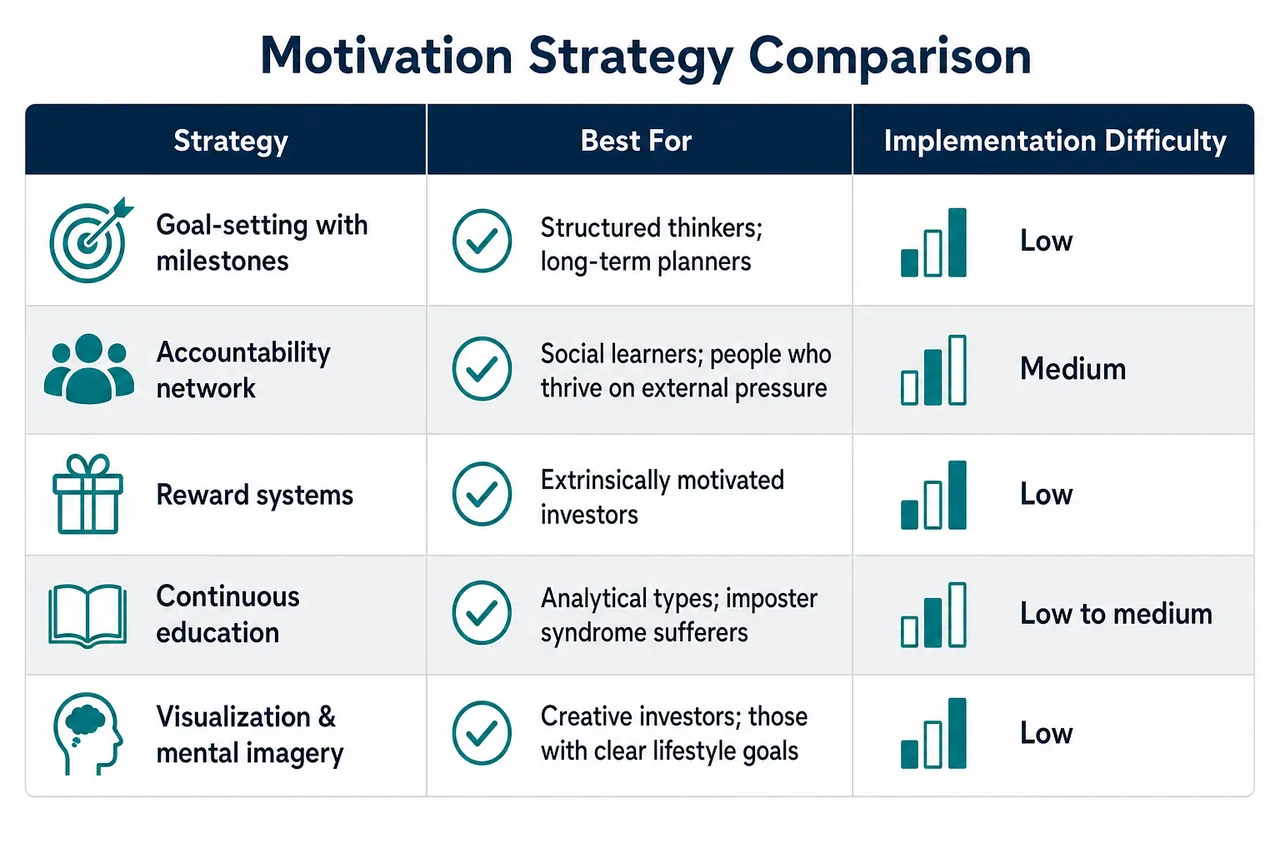
| Strategy | Best For | Strengths | Limitations | Implementation Difficulty |
|---|---|---|---|---|
| Goal-setting with milestones | Structured thinkers; long-term planners | You get clear direction and measurable progress. Overwhelm drops instantly. | Goals drift and need refreshing. The system can feel suffocating if life shifts. | Low — spend 1–2 hours upfront and you're done |
| Accountability network | Social learners; people who thrive on external pressure | Peer support isn't just motivational—it's deal flow and shared battle scars. You get access to knowledge most investors don't have. | It demands consistent time investment. Finding partners worth your while? That's the hard part. | Medium — building real relationships takes sustained effort |
| Reward systems | Extrinsically motivated investors | Immediate positive reinforcement keeps your energy locked in. You feel the wins as they happen. | Rewards can feel empty if they're not tied to actual milestones. Make them count or skip this. | Low — design your own reward ladder in an afternoon |
| Continuous education | Analytical types; imposter syndrome sufferers | It builds genuine competence and actual confidence—not just the feeling of it. | Education becomes procrastination. "I'll start investing once I finish this course" is how deals die. | Low to medium — your schedule discipline matters more than the learning |
| Visualization & mental imagery | Creative investors; those with clear lifestyle goals | Your daily grind connects directly to the future you want. Anxiety drops when the vision is vivid. | Visualizing alone is fantasy. Pair it with concrete action plans or you're just daydreaming. | Low — 5–10 minutes daily is all you need |
| Pain/fear-based motivation | Investors driven by avoiding financial insecurity | Fear works fast. It creates urgency when nothing else will. | It burns out. You'll make rushed, stupid decisions if you live in fear long-term. Watch yourself. | Low — but protect your mental health doing this |
Invest Continuously in Your Own Education
You can't be confident without competence. The more you understand real estate fundamentals—market analysis, underwriting, deal structures, financing options—the faster you'll move from analysis paralysis to actually making offers. Hesitation isn't a character flaw. It's just ignorance with better manners. Knowledge kills it.
Develop Essential Analytical Skills
Cap rates. Cash-on-cash returns. Gross rent multipliers. DSCR ratios. These aren't optional metrics you can skip. They're the difference between investors who close deals confidently and ones who spin their wheels endlessly wondering if they're overpaying. Running a fix-and-flip deal through our fix and flip calculator before you commit capital takes 10 minutes and saves you from leaving money on the table. The 70% rule works as a quick filter too—it keeps you from overpaying on buy-and-hold acquisitions when you're running hot.
Stay Current on Market Conditions
Rates shift. Everything else follows. With the 30-year fixed mortgage rate sitting at 7.28% as of the week ending November 19, 2026, financing costs matter right now—and they'll matter differently six months from now. If you're not tracking how rate environments impact cap rates, buyer demand, and rental yields, you're making decisions on stale data. Subscribe to local market reports. Track your target neighborhoods every month. Know your submarket's vacancy trends cold.
Use Courses and Communities Strategically
Formal education cuts your learning curve in half, but only if you pick programs that actually teach you to execute. Our best real estate investing courses for 2026 roundup helps you find one that matches your level and goals. And don't just sit through lectures. Grab a real deal and start analyzing it immediately—theory stays stuck in your head until you force it into practice.
New to this? Our complete beginner's guide to real estate investing gives you the foundational concepts you need before you jump into advanced strategies.
Back to topBuild Action Into Your Schedule — Not Just Your Intentions
Most motivation problems are scheduling problems. You don't lack enthusiasm — you lack a system that actually converts it into daily action. Without protected time, deal analysis gets buried under the urgent stuff: your job, family, everything else screaming for attention.
Create a Non-Negotiable Weekly Investing Block
Block out a specific, recurring time slot. Two hours on Tuesday evenings. Saturday mornings. Whatever fits your life. This block is exclusively for real estate — analyzing deals, making calls, running numbers, hitting networking events. And it's non-negotiable. Treat it like a client meeting you absolutely cannot reschedule.
Start Smaller Than You Think You Should
Momentum comes from action, not from thinking about action. Stuck? Make your first step absurdly small. Drive through your target neighborhood for 20 minutes and document what you see. Send one email to a local agent. Run numbers on a single property using our rental property calculator. Micro-actions kill inertia. They create the momentum that leads to bigger moves.
Use Pain and Pleasure Deliberately
Some investors are pulled toward something — financial freedom, family time, travel. Others are pushed by what they're running from — job insecurity, money stress, paycheck dependence. Both work. What matters is knowing which one drives you, then connecting your daily actions to it explicitly. When deal analysis feels like a grind, ask yourself: "What does finishing this get me closer to, and what does skipping it keep me trapped in?"
Design a Reward System That Reinforces Progress
Lock in specific rewards for specific milestones before you hit them. Analyze 10 deals, you get dinner at your best restaurant. Submit your first offer, take a weekend trip. Close your first deal, do something that actually marks it. These aren't frivolous. They're neurological anchors that wire real estate action to positive outcomes. That makes the next action easier.
Back to topVisualize Specifically, Not Vaguely
Visualization isn't just motivational nonsense—when you do it right, it works. Research shows that detailed mental imagery activates the same neural pathways as actually doing the thing. Negotiating a deal in your head. Walking through a renovation timeline. Reviewing lease terms with a new tenant. Your brain fires the same neurons either way, and that builds real confidence before high-stakes moments.
But here's what kills most visualization attempts: vagueness. You can't just daydream about "success" and expect results. That's useless.
What actually moves the needle? Mental rehearsal with teeth. Picture yourself fielding your first tenant complaint—word for word, objection by objection. Walk through exactly how you'll negotiate a seller down from their asking price, what you'll say when they push back, how you'll handle the silence after your offer. This isn't meditation. It's training. And it preps you for those moments in ways that pure book knowledge never will.
Back to topDraw on Wisdom From Those Who Came Before You
When motivation dips, perspective from investors and thinkers who've navigated similar challenges can reset your mental framing quickly. Warren Buffett's consistent advocacy for real estate as a core wealth-building vehicle reminds us that the fundamentals haven't changed. Franklin Roosevelt's observation that real estate is "the safest investment in the world" when managed with common sense shows the durability of the asset class. Theodore Roosevelt's "do what you can, with what you've, where you're" is as applicable to a first-time investor with limited capital as it was to anything else.
These aren't just inspirational quotes. They're shorthand reminders of a centuries-long track record of real estate creating wealth for people who stayed committed long enough to let it work.
Back to topAvoid the Costly Mistakes That Kill Momentum
A preventable mistake costs real money. Worse? It kills your confidence. You overpay for a property, underestimate rehab costs, or misread financing terms—and suddenly the next deal feels impossible. The financial hit stings. But the doubt? That lingers. Our full guide to real estate investing mistakes beginners make walks through the 20 most expensive errors and exactly how to dodge them. Read it before your first deal, not after. This matters.


Conclusion: Motivation Without Action Is Just Entertainment
None of this matters if you don't actually do something. Real estate investing motivation that moves the needle isn't about getting inspired — it's about designing systems, habits, and environments that make consistent action feel inevitable. Pick a specific goal today. Block time this week. Tell someone what you're committing to. Analyze one property's numbers. Small? Sure. But they're real, and real moves compound.
The investors building actual wealth through real estate aren't waiting for perfect market conditions, better rates, or total confidence. They start messy and improve through execution. You've got the knowledge now. Go use it.
Back to topFrequently Asked Questions
How do I stay motivated when the real estate market is slow?
Slow markets actually produce better acquisition opportunities — if you're patient enough to capitalize on them. That's when you anchor to your long-term goals instead of obsessing over short-term market noise. Use the downtime strategically. Sharpen your underwriting skills. Expand your network. Get pre-approved for financing so you can move within days when the right deal appears. And revisit your original "why" — the reason you started investing in the first place. That perspective shift alone can carry you through discouraging stretches.
What's the best way to overcome procrastination as a real estate investor?
Set a decision rule and actually follow it. If a deal meets your pre-defined criteria after analysis, you submit an offer within 48 hours. No more research. No more "let me think about it." Procrastination isn't laziness — it's uncertainty. Build your analytical skills until underwriting a deal feels routine, and the hesitation shrinks naturally. Stuck? Start stupidly small. Analyze one property. Make one phone call. Attend one event. That's enough.
How important is an accountability partner for real estate success?
It's not optional in your first one to two years. The solo investor relying entirely on internal motivation is fighting an uphill battle. An accountability partner — co-investor, mentor, or peer at your level — creates external commitment that fills the gaps when your internal drive dips. And they're invaluable for deal analysis. A second set of eyes improves both your decision quality and your motivation simultaneously.
Can visualization actually help me become a better real estate investor?
Vague daydreaming about financial success? Not useful. Detailed mental rehearsal works. Spend five to ten minutes daily walking through specific scenarios: a negotiation, explaining your offer to a seller, reviewing financials with a lender. That activates performance-related neural pathways and builds genuine confidence. Pair the visualization with concrete action steps for real results.
How do I reignite motivation after a deal falls through or a property underperforms?
Give yourself a defined recovery period — be honest that it stings, then set a time limit on it. After that, conduct a structured post-mortem. Document your original thesis. Identify where reality diverged from your assumptions. Write down what you'd do differently. Turn the failure into a lesson you can reference later. Then commit to one specific next action within seven days — not a vague intention, but something calendar-blocked. Momentum rebuilds through movement, not through waiting to feel ready.
Back to top