


Discover the most important real estate investing lessons 2026 investors need to know. Learn strategies that work in today's market conditions.
Products and Tools Mentioned in this Post

Table of Contents
- The 2026 Real Estate Market: What the Numbers Actually Say
- Investment Strategy Comparison: Picking the Right Vehicle for Your Situation
- Critical Metrics Every Investor Must Understand in 2026
- Tax Advantages: The 2026 Investor's Full Picture
- Financial Preparation and Risk Management: Lessons Beginners Skip
- Common Mistakes Specific to 2026 Conditions
- Financing Options: Beyond the Conventional 30-Year Fixed
- Inflation Protection: Why Real Estate Remains Relevant
- Building Your Team and Systems: The Infrastructure That Scales
- Your 2026 Action Plan: A Beginner's Roadmap to the First Deal
- After Your First Deal: Scaling Without Overextending
- Conclusion: The Long Game Always Wins
- Frequently Asked Questions
Forget timing the market. What actually matters in 2026 is understanding how current conditions change your deal math and adapting your strategy around it. Median existing single-family home prices hit $432,900 in Q3 2026, and 30-year fixed rates are sitting around 7.42%. The investors pulling ahead right now? They crunch the numbers first, pick their lane, and stack their finances tight before making a move. This guide walks you through the real lessons from every major approach—buy-and-hold, BRRRR, house hacking, flipping, REITs, crowdfunding, wholesaling—so you can step into 2026 with actual conviction instead of just hoping something sticks.

The 2026 Real Estate Market: What the Numbers Actually Say
You need an honest picture before you pick a strategy. 2026 isn't 2021. It's not 2009 either. This market has its own pressures and its own opportunities.
Prices, Rates, and Loan Limits
Home values are stubbornly high. The NAR reported a Q3 2026 median existing single-family home price of $432,900. Meanwhile, the Census Bureau / HUD median new home sale price sat at $393,300 as of Q3 2026. That $39,600 spread between new and existing inventory means sellers of existing homes still have pricing power in most markets.
Rates didn't retreat to where most buyers hoped. Freddie Mac's weekly survey for the week of November 12, 2026 placed the 30-year fixed rate at 7.11%, while Bankrate's national lender survey for the week of November 19, 2026 showed 7.42%. Your actual rate depends on credit profile, loan type, and lender — which is why shopping multiple sources matters.
Good news if you're buying larger or multi-unit properties. The FHFA raised the 2026 baseline conforming loan limit to $832,750 for one-unit properties, with a high-cost area ceiling of $1,249,125 and a four-unit property limit of $1,601,750. Higher limits qualify more properties for conventional financing, which carries lower rates than portfolio or hard-money loans.
House hackers buying their first duplex or triplex often use FHA financing. The 2026 FHA loan floor is $541,287. You can get in with as little as 3.5% down if your credit score qualifies, making FHA one of the most accessible entry points for new investors.
For a deeper look at how all of these macro forces interact, see our full breakdown at Real Estate Market Trends 2026: What Investors Need to Know.
2026 Market Outlook: Rates, Prices, Inventory, and Sales Volume
Where the market's heading matters more than where it's been. These directional views come from analysts and industry organizations as of late 2026, but check current sources before you commit capital. They aren't guarantees.
Mortgage rates are expected to stay elevated through the rest of 2026 and into 2027. Most forecasters see the 30-year fixed rate staying in the high-6% to mid-7% range unless the Federal Reserve or inflation data shifts significantly. If rates drop, it'll probably happen gradually — not in a single dramatic plunge. Investors waiting for a return to 5% or 6% rates? You might be waiting a long time. Underwrite every deal at today's rate and treat any future decline as upside, not your exit strategy.
Home prices are expected to appreciate modestly or stay flat nationally through 2026, with real variation by market. Limited existing-home inventory — homeowners locked in by low-rate mortgages from 2020–2021 — combined with persistent demand keeps a floor under most metros. Sharp broad-based price declines aren't widely forecast, though specific overbuilt or insurance-stressed submarkets could see corrections.
Inventory defines this cycle. The lock-in effect — homeowners unwilling to trade a 3% mortgage for a 7%+ one — has kept existing-home supply well below historical norms. New construction has picked up in some Sun Belt metros, adding supply pressure in those specific areas. And that's the squeeze on investors: low inventory means serious competition for quality deals. Off-market sourcing, wholesaler relationships, and direct-to-seller marketing matter more than they did in 2019 or 2020.
Sales volume for existing homes remains well below 2021 peaks and pre-pandemic norms. Fewer transactions mean fewer comps, which makes appraisals and ARV estimates less certain — a real risk for BRRRR and flip investors. It also means motivated sellers are a smaller pool, so deal-finding requires more effort and marketing spend than in a high-volume market.
Patient investors with local expertise and rigorous underwriting win in 2026. Speculation and the assumption that rising prices will bail out a weak deal? That's a losing game.
What High Rates Mean for Your Deals Right Now
At 7%+ rates, monthly payments crush cash flow. A $100,000 loan costs significantly more than two or three years ago. That's why investors succeeding in 2026 do one or more of these: buy at a deeper discount, put more equity into the deal, find properties with higher rents relative to price (better cap rates), or structure creative financing like seller financing. Your deal doesn't cash-flow at today's rate? Don't assume rates will fall and save it. Run the numbers at the current rate and decide from there. Use our rental property calculator to stress-test any deal at multiple rate scenarios before you make an offer.
Regional Variation: Location Still Decides Everything
National averages hide enormous variation. Sun Belt metros that exploded in 2021–2022 have seen price corrections while still carrying high insurance premiums — a double hit on cash flow. Midwest and mid-Atlantic secondary cities often show stronger rent-to-price ratios, lower entry prices, and steadier appreciation. The lesson isn't "avoid expensive markets" — it's "know your market's specific numbers." Cap rates, vacancy rates, rent growth, and landlord-tenant law vary enormously by state and city. Research your target market before researching any specific property. The Insurance Crisis 2026: Impact on Real Estate Investing article is essential reading if you're considering coastal or high-risk-weather markets, where insurance costs have become a deal-breaker for many landlords.
Back to topInvestment Strategy Comparison: Picking the Right Vehicle for Your Situation
Experienced investors keep relearning what beginners skip entirely — the best strategy depends on your capital, time, risk tolerance, and goals. Not the other way around. Here's an honest look at what's actually available to you in 2026.
| Strategy | Capital Required | Time Commitment | Risk Level | Best For |
|---|---|---|---|---|
| Buy and Hold (Rental) | Medium–High (15–25% down) | Low–Medium (self-manage or PM) | Low–Medium | Long-term wealth builders, W-2 income earners |
| House Hacking | Low (3.5–5% FHA/conventional) | Medium (you live on-site) | Low | First-time investors with limited capital |
| BRRRR Method | Medium (rehab + hold capital) | High (active management required) | Medium–High | Investors comfortable with renovations |
| Fix and Flip | High (purchase + full rehab) | Very High (full-time project) | High | Experienced investors with contractor access |
| REITs | Very Low (any brokerage amount) | Very Low (passive) | Low–Medium (market-correlated) | Passive investors, diversifiers |
| Real Estate Crowdfunding | Low–Medium ($500–$25,000+) | Very Low (passive) | Medium (platform/deal risk) | Investors wanting passive exposure without landlord duties |
| Fractional Investing | Very Low ($50–$1,000+) | Very Low | Low–Medium | Complete beginners building familiarity with real estate |
| Wholesaling | Very Low (marketing costs) | Very High (lead generation, contracts) | Low (no ownership) | Experienced networkers with strong deal-finding skills |
Each one deserves a closer look. Pick the section that matches where you are today.
Buy and Hold: The Foundational Wealth Builder
Rental properties. You buy one. You hold it. Rent covers the mortgage, you build equity through amortization, and over time you watch appreciation do the heavy lifting. It's not flashy. And it's not quick. But most real estate millionaires got there this way because four return drivers work simultaneously: monthly cash flow, principal paydown, appreciation, and tax deductions. For the full mechanics, read What's Buy-and-Hold Real Estate Investing? The Complete Investor's Guide.
What's changed in 2026? Cash flow is tighter than it was two or three years ago. But here's what matters: equity growth through amortization at today's loan sizes is substantial. A $500,000 loan over 30 years means you're paying thousands in principal in year one alone. That's real wealth building, even if monthly cash flow is thin some months.
House Hacking: The Smartest First Move for Low-Capital Investors
You buy a small multi-unit — duplex, triplex, fourplex — live in one unit, rent the others. The rental income pays your mortgage. Sometimes you're nearly rent-free. Sometimes you pocket cash flow from month one. FHA lets you in for as little as 3.5% down. It's the lowest barrier to direct real estate ownership on the market.
One thing's changed in 2026 that you can't ignore: insurance. Storm-prone and wildfire-risk areas have seen premiums spike. Don't estimate them — calculate them. Run the numbers through our rental property calculator with actual insurance quotes baked in. Hope is not a strategy.
BRRRR: Recycle Capital and Scale Faster
Buy distressed. Rehab to ARV. Rent it. Refinance based on the new value. Pull your capital out. Repeat. That's the BRRRR method, and it's capital recycling at its core. You build a portfolio with far less of your own money tied up compared to traditional buy-and-hold. The trap? The rehab. Cost overruns kill deals. Timeline delays kill deals. Appraisals coming in below your expected ARV can lock your capital up indefinitely. Run every BRRRR deal through our BRRRR calculator before you commit to a purchase price. Seriously.
Fix and Flip: Active Income, Not Passive
Flipping isn't passive. It's a business. You need contractor relationships that actually work, project management skills, accurate ARV estimates, and enough cash to carry the property for months. In a 7%+ rate environment, hard-money loans eat margins fast. This is best for experienced investors with solid local networks and construction chops. Beginners should not start here.
Use our fix and flip calculator and our 70 percent rule calculator before you get emotionally attached to a property. If the numbers don't work on paper, they won't work in reality.
REITs: Real Estate Exposure Without the Landlord Work
REITs trade on public exchanges. They're required to distribute at least 90% of taxable income to shareholders as dividends. You get instant diversification, easy liquidity, zero tenant calls at midnight. The cost? They track the stock market closer than direct properties do. You also lose control over which assets you own. For investors building capital before their first direct purchase, REITs are solid — steady income plus exposure while you save.
Real Estate Crowdfunding and Fractional Investing
Platforms like Fundrise and RealtyMogul let accredited and non-accredited investors pool capital into deals starting at $500 or less. Fractional platforms go deeper — you can buy fractional shares of actual rental properties. These work for three specific goals: learning real estate fundamentals, earning passive income while you save for a direct deal, and diversifying into geographies you can't reach directly. What you're trading away is liquidity (most deals lock capital for 3–7 years) and transparency. Platform risk exists too — if the platform fails, your capital's tied up in bankruptcy court.
Wholesaling: High Skill, Low Capital
Get a distressed property under contract below market. Assign that contract to a flipper or landlord for an assignment fee. Never close. That's wholesaling. Capital requirement is minimal. Skill requirement is not. You need to find motivated sellers consistently, which means marketing spend and relationship building at scale. Wholesaling gets sold to beginners as the easy entry point. It's not. You need deal evaluation chops, negotiation skills, and legal compliance down cold. Think of it as a deal-sourcing business with real estate as the product.
Back to topCritical Metrics Every Investor Must Understand in 2026
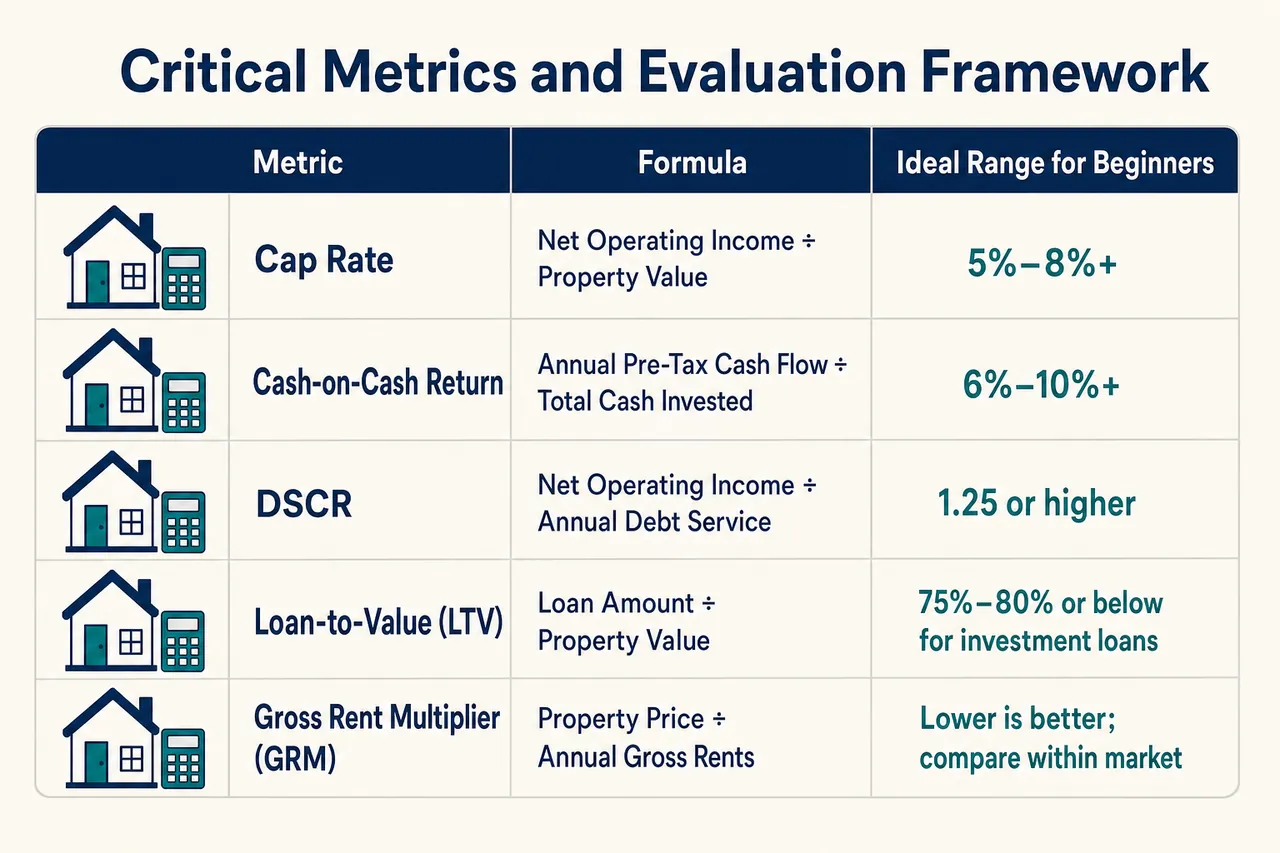
Bad decisions kill your returns. The investors who crash in any market? They're the ones chasing emotion, optimism, or whatever the seller's pro forma promised instead of doing their own hard analysis. These metrics separate winners from losers.


| Metric | Formula | Ideal Range for Beginners | What It Tells You |
|---|---|---|---|
| Cap Rate | Net Operating Income ÷ Property Value | 5%–8%+ (market-dependent) | Return on value before financing; use to compare properties in the same market |
| Cash-on-Cash Return | Annual Pre-Tax Cash Flow ÷ Total Cash Invested | 6%–10%+ | Actual return on the dollars you put in; accounts for your specific financing |
| DSCR | Net Operating Income ÷ Annual Debt Service | 1.25 or higher | Whether rental income covers the mortgage; lenders use this for DSCR loans |
| Gross Rent Multiplier (GRM) | Property Price ÷ Annual Gross Rents | Lower is better; compare within market | Quick screening tool; not a substitute for full cash flow analysis |
| Loan-to-Value (LTV) | Loan Amount ÷ Property Value | 75%–80% or below for investment loans | Equity cushion; affects rate, PMI, and refinance options |
Cap Rate: Your Market-Neutral Comparison Tool
Strip out financing and you get cap rate. Divide net operating income (gross rent minus all operating expenses, excluding mortgage payments) by purchase price. What you're seeing: what a property would return if you paid all cash. That's your apples-to-apples comparison. A higher cap rate? More return per dollar of value—but also usually more risk or a neighborhood investors are avoiding. Use our cap rate calculator on every property. The mistake most beginners make: comparing a 5% cap in Denver to a 5% cap in Phoenix. Markets move differently. A 5% cap in one city is a screaming deal; in another, it's overpriced garbage.
Cash-on-Cash Return: The Metric That Actually Reflects Your Reality
Cap rate ignores one huge thing: how you're financing the deal. Cash-on-cash return doesn't. Take your actual annual cash income and divide it by the actual cash you put in—down payment, closing costs, rehab, all of it. When rates hit 7%+, the gap between cap rate and cash-on-cash explodes. That 6% cap rate property? It could spit out only 2% cash-on-cash. It could even bleed money. High borrowing costs change everything. Run this calculation using our cash-on-cash return calculator before you commit to any deal.
DSCR: How Lenders See Your Deal
DSCR loans are everywhere now. And if you've got a complex tax situation or you're stacking multiple properties, they're a lifesaver because lenders qualify you on the property's income, not your personal 1040s. Here's what lenders demand: a 1.25 DSCR minimum. Translation: your rental income needs to be 25% fatter than your mortgage payment. Want to know if a deal qualifies? Use our DSCR calculator before you pitch it to a lender.
LTV: Your Safety Cushion
Loan-to-value tells you how much skin you actually have in the game. At 80% LTV you're holding 20% equity. Drop to 90% LTV and you've only got 10%. Most conventional lenders won't go past 75–80% LTV on investment property—that's 20–25% down. More equity means lower monthly payments, better rates, and real protection if the market dips. It also gives you room to refinance later. Never max out the LTV just to squeeze into a deal. That's how you end up trapped.
Back to topTax Advantages: The 2026 Investor's Full Picture
Real estate's tax treatment crushes other asset classes. And 2026 brings several critical updates you need to know about.

Depreciation: Your Largest Annual Deduction
Residential rental property depreciates over 27.5 years using the straight-line method under 26 U.S.C. §168(c). Every single year you own that rental, you deduct 1/27.5th of its cost basis (land doesn't count) from your taxable income — even though the property's probably gaining value. A $300,000 depreciable basis? That's roughly $10,909 annually in a non-cash deduction. That money shelters rental income from tax.
But 2026 changes everything. Bonus depreciation's back at 100% under the One Big Beautiful Bill Act (P.L. 119-21) and IRS Notice 2026-11 — but only for qualified property. Personal property and certain improvements qualify. The building structure itself doesn't. Through a cost segregation study, you identify components that hit 100% expensing immediately in year one. Front-loading depreciation by decades matters. If you're buying a rental with significant personal property or land improvements, talk to a real estate CPA about whether cost seg pencils out for your deal.
The QBI Deduction for Rental Investors
The Section 199A qualified business income (QBI) deduction stays at 20% and is now permanent under the OBBBA. Here's what that means for you: if your rental activity qualifies as a business — which requires either hitting IRS safe harbor rules or passing a facts-and-circumstances test — you deduct 20% of your net rental income from your taxable income. Get the full deduction if your income stays at or below $201,750 as a single filer, or $403,500 married filing jointly. Go higher and phase-outs kick in.
This deduction's among the most valuable tools real estate investors have. But it demands proper documentation and usually requires a tax pro who actually understands real estate.
Capital Gains Tax: What You Keep When You Sell
Sell a rental property and your gain gets taxed at long-term capital gains rates (assuming you held it over a year). In 2026, the brackets look like this: Single filers pay 0% on gains up to $49,450 of taxable income, 15% from $49,451 to $545,500, and 20% above $545,500. Married filing jointly? You're at 0% up to $98,900 and 20% above $613,700. High earners get hit with the 3.8% Net Investment Income Tax (NIIT) on investment gains above $200,000 (single) or $250,000 (married).
One thing catches most sellers off guard: depreciation recapture. Every deduction you've taken — or could've taken — gets taxed on sale at a maximum rate of 25% under Section 1250 rules. That adds up fast. Use our capital gains tax calculator for real estate before you decide to sell. Know your number.
The 1031 Exchange: Defer Tax Indefinitely
A 1031 exchange defers capital gains tax on the sale of an investment property by rolling proceeds into a like-kind replacement property. The timing's brutal — 45 days to identify your replacement after closing on the original property, and 180 days total to complete acquisition (or your tax return due date with extensions, whichever comes first) under 26 U.S.C. §1031(a)(3). Miss either deadline and the deferral blows up. Use our 1031 exchange calculator to see how much tax you're actually deferring and whether the exchange makes sense for your numbers.
And don't overlook the primary residence exclusion. Sell a home where you've lived 2 of the past 5 years, and you exclude up to $250,000 of gain ($500,000 married filing jointly). House hackers who eventually sell their owner-occupied unit may bank this exclusion.
Back to topFinancial Preparation and Risk Management: Lessons Beginners Skip

Three things kill real estate investors. Undercapitalization. Poor credit that locks them out of decent financing. And no contingency plan when reality hits. You can avoid all three.
Credit Score: Your Gateway to Favorable Terms
Your credit score controls your interest rate, your down payment, and whether you even qualify for the loan. Most lenders require 680+ for investment property loans—better rates open up at 720 and 740. Below those numbers? Spend the next 6–12 months paying down revolving balances, disputing report errors, and staying away from new credit inquiries. That gap between 680 and 740 on a $400,000 mortgage costs you over $100 monthly in interest. Over 30 years, that's money bleeding straight out of your cash flow.
Emergency Reserves: Non-Negotiable
Each rental needs its own capital reserve sitting in cash. We're talking money set aside specifically for that property's unexpected repairs, vacancies, and CapEx like roof, HVAC, and plumbing work. Aim for 10% of gross annual rent per property as a starting benchmark. Your personal emergency fund (3–6 months of living expenses) stays completely separate. And don't mix them. That's how beginners end up forced into a distressed sale at the worst possible time.
Keep Your Day Job Longer Than You Think
This one circles through the real estate community constantly for a reason. Don't quit your W-2 income too early. Your employment income makes you a stronger borrower. It funds your reserves. It gives you breathing room to survive a bad quarter without liquidating assets. Most successful operators hold their day jobs through 3–5 properties before rental income stabilizes enough to support a full transition. For what experienced investors are actually saying on this topic, check out Real Estate Investing for Beginners: What Reddit's Top Investors Are Saying.
High-Interest Debt First
Carrying 20%+ APR credit card debt? Kill it before you buy that first rental. That's almost always the right math. No property in 2026 reliably throws off 20% cash-on-cash returns. Eliminating high-interest debt improves your credit score, opens up monthly cash flow, and removes the financial stress that turns real estate ownership from wealth-building into a constant headache.
Back to topCommon Mistakes Specific to 2026 Conditions
Every market cycle spawns its own breed of costly investor errors. Right now, these are the ones hurting people most.
- Underestimating insurance costs: Landlord insurance premiums have jumped in most markets. If you're running 2022 or 2023 numbers on a 2026 deal, your cash flow projections are dead on arrival. Get an actual insurance quote before you make an offer—not an estimate, not a ballpark.
- Assuming rates will fall "soon": You see this all the time. Investors buy deals that only pencil if rates drop 150–200 basis points, planning to refinance their way to profitability. That's speculation wearing an investor hat. Buy the deal that works right now, at today's rates. If rates do fall and you refinance, great—but don't build your strategy around it.
- Skipping property management cost modeling: Self-managing sounds awesome until a 2 AM pipe burst at a vacant unit changes your mind. Model 8–10% for professional management into every single deal, even if you swear you'll handle it yourself. It keeps you honest, and if you eventually hire someone, the deal still makes sense.
- Over-leveraging on your first deal: Maxing out your LTV with nothing left in reserves is how one bad month wipes you out. And it will happen. Don't stretch to the absolute limit. Leave cushion in both your loan and your bank account.
- Ignoring landlord-tenant law: Every state and half the cities within them have their own rules—security deposit limits, notice periods, eviction timelines, habitability standards. Break them accidentally and you're still on the hook. Learn your jurisdiction's rules before you close, not after your first dispute turns into a lawsuit.
- Skipping entity structure research: Holding investment property in your personal name means your personal stuff is on the line if something goes wrong. LLCs exist for a reason. Check out Best LLC Services for Real Estate Investors 2026 for real guidance on protecting your assets the right way.
Financing Options: Beyond the Conventional 30-Year Fixed
Your financing structure determines whether you're competing or dominating in 2026. Investors closing better deals? They're not stuck on conventional mortgages — they know how to layer structures together.
- Conventional loans: You'll get the best rates here if you're well-qualified, but expect to put down 20–25% on investment properties. The conforming limit sits at $832,750 in most markets.
- FHA loans (owner-occupant only): Only 3.5% down required if your credit qualifies. Perfect for house hackers running 1–4 unit properties. Standard markets max out at $541,287 in 2026.
- DSCR loans: This one's a game-changer. You're approved based on what the property makes, not what your W-2 says. Self-employed? Complex tax situation? DSCR is your answer. Run your numbers through our DSCR calculator first.
- Portfolio loans: The lender keeps the mortgage instead of selling it off to Fannie Mae. That means looser underwriting rules, but you'll pay higher rates. This solves problems for properties that don't fit the standard box.
- Hard money loans: High rates, short terms. Built for flippers and BRRRR plays closing in 6–18 months. Exit strategy's everything here.
- Seller financing: And this is where real negotiating power shows up. When the seller carries paper, you're suddenly talking below-market rates, minimal down, flexible terms. In this rate environment? Both sides are hungry for creative deals. Our seller financing calculator helps you model what actually pencils.
Inflation Protection: Why Real Estate Remains Relevant
Physical property works as an inflation hedge. When prices rise across the board, construction costs spike—which means your replacement value and property price rise with it. Rents climb too, letting you maintain real (inflation-adjusted) income year after year. Not every market delivers this every year. But this structural advantage is exactly why experienced investors keep returning to real estate as a core holding.
And here's what's changed by 2026: inflation's also hammered operating costs—insurance premiums, maintenance bills, property taxes in many states have all gone up. You get inflation protection on the asset and revenue side. But expenses bite harder. That means your net margin discipline has to be sharper than it's ever been.
Back to topBuilding Your Team and Systems: The Infrastructure That Scales
Your first deal teaches you real estate. By your second through fifth deals, you'll figure out the hard way—it's a team sport. Investors who actually scale past 5–10 units don't reinvent the wheel on every deal. They build repeatable systems instead.
You need a real estate agent who gets investment analysis, not just residential sales comps. A lender who specializes in investment property financing. A CPA with real estate expertise on the books. And an attorney in your target market who knows the local nuances. Property management matters too—either hire a rock-solid manager or build the systems to do it yourself. Don't forget your contractor network; you'll lean on them constantly.
Technology changes the game. AI-powered deal analysis tools cut your underwriting time in half (check out AI Tools for Real Estate Investors: Complete Guide 2026). A solid CRM keeps your pipeline organized and follow-ups automated—see Best CRM for Real Estate Investors 2026 for the best platforms. And accounting software? It's non-negotiable if you want your books tax-ready and audit-proof (we break down the options in Best Real Estate Bookkeeping Software for Investors 2026).
Back to topYour 2026 Action Plan: A Beginner's Roadmap to the First Deal
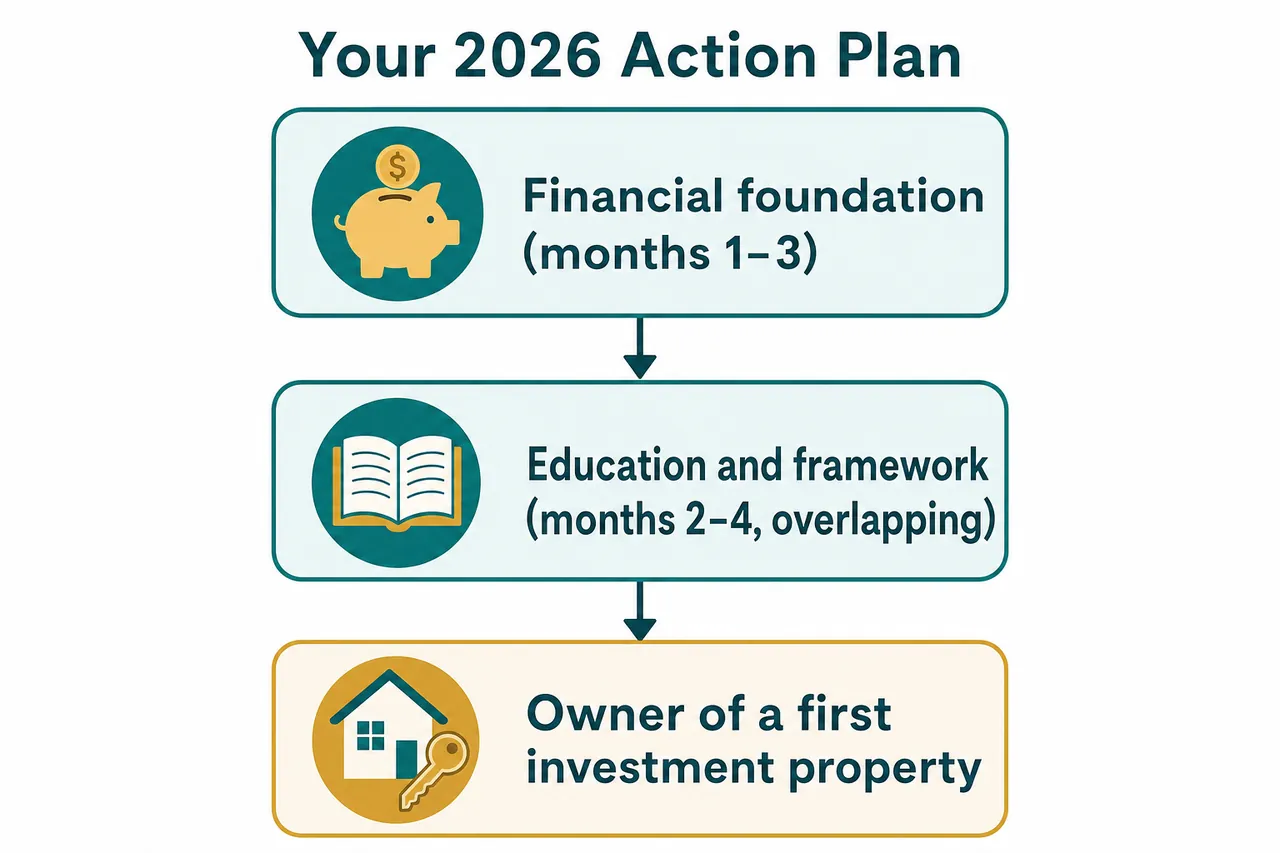
You can memorize every strategy and metric out there. But that won't get you to closing. What actually works is a step-by-step sequence that moves you from "interested" to "owner of a first investment property."
- Financial foundation (months 1–3): Pull your credit reports and find out exactly where you stand. Pay down revolving debt. Start building your down payment savings now—don't wait. Calculate your true monthly budget and determine how much capital you can realistically deploy without blowing up your personal finances. What's your credit score, and what loan products does it actually qualify you for?
- Education and framework (months 2–4, overlapping): Cap rate. Cash-on-cash. DSCR. GRM. Learn these metrics until you can calculate them without breaking a sweat. Read through actual case studies of deals that worked—and ones that didn't. A structured course can accelerate this. Check out our review of the Best Real Estate Investing Courses 2026 and our breakdown of Real Estate Mentorship Programs: What's Worth Paying For in 2026.
- Market selection (month 3–4): Pick a target market—ideally somewhere you can actually drive to and walk the neighborhoods. Spend 60 days digging into every listing in your specific price range and property type. Build a mental model of what normal rent-to-price ratios look like there. This groundwork is what lets you spot a deal the moment it hits the market.
- Team building (month 4–5): Find an agent who actually understands investor deals. Get pre-approved with a lender who does investment property loans, not just owner-occupant financing. Identify a local real estate attorney. And build these relationships before you need them. That's not optional.
- Evaluate 20+ deals on paper (month 5–6): Run the numbers on at least 20 properties using our calculators before you make a single offer. This builds pattern recognition and discipline fast. Most won't pencil out. That's exactly what should happen.
- First offer and due diligence (month 6+): When the numbers work, make your offer with appropriate contingencies. Use that inspection period to verify every single assumption you made. Get actual rent comps from the market. Pull real insurance quotes. Get property tax amounts in writing. Get contractor bids for any work you're planning. Only close when the numbers still make sense after you've done the full due diligence.
Want to structure your investing as a real business from day one? See How to Start a Real Estate Investing Business: 2026 Guide.
Back to topAfter Your First Deal: Scaling Without Overextending
Your first deal closes. You've got cash flow. You're riding high—and that's exactly when most investors blow it up. Confidence isn't bad, but overconfidence kills portfolios. The ones who actually scale follow a simple playbook: nail down that first asset, figure out what worked (and what bombed), rebuild your reserves, then dig into deal number two with the same due diligence you used on deal one. Don't cut corners just because you've done this before.
Once you've got multiple properties, systems beat hustle every single time. And I mean every time. You need property management software that doesn't suck, automated rent collection so tenants can't use "I forgot" as an excuse, lease agreements that actually protect you, and bookkeeping that makes sense at tax time. This is what separates a real business from a lifestyle job that exhausts you. What's really holding you back from acquiring more deals? Usually it's admin work eating your day. Virtual Assistants for Real Estate Investors: What to Delegate breaks down exactly which tasks you can hand off so you're actually spending time on acquisition and strategy instead of data entry.
Back to topConclusion: The Long Game Always Wins
Real estate rewards long-term disciplined investors and punishes short-term speculators. That's the core lesson threading through every strategy, metric, and market condition in 2026. The investors who actually built meaningful wealth through real estate didn't time the market perfectly. They bought fundamentally sound assets. They ran rigorous numbers. They managed risk with appropriate reserves. And they held through market cycles that made the news sound absolutely terrifying.
With median home prices at $432,900 and rates in the 7%+ range, you need more precision than investors who bought in lower-rate environments. Cash flow is tighter. Mistakes cost more. But here's what hasn't changed: the tax advantages, inflation protection, amortization, and long-term appreciation that make real estate work in the first place. The fundamentals are intact. What you need is better preparation, more analytical rigor, and more patience than the investors who entered when conditions were easier.
Start with the calculators. Run the numbers. Build your team. Then make your first move with confidence—the kind that comes from knowing your math is right, not just your optimism.
Back to topFrequently Asked Questions
What's the most important metric to evaluate a rental property in 2026?
Cash flow after all expenses — mortgage, taxes, insurance, management, maintenance, vacancy allowance — that's your primary metric. Cap rate? It's useful for comparing unleveraged deals, but it won't tell you what you're actually pocketing. Cash-on-cash return does. That's the number that matters when you're deciding whether to pull the trigger. Run every deal through our cash-on-cash return calculator.
Can I still find cash-flowing properties when mortgage rates are above 7%?
Absolutely. It just means you can't be lazy about it. Market selection, negotiation, property type — you need discipline across the board. Secondary Midwest and mid-Atlantic cities with strong rent-to-price ratios? Those still cash-flow. High-cost coastal markets? Forget it. House hacking with FHA financing works. BRRRR deals bought at real discounts work. Seller financing works. The strategies exist. You just have to actually use them.
How much money do I need to start investing in real estate?
That answer depends entirely on what you're doing. REITs and crowdfunding platforms? Sometimes under $1,000. House hacking a duplex with an FHA loan on a $400,000 purchase gets you in the door for roughly $14,000–$25,000 down plus closing costs. Conventional investment property? You're looking at 20–25% down plus reserves. More capital means more optionality and way more cushion when things get ugly. That's always true, no matter which path you choose.
What are the main tax benefits of owning rental property in 2026?
You've got depreciation deductions stretched over 27.5 years on residential property. Cost segregation can get you to 100% bonus depreciation on qualifying personal property. The 20% QBI deduction if your rental qualifies as a business activity. Then there's mortgage interest, insurance, management fees, repairs — all deductible. And 1031 exchanges let you defer capital gains tax indefinitely. Want to see what this looks like for your situation? Use our capital gains tax calculator and 1031 exchange calculator.
Should I invest in real estate or pay off debt first?
Kill high-interest debt first. Credit cards at 15–25% APR? They're gone before you buy anything. No rental property today returns 20%+ cash-on-cash after costs and risk. It's not close. Once that's paid off and your credit score's solid, then you save for down payment and move into real estate. Student loans and auto loans are different — lower rates change the math. But run your specific numbers before you decide.
Back to top