


Explore Harvard's real estate program and compare top universities. Find the right pathway for investors, from executive certificates to intensive courses.
Table of Contents
- Harvard's Real Estate Education Market
- Flagship Program: Advanced Management Development Program in Real Estate (AMDP)
- Real Estate Management Program (HBS/GSD Joint Offering)
- Real Estate Investment Graduate Certificate (Online)
- Harvard Real Estate Programs Comparison Matrix
- Specialized Short Courses and Fundamentals Programs
- Niche Programs: Placemaking, Design, and Project Management
- How Harvard Compares to MIT, Wharton, and Other Programs
- Choosing the Right Program Format for Your Goals
- Faculty, Teaching Methods, and Learning Environment
- Program Outcomes and ROI Considerations
- Enrollment, Application, and Practical Next Steps
- Conclusion: Matching Harvard's Programs to Your Investment Strategy
- Frequently Asked Questions
Harvard's real estate education spans everything from $1,990 short courses to a $53,500 executive program. You'll find one-year executive leadership tracks, joint HBS/GSD intensives, online graduate certificates, and dozens of specialized workshops—from affordable housing to AI and proptech. Want to sharpen your financial analysis skills? There's a structured pathway for where you are right now. This guide walks through every major program, lays out the costs and formats side by side, and shows how Harvard stacks up against MIT, Wharton, and Columbia. Before you commit anywhere from $1,990 to $53,500, you'll know exactly what you're getting.

Harvard's Real Estate Education Market
Harvard doesn't house real estate in one tidy department. You'll find programs spread across the Graduate School of Design (GSD), the Harvard Business School (HBS), and the Division of Continuing Education (DCE/Extension School). Each one attracts different investors—from developers focused on design and urban strategy to finance-minded operators running cap rate models. The GSD emphasizes design and development. HBS brings the case method and hard-core finance analysis. The Extension School offers online, credit-bearing courses that count toward a formal graduate certificate, and they're actually accessible.
This scattered approach has real consequences. You get more options, sure. But it also creates confusion. Which school you pick? That tells you everything about teaching style, who you'll network with, and what employers actually think of your credential.
Costs swing wildly depending on what you're after—$1,350 to $16,000 for executive and short-format programs, then jump to $53,500 for the year-long AMDP if you want the full experience. The online Graduate Certificate runs $14,320 total. So Harvard's got something for nearly every budget. Just know that cheap doesn't mean weak, and expensive doesn't always mean better—it depends on your AROI on that credential and your network.
The comparison matrix below maps every program across cost, duration, and format so you don't waste time figuring out which one fits your situation.
Back to topFlagship Program: Advanced Management Development Program in Real Estate (AMDP)
Program Structure and Duration
Harvard GSD's premier executive leadership offering is the Advanced Management Development Program in Real Estate (AMDP). You're looking at a year-long program with five weeks on campus at Harvard. Complete it, and you're an alumnus — that credential matters in this industry. Class 28 is running now, and the program fee sits at $53,500.
Who AMDP Serves and What It Covers
This isn't for junior staff. AMDP pulls in C-suite leaders, development firm principals, and institutional investors with 10+ years under their belt. If you're managing nine figures in deployed capital, you're in the right room.
The curriculum doesn't stay siloed in spreadsheets and cap rate calculations. You'll blend design thinking, development strategy, financing structures, investment analysis, and organizational leadership. That cross-disciplinary focus — the emphasis on narrative and design alongside numbers — is pure GSD. Business schools run straight finance tracks. This isn't that.
Five weeks on campus is brutal in the best way. Real case studies. Peer executives from every major market. A network you'll actually use ten years later. And here's what matters: you need to know if a year-long leadership sprint aligns with where your career's headed right now. Cost is one piece. Timing is everything.
Back to topReal Estate Management Program (HBS/GSD Joint Offering)
Format, Curriculum, and Methodology
Six days. That's what you're getting here — an intensive held right on the Harvard Business School campus, jointly run by HBS and the Graduate School of Design. At $16,000 (tuition, materials, accommodations, meals all included), you're paying premium rates for short-format executive education. And you should expect premium positioning.
The curriculum hits sustainability, design principles, deal financing, emerging technology, and dealmaking. You get HBS's case method alongside GSD's interactive design exercises and simulations — a combination you won't find at most real estate programs. Single-discipline offerings pale in comparison. The program forces you to think about both the financial structuring of a deal and the design and urban context where that deal actually lives.
Admission, Audience, and Requirements
Open to owners, operators, developers, investors, lenders, and service providers. You don't need a formal real estate degree. But you do need real industry experience walking through the door.
Applications close roughly one week before the program starts, though seats typically fill earlier. Plan on 12–15 hours of prep work beforehand. If you're rusty on underwriting or financial modeling, there's an optional refresher for that.
When you finish those six days, you walk away with a Harvard Certificate of Completion. That credential carries genuine weight in this industry, especially if you're repositioning yourself or expanding into new markets.
The cohort pulls from everywhere: 39% North America, 17% Middle East, 16% Latin America, 14% Europe, 10% Asia Pacific, and 4% Africa. If you've got cross-border ambitions, that peer network alone is worth material value.
Back to topReal Estate Investment Graduate Certificate (Online)

Program Structure and Courses
Harvard Extension School runs this Real Estate Investment Graduate Certificate entirely online. Four courses. $14,320 total, which breaks down to $895 per credit—or $3,580 per course since each one's worth 4 credits. You can sprint through in eight months or take your time over three years, depending on what your deal flow looks like.
What you're actually learning:
- Financial analysis and property valuation — model cash flows, apply valuation methodologies, and stress-test assumptions so you don't get caught off guard
- Investment structures and capital stacks — understand how equity and debt layer together, negotiate joint venture terms, and structure partnership frameworks that protect your position
- Asset management and portfolio strategy — manage your holdings through the hold period, execute repositioning moves, and plan your exit
- Market analysis and due diligence — read market data like a pro, evaluate submarkets with real conviction, and underwrite deals that actually pencil
This is what you do every week if you're serious about investing. Want to test-drive these concepts on actual deals? Our rental property calculator and cap rate calculator let you apply what you learn in class to live opportunities.
Outcomes, Employer Partnerships, and Stackability
97% of certificate graduates would recommend this program. And 94% say they actually feel ready for the next move in their career. That's not marketing speak—that's real feedback from people who've used it.
Who's hiring these people? Berkshire Hathaway, Fidelity, Wells Fargo, Keller Williams. You're looking at institutional investment shops, mortgage finance operations, and brokerage networks all pulling from the same graduate pool.
But this certificate is stackable. Credits apply toward certain Harvard master's degrees, so you're not locked in. Take it as a credential on its own, or use it as a testing ground before you commit to a full master's program. If you're shopping around for other options, our breakdown of real estate investing certificate programs covers accredited credentials beyond Harvard too.
Back to topHarvard Real Estate Programs Comparison Matrix
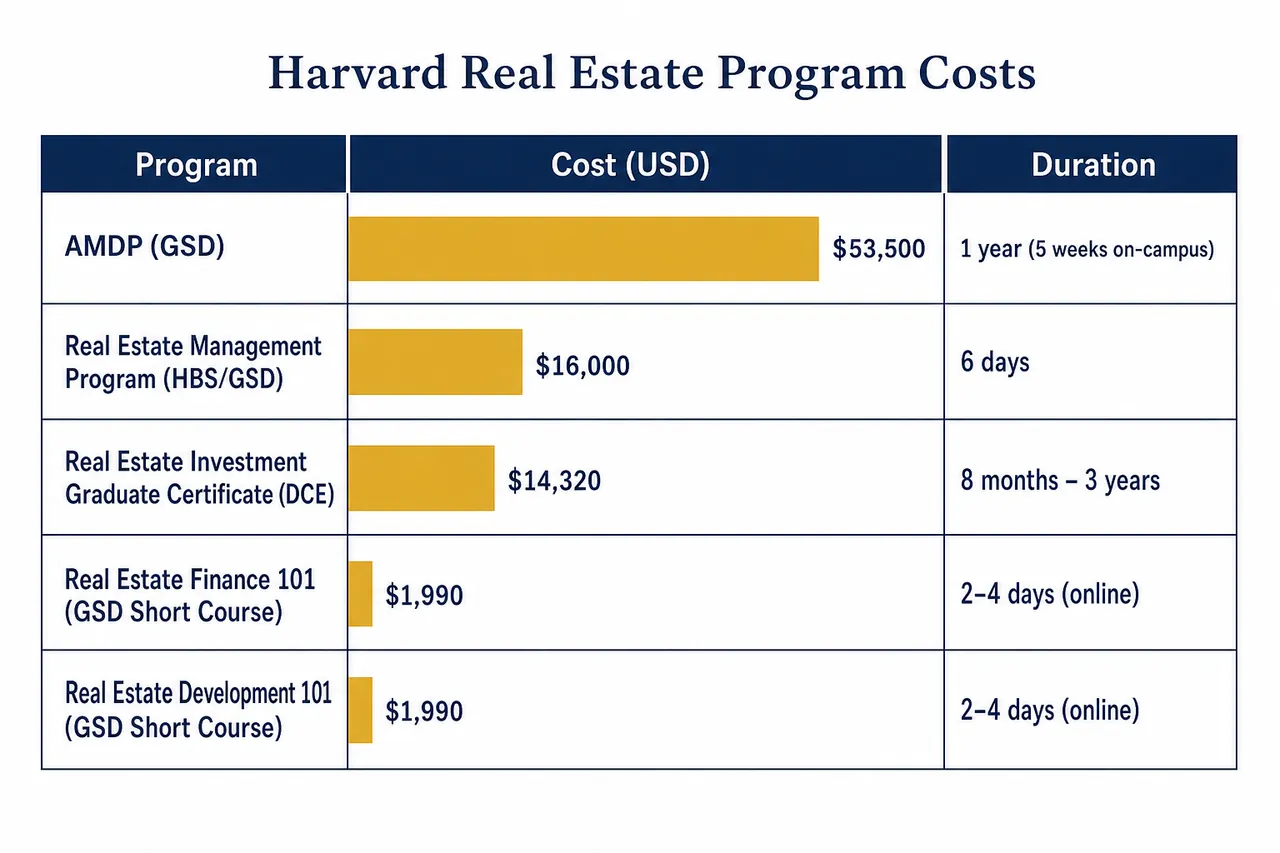
Looking to level up your RE credentials? Harvard offers five different pathways depending on where you are in your career and what you're trying to master. Some take a week. Others stretch over three years. And the price range? It spans from under $2K to over $53K.
| Program | Duration | Format | Cost | Target Audience | Credential |
|---|---|---|---|---|---|
| AMDP (GSD) | 1 year (5 weeks on-campus) | Hybrid (on-campus residency) | $53,500 | Senior executives, principals (10+ years) | Harvard alumni status |
| Real Estate Management Program (HBS/GSD) | 6 days | On-campus (HBS) | $16,000 | Owners, operators, developers, investors | Harvard Certificate of Completion |
| Real Estate Investment Graduate Certificate (DCE) | 8 months – 3 years | Online | $14,320 | Career-changers, working professionals | Graduate Certificate (stackable) |
| Real Estate Finance 101 (GSD Short Course) | 2–4 days (online) | Online | $1,990 | Newcomers, support professionals | Certificate of Participation |
| Real Estate Development 101 (GSD Short Course) | 2–4 days (online) | Online | $1,990 | Newcomers to development track | Certificate of Participation |
Want the heavyweight credential? The AMDP runs you $53,500 and demands serious skin in the game—you need a decade-plus track record and 5 weeks on campus. But you walk out with Harvard alumni status, which opens doors.
The 6-day Real Estate Management Program at HBS is the sweet spot for active investors and developers who can't disappear for a year. At $16,000, it's pricey for a week, yet the network alone pays dividends.
If you're pivoting careers or working full-time, the online Graduate Certificate takes 8 months to 3 years depending on your pace. You'll spend $14,320 total and get a stackable credential—meaning you can layer it on top of other qualifications later.
Short on time and budget? Start with Finance 101 or Development 101. Each costs $1,990 and runs 2–4 days online. Neither will make you an expert, but they'll give you the fundamentals and get your foot in the door at Harvard.
Back to topSpecialized Short Courses and Fundamentals Programs
Real Estate Finance 101 and Development 101
Want Harvard-level content without the multi-week commitment? GSD Executive Education offers two entry-level online courses built for investors and agents. Real Estate Finance 101 costs $1,990 and covers financial fundamentals, valuation basics, and deal structuring. Real Estate Development 101 runs the same price at $1,990 — it takes you from site selection through project delivery.
Both courses are online and compressed into two to four days. No prior formal real estate education required. They work perfectly as low-risk previews before you drop serious money on a longer program. Or use them as targeted skill gaps. An acquisitions-focused investor pivoting into development? This fills that blind spot fast.
Beyond these two, GSD offers additional short courses on affordable housing, international strategies, and AI and proptech. Pricing varies. The full range spans roughly $1,350 to $16,000 depending on program length, format, and whether they're throwing in meals and accommodations. Check the GSD Executive Education website for current rates before you enroll — they update every cycle.
AI, Data Analytics, and Proptech
Harvard GSD has built out serious coursework around artificial intelligence and machine learning in real estate. These aren't fluff electives. The curriculum covers proptech applications, data-driven asset management, and predictive analytics for investment decisions. Already using tech tools in your deals? Our guide to AI tools for real estate investors gives you the practical playbook that sits alongside what Harvard teaches academically.
International Real Estate Strategies
Cross-border deal negotiation. Global market entry. Capital flows between jurisdictions. Legal and regulatory complexity in international transactions. That's what this course unpacks. If you're working deals outside the U.S. or bringing foreign capital into domestic projects, this matters. And the Real Estate Management Program pulls participants from 47% outside North America. Your peer network in this room becomes deal flow.
Affordable Housing Specializations
This is where mission meets money. The affordable housing curriculum gets technical — Low-Income Housing Tax Credits (LIHTC), layered financing structures, mixed-income community design, and development strategies for expensive urban markets. If you're active in affordable housing, LIHTC isn't just policy talk. It's a hard technical skill set. Understanding how to stack LIHTC with other financing tools separates investors who win deals from those who don't.
Back to topNiche Programs: Placemaking, Design, and Project Management

GSD Executive Education runs several programs at the intersection of real estate and urban design. Smart investors know this matters. Design decisions and placemaking strategy aren't soft considerations anymore — they're hard value drivers that move cap rates and exit multiples.


- Story Building and Narrative Placemaking: You learn how to develop and communicate a compelling narrative around a project. This affects community reception and investor appetite — sometimes dramatically. The ability to articulate why a place matters, not just what it costs, separates winners from commoditized deals in tight markets.
- Integrated Project Management: Cross-disciplinary collaboration reduces risk. Design coordination catches problems early. Delivery process gets faster and leaner. And if you're overseeing complex development projects, this applies to your work immediately.
- Hotel Design and Development: Hotel assets work differently than apartments or office. Financing, branding, design considerations — they're their own animal. These courses pull from case studies of globally recognized hospitality properties so you see how the best operators actually think.
- Walkable City Program: Urban design principles. Transit-oriented development. Community-oriented planning. Walkability scores now show up on your underwriting spreadsheets. Tenants demand it. Property valuations reflect it. This program covers what actually moves the needle.
How Harvard Compares to MIT, Wharton, and Other Programs
Harvard's real estate programs aren't operating in a vacuum. When you're evaluating where to invest your time and money, you're really looking at three major players: MIT's Center for Real Estate, Wharton's real estate concentration within the MBA, and a few others worth knowing about.


MIT MSRED (Master of Science in Real Estate Development) is a 12-month degree program. It's built for quant-focused investors. The curriculum dives deep into quantitative analysis, urban economics, and real estate finance. Tuition runs $95,108 for 2025–26, with 2026–27 structured at $36,998 per term for fall and spring, plus $24,666 for summer. That's roughly 10% above standard MIT graduate tuition—a premium for a premium program. Want serious spreadsheet mastery? This is your move.
Wharton MBA with Real Estate Concentration costs $87,970 per year, with total annual tuition and fees hitting $93,008. Two years? $175,940 combined. And you're not just getting real estate knowledge here—you're getting general management training plus access to one of the strongest real estate faculty networks in the country. This path works if you need an MBA credential to go with your real estate specialization.
Columbia GSAPP MS in Real Estate Development—currently verified tuition data isn't solid. Check Columbia GSAPP's program page directly before you make any cost comparisons.
Harvard's executive and certificate programs play in a different arena entirely. They're built for working professionals who can't afford to step away for 12–24 months, who need specific skill gaps filled fast, and who understand the value of that Harvard name on a certificate—all without paying degree-level tuition. If you're shopping across the full spectrum of programs out there, our roundup of best online commercial real estate classes covers options at every price point.
Back to topChoosing the Right Program Format for Your Goals
What matters most: your career stage, your budget, and how much time you can actually free up. Pick based on those constraints.
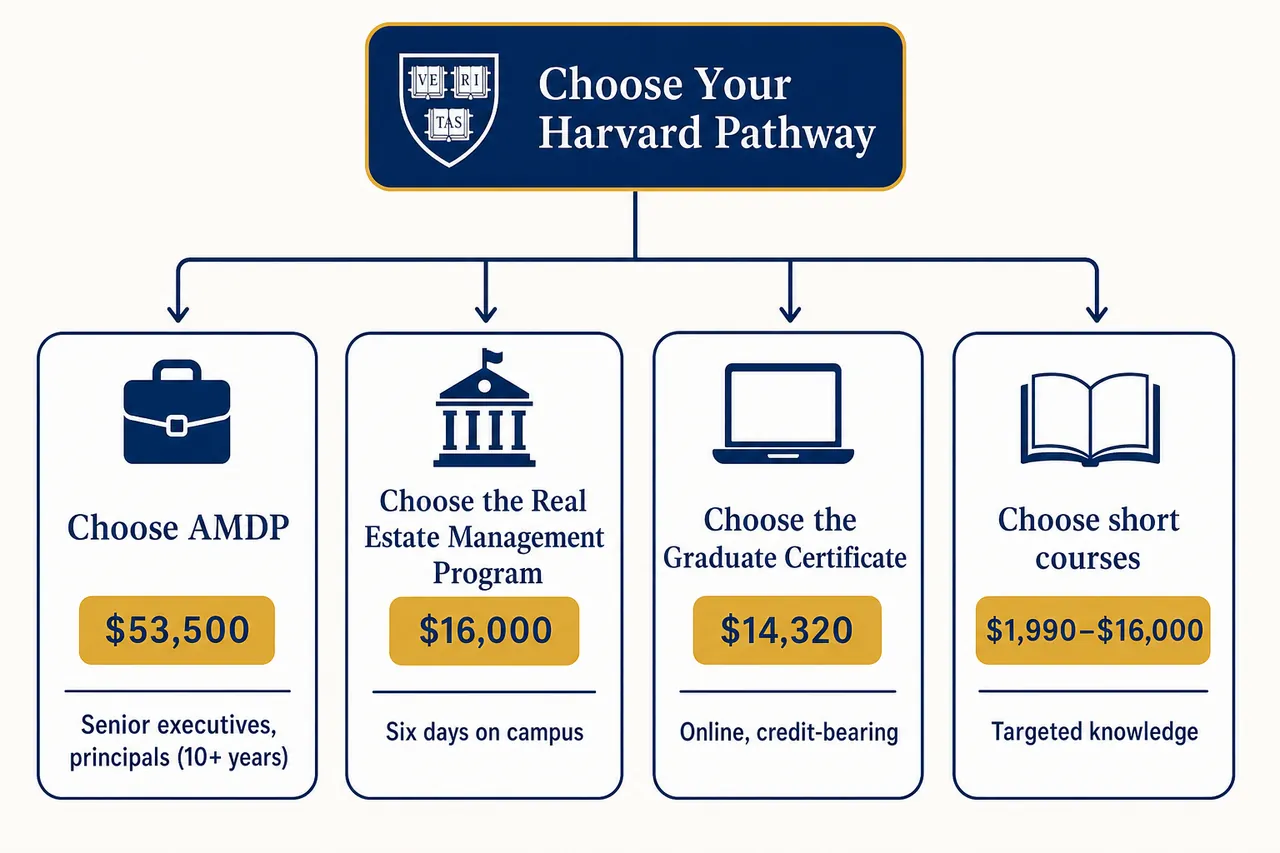
- Choose AMDP if you're running something significant and need a peer group that actually gets it. You're paying $53,500 to reposition yourself at the C-suite level and walk away with an HBS network that'll stay useful for decades.
- Choose the Real Estate Management Program if you need Harvard on your résumé fast. Six days, $16,000, and you get access to both HBS and GSD faculty—that cross-disciplinary model matters if you're doing complex projects.
- Choose the Graduate Certificate if you're running deals now and can't afford to disappear from your business. It's online, credit-bearing, and stacks toward a graduate degree if you want it later. At $14,320, you're getting Harvard's strongest financial analysis curriculum without the full-time commitment.
- Choose short courses ($1,990–$16,000) for precision. Need to sharpen up on development process? AI in real estate? Affordable housing regulations? International markets? Grab the specific course. Length and format vary, so check the GSD Executive Education site for exact pricing on what you need.
Once you've picked your program, don't skimp on the tools. Financial modeling teaches frameworks—your calculators should actually work for real deals. Our cash-on-cash return calculator and DSCR calculator let you stress-test transactions immediately. And if you're in development or flipping? The fix and flip calculator and BRRRR calculator handle the project-level underwriting these programs actually teach.
Back to topFaculty, Teaching Methods, and Learning Environment
Harvard pulls real estate faculty from both HBS and GSD—Senior Lecturers of Business Administration paired with Associate Professors from the Graduate School of Design. This isn't just window dressing. HBS faculty know investment partnerships, capital markets, and asset performance inside out. GSD brings design theory, urban planning, and project delivery to the table. You get instructors who can walk through both the equity return on a deal and why the building itself matters.
The case method is HBS's core teaching tool. You're placed in the decision-maker's seat, working through real, documented business situations with incomplete information and real stakes on the line. For real estate investors, that's gold—deals are situational by nature, and reasoning through ambiguous, high-stakes calls with imperfect data is exactly what this method trains you to do. GSD layers in interactive simulations and design exercises that add spatial and experiential thinking to the financial rigor.
Learning groups—small cohorts within the program—drive peer-to-peer knowledge sharing. And this matters in real estate. Market knowledge is local and experiential. A developer from São Paulo, a lender from Dubai, and an operator from Chicago in the same group? That cross-pollination beats any case study.
Back to topProgram Outcomes and ROI Considerations
Harvard Extension School certificate graduates report a 94% career readiness rate and a 97% recommendation rate. Strong numbers, sure — but your ROI depends entirely on your specific deals and market conditions. Use this framework to actually measure whether the tuition makes sense for you:
- Direct knowledge ROI: Will better financial modeling skills sharpen your underwriting? Can you spot value-add plays you're currently missing or avoid mispricing risk on deals? The national median existing-home price sits at $417,500 as of September 2026. One avoided mistake at that price point pays back the $14,320 tuition several times over.
- Network ROI: You're gaining access to a genuinely global participant base. 39% from North America, 17% Middle East, 16% Latin America, 14% Europe. That's not window dressing — it's real capital sources, deal partners, and market intel you can actually use. If you're expanding regionally, this network becomes a tangible business asset.
- Credential ROI: The Harvard name opens doors. Institutional capital, JV partners, development opportunities — they all move faster when credibility isn't a question mark. You can't put a number on it, but participant testimonials consistently mention this as a serious business development advantage.
If you're weighing education costs against your overall investment strategy, check our breakdown of best banks for real estate investors — capital sources matter when you're building your financial plan. And don't skip our guide on what's worth paying for in real estate mentorship programs. Formal education and mentorship do different jobs, but they complement each other well.
Back to topEnrollment, Application, and Practical Next Steps
Harvard GSD Executive Education splits into two tracks. Admission-only programs like AMDP demand a formal application and review process. Open enrollment programs—the short courses—take participants rolling basis, no gatekeeping. The Real Estate Management Program's application deadline sits one week before start, but don't wait. Seats fill fast and often disappear well before that official cutoff.
The Extension School's Graduate Certificate works differently. You apply to Harvard Extension School first, then pick and choose your courses one at a time. Want to test the material before dropping money on all four courses? This model lets you do exactly that.
And here's something most people miss: bring your team. Organizations that send multiple professionals through the same program build a shared playbook and common language around deal evaluation and investment criteria. That alignment pays for itself when you're debating cap rates or structuring your BRRRR strategy together.
Back to topConclusion: Matching Harvard's Programs to Your Investment Strategy
No other school packs this many formats, price points, and career stages into one portfolio. You've got options ranging from a $1,990 online crash course in real estate finance all the way up to a $53,500 year-long executive program with alumni perks. Working investors who need to sharpen their financial analysis and valuation chops? The Graduate Certificate's your play—online, stackable credits, $14,320 total. It's the most accessible credential on the menu. The joint HBS/GSD Real Estate Management Program is different. It's the only cross-disciplinary experience compressed into that timeframe. And if you're running a shop and ready to block out a full year to reset your position at the top? AMDP defines that category.
What's the actual gap in your business right now? Technical underwriting? Deal leadership? Global network? Formal credential on the resume? Pick the program that closes that specific hole. Use the comparison matrix in this guide to line up your situation, then hit Harvard directly to confirm current pricing, dates, and availability before you apply.
Back to topFrequently Asked Questions
What's the cheapest way to get a Harvard credential in real estate?
Two entry-level short courses — Real Estate Finance 101 and Real Estate Development 101 — cost $1,990 each and you'll get a Certificate of Participation when you're done. If you want something with actual academic credit, the Real Estate Investment Graduate Certificate through Harvard Extension School runs $895 per credit. The beauty here? You take one course at a time.
How does the Harvard Real Estate Investment Graduate Certificate compare to a full master's degree?
Four online courses, $14,320 total, and you're finished. That's the certificate. It's built for working professionals and you can actually stack it toward certain Harvard master's programs if you want to keep going. A full master's? That's a different animal. MIT's MSRED costs $95,108 for 2025–26 and demands full-time or near-full-time hours. Same story at Wharton. Pick the certificate if you need flexibility and laser-focused skills for your deals. Pick the degree if you're chasing an academic or institutional role.
Do Harvard real estate programs require prior real estate experience?
AMDP? Absolutely — that's for senior professionals only. The Real Estate Management Program wants experienced owners, operators, developers, and investors. But the short courses like Real Estate Finance 101 and Development 101 don't care if you've never done a deal. Neither does the Graduate Certificate, technically. You just need to meet Harvard Extension School admission standards and show you're serious.
Can Harvard's real estate programs help me if I'm a real estate agent rather than an investor?
Yes. Short courses and the Graduate Certificate are both worth your time, especially if you're working with investor clients or handling commercial transactions. You'll learn deal structuring, financial analysis, market evaluation — the skills that separate agents from advisors. A Certificate of Completion from the Real Estate Management Program carries weight if you're repositioning into development or advisory work. Want more options at different price points? Our article on best online commercial real estate classes rounds out what's available.
Are there financing or payment plan options for Harvard's real estate programs?
Harvard doesn't advertise installment plans or third-party financing for the short courses. The Graduate Certificate has a built-in advantage though — you pay course-by-course instead of dropping $14,320 upfront. AMDP and the Real Estate Management Program? Call the GSD Executive Education office directly. Payment options aren't public, and they shift from cohort to cohort.
Back to top