


Learn when to hire a real estate tax consultant and how to choose the right specialist to minimize taxes on investment properties and maximize returns.
Table of Contents
- What's a Real Estate Tax Consultant?
- Services Real Estate Tax Consultants Provide
- When You Need a Real Estate Tax Consultant
- Commonly Missed Deductions for Rental Property Owners
- How to Choose a Real Estate Tax Consultant
- Common Real Estate Tax Mistakes to Avoid
- Tax Planning Strategies Worth Discussing with Your Consultant
- Conclusion
- Frequently Asked Questions
A real estate tax consultant specializes in property-specific tax rules that general accountants routinely miss—depreciation schedules, 1031 exchanges, passive loss limitations, entity structuring for rental portfolios. And here's what matters: if you own investment property, your tax situation is fundamentally different from a W-2 employee's. Hire the wrong advisor, and you'll lose more money than the consultant's fee ever cost. This guide walks you through what these specialists actually do, when you need one, and how to evaluate candidates before signing that engagement letter.

What's a Real Estate Tax Consultant?

A real estate tax consultant advises property owners and investors on minimizing tax liability across the full lifecycle of real estate ownership — from pre-purchase entity selection through acquisition, management, and eventual sale or exchange. Unlike a general tax preparer, whose job is largely to record history accurately, a real estate tax consultant works proactively: identifying deductions before you file, structuring transactions before you close, and modeling the tax impact of decisions before you make them.


You're really looking at someone who operates at the intersection of tax law, real estate law, and financial planning. A skilled consultant coordinates with your attorney, lender, and property manager. Every move matters — refinancing, renovation, tenant turnover, portfolio expansion. They make sure tax efficiency is baked into all of it.
Real Estate Tax Consultant vs. CPA vs. General Accountant
Not all CPAs know real estate. That's the critical distinction. Many real estate tax consultants hold CPA licenses, but specialization matters enormously when your portfolio grows complex. The table below breaks down how these roles actually differ.
| Role | Typical Credentials | Specialization | Best For |
|---|---|---|---|
| Real Estate Tax Consultant | CPA and/or Enrolled Agent with real estate focus; may hold CCIM or other real estate designations | Property-specific tax strategy: depreciation, 1031 exchanges, cost segregation, entity structuring | Investors with two or more properties, commercial owners, flippers, developers, multi-state portfolios |
| CPA / Tax CPA | CPA license (state-issued); may have no real estate focus | General tax compliance and planning; breadth varies widely by practice | Business owners and individuals who need broad tax compliance; fine for a single rental if activity is simple |
| General Accountant | May hold CPA or just a bachelor's in accounting; no specialized license required | Bookkeeping, financial statements, basic tax prep | Small businesses needing bookkeeping; not adequate for complex real estate portfolios |
And then there's a real estate tax attorney. Different animal entirely. Attorneys handle the legal disputes — tax court proceedings, IRS audits that escalate to litigation, deed and title issues with tax consequences. Consultants focus on proactive planning and return preparation. For serious investors, you might need both at different stages.
Back to topServices Real Estate Tax Consultants Provide
Tax Planning and Strategy
Before you close a deal, you need forward-looking strategy—not hindsight tax prep. A consultant reviews your acquisition pipeline, recommends optimal purchase timing, projects annual tax costs of holding versus selling, and locks it all into your overall financial picture. Engaging early compounds returns across your entire investing career. This is work that happens before transactions close, not after.
Depreciation and Cost Segregation
Residential rentals depreciate over 27.5 years; commercial over 39. That's the baseline. But a cost segregation study reclassifies building components—flooring, lighting, landscaping, certain electrical systems—into accelerated 5-, 7-, or 15-year classes. For large acquisitions, this front-loads massive deductions in years one through five, sheltering substantial rental income when you need it most.
Your consultant models whether the engineering study pencils out economically for your specific property and coordinates the technical analysis.
When you sell, depreciation recapture hits you at a capped 25% rate under Section 1250, separate from your standard capital gains treatment. A good consultant models this exposure before you list, so you're not shocked at closing.
1031 Like-Kind Exchanges
Section 1031 lets you defer capital gains by swapping one investment property for another. The timing rules are brutal and unforgiving. You've got 45 calendar days to identify replacement property and 180 days to close—or by tax-return due date with extensions, whichever comes first. These rules haven't changed since 2017. Miss either deadline and you lose the entire deferral; the gain recognizes immediately.
Your consultant keeps the clock running, works with the qualified intermediary, and ensures identification notices meet IRS requirements to the letter.
Use our 1031 exchange calculator to estimate deferred gain and available equity before you engage an intermediary.
Capital Gains Tax Planning
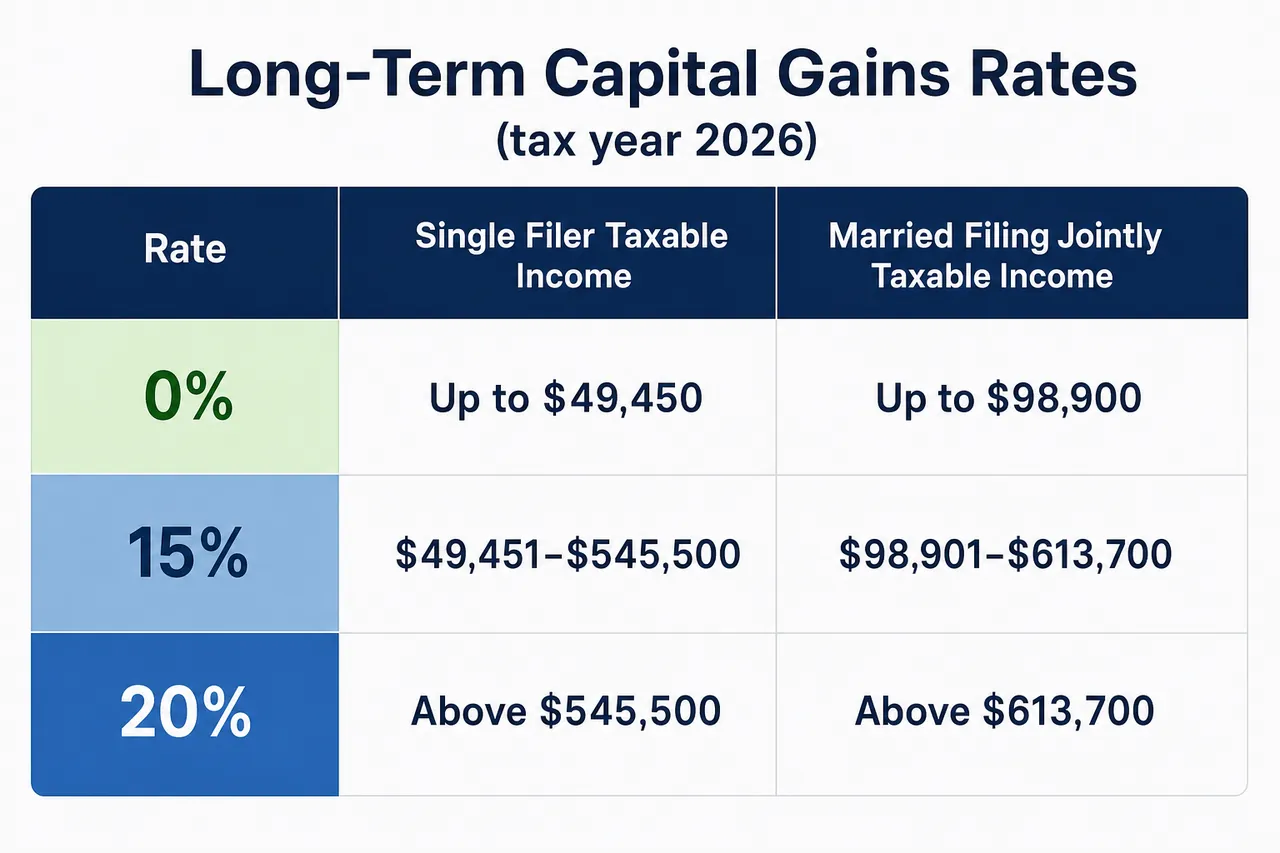
Hold property one year or less and you're taxed at ordinary income rates. Hold it longer than one year and you get long-term treatment. The difference can be enormous. For tax year 2026, long-term rates break down like this:
| Rate | Single Filer Taxable Income | Married Filing Jointly Taxable Income |
|---|---|---|
| 0% | Up to $49,450 | Up to $98,900 |
| 15% | $49,451–$545,500 | $98,901–$613,700 |
| 20% | Above $545,500 | Above $613,700 |
Add in the 3.8% Net Investment Income Tax surtax on net investment income above $200,000 MAGI (single) or $250,000 (married filing jointly), layer on the 20% long-term rate and 25% depreciation recapture, and your effective rate on a large sale can hit 28% or higher—before state taxes touch it. A consultant models this accurately before you sell. Run preliminary numbers with our capital gains tax calculator for real estate.
Passive Activity Loss Rules
The IRS treats rental income as passive. That means losses offset only other passive income—not your W-2 wages or business earnings—unless you qualify for an exception. The biggest one? Real estate professionals who log 750+ hours per year materially participating in real estate can deduct rental losses against ordinary income without limits. For everyone else, the $25,000 rental loss allowance phases out starting at $100,000 MAGI and vanishes entirely at $150,000. Your consultant tracks your documented hours, proves material participation, and structures your portfolio to maximize allowable losses.
Qualified Business Income (QBI) Deduction
If your rental activity rises to the level of a genuine "trade or business," you might qualify for the 20% QBI deduction under Section 199A. The qualification criteria are fact-specific and frequently litigated—especially the question of whether a rental portfolio actually rises to business-activity status.
A real estate tax consultant assesses whether you qualify, documents the business activity required, and determines if a safe harbor election makes sense for your situation.
Entity Structure Selection
Sole proprietorship, LLC, S-corp, or C-corp—your choice has lasting tax and legal consequences. Here's what matters:
| Entity Type | Tax Filing | Pass-Through? | Passive Loss Rules Apply? | Complexity |
|---|---|---|---|---|
| Sole Proprietorship / Schedule E | Personal return (Schedule E) | Yes — directly on Form 1040 | Yes | Low |
| Partnership / Multi-Member LLC | Form 1065; K-1s to partners | Yes | Yes | Medium |
| S-Corporation | Form 1120-S; K-1s to shareholders | Yes | Yes (with material participation rules) | Medium-High |
| C-Corporation | Form 1120 (entity-level tax) | No — double taxation on distributions | No (entity owns assets) | High |
Most residential portfolios live in LLCs taxed as partnerships or disregarded entities. You get liability protection, pass-through taxation, and profit-allocation flexibility. C-corps rarely pencil out for long-term rentals because distributing appreciated property triggers both corporate-level and shareholder-level tax hits. Your consultant evaluates which structure aligns with your risk tolerance, investor count, and exit strategy.
Principal Residence Exclusion vs. Investment Property
Sell your primary home and you may exclude up to $250,000 in gain ($500,000 married filing jointly) under IRC §121—if you've owned and occupied it as your primary residence for at least two of the five years before sale, and haven't claimed this exclusion on another home within the prior two years. Investment properties don't get §121 protection, making the distinction critical.
Your consultant advises on conversion timing and handles the partial exclusion rules that apply when a property had periods of rental use. With September 2026 median existing-home prices at $417,500, many sellers stay well within the exclusion limit. But if you bought years ago or in an appreciating market, your gains might exceed the cap. Pre-sale planning isn't optional in that scenario.
Back to topWhen You Need a Real Estate Tax Consultant

Most investors think they don't need a specialist—until they do. That threshold hits sooner than you'd expect.
- You own two or more investment properties — Passive loss tracking gets messy fast. Depreciation across multiple schedules and cross-property planning will trip up any generalist. This is where complexity lives.
- You're evaluating a 1031 exchange — Miss the 45- or 180-day deadlines, and that's it. No do-overs. Irreversible. A specialist makes sure you don't blow this.
- You're selling appreciated property — Depreciation recapture, NIIT exposure, state tax layering—these need pre-sale modeling. Post-closing regret is expensive and avoidable.
- You hold property in multiple states — Multi-state filing obligations aren't optional. Apportionment rules and state-specific deduction regimes are actually complex. Generalists get this wrong all the time.
- You're transitioning from active employment to full-time investing — Your real estate professional designation, QBI eligibility, and self-employment tax burden all shift at once. And they interact. Our article on when to quit your day job walks through how this transition reshapes your whole tax picture.
- You've inherited property — Stepped-up basis rules, estate tax interaction, the hold-versus-sell-versus-exchange decision—you need a specialist's input immediately, not months later.
- You're purchasing commercial property — Cost segregation opportunities alone can be huge. Add NNN lease structures and 39-year depreciation into the mix, and specialist planning pays for itself at closing.
- You're flipping properties — The IRS might reclassify you as a dealer in real estate. That kills long-term capital gains treatment and 1031 eligibility entirely. A consultant structures your activity to defend the investor characterization and keeps that door open.
A real estate tax consultant isn't a standalone hire. You'll want them as part of your broader advisory team. If you're still assembling one, check our guide on which professionals to hire first—sequencing matters.
Back to topCommonly Missed Deductions for Rental Property Owners
Even if you're working with an accountant, you're probably leaving money on the table. Most investors miss these deductions entirely:
Repairs vs. Capital Improvements
This decision matters more than almost any other tax classification in rental property ownership. A repair brings a property back to working condition and you deduct it fully in the year you pay it. A capital improvement adds real value, extends how long the asset lasts, or repurposes the property—that gets capitalized and depreciated over 5, 15, 27.5, or 39 years depending on what it is. The IRS gives you safe harbors through tangible property regulations. That "routine maintenance" and "small taxpayer" safe harbor? They let you expense items immediately that would otherwise require capitalization. A good consultant applies these aggressively so you're not stuck capitalizing ordinary maintenance. Check our related article on over-improvement in real estate for the right call on when renovations stop paying for themselves.

| Expense Type | Deductible? | Treatment | Examples |
|---|---|---|---|
| Repairs | Yes — immediately | Deducted in full in year paid (Schedule E) | Patching roof leak, replacing broken window, repainting between tenants |
| Capital Improvements | Yes — over time | Capitalized and depreciated over recovery period (5, 15, 27.5, or 39 years) | New roof, HVAC replacement, adding a bathroom, structural additions |
| Personal Use Expenses | No (or pro-rated) | Allocate between personal and rental use days for vacation/mixed-use property | Portions of a vacation home used personally; primary residence improvements |
| Professional Services | Yes — immediately | Deducted in full (management fees, legal, accounting, consulting) | Property management fees, attorney fees, tax consultant fees, appraisal fees |
Other Frequently Overlooked Deductions
- Mortgage interest on investment property loans — deductible without the limits that cap primary residence mortgage interest
- Property taxes — fully deductible on rental property; the SALT cap doesn't touch Schedule E rentals
- Travel and vehicle expenses — drive to inspect properties, collect rent, or meet with contractors? That's deductible. Keep IRS mileage documentation though
- Home office deduction — managing your portfolio from a dedicated home office space? A portion of your home expenses are deductible
- Insurance premiums — landlord liability, hazard, umbrella coverage—all deductible
- Utilities paid by landlord — if your lease puts the utility bill on you, it's deductible
- Depreciation — this one kills investors who self-prepare taxes. Skip claiming it and the IRS recaptures it on sale anyway. Failing to take depreciation costs you twice
How to Choose a Real Estate Tax Consultant
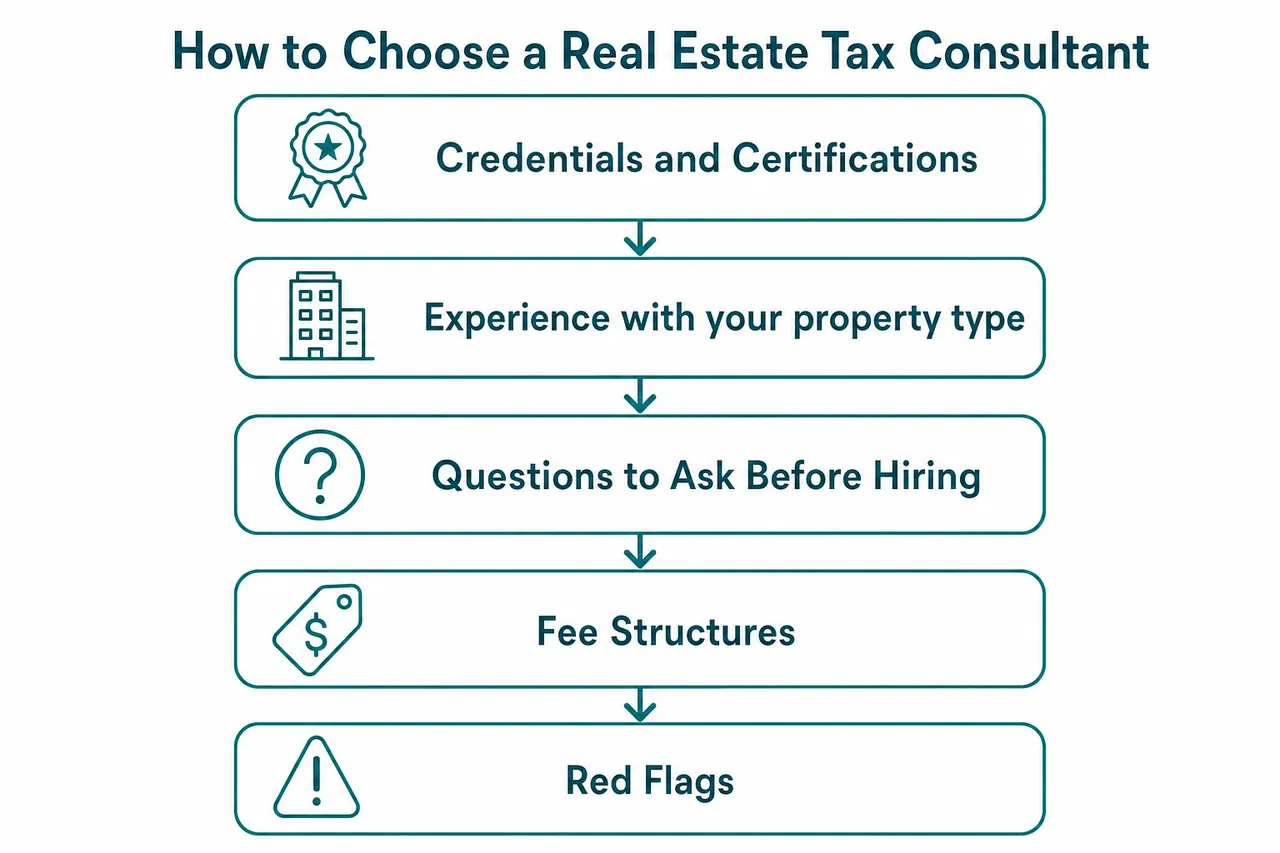
Credentials and Certifications
You need two things above all else: a Certified Public Accountant (CPA) license or an Enrolled Agent (EA) designation. CPAs are licensed by state boards and can represent you in front of the IRS. Enrolled Agents get their federal license directly from the IRS and live and breathe tax strategy. Many EAs know real estate inside and out without holding a CPA license at all. Beyond those two, look for the CCIM (Certified Commercial Investment Member) credential or advanced tax study—a Master of Science in Taxation or LL.M. in Taxation signals someone who's serious about depth.
But a fancy credential means nothing if they don't specialize in real estate. Ask how many of their clients invest in real estate, and what size and complexity their typical deals run. That answer tells you everything.
Questions to Ask Before Hiring
| Category | Questions to Ask | What a Strong Answer Looks Like |
|---|---|---|
| Experience | What percentage of your clients are real estate investors? Have you handled cost segregation, 1031 exchanges, or multi-state portfolios like mine? | Real estate is a primary focus; can describe specific, complex deals handled |
| Credentials | Are you a CPA, Enrolled Agent, or both? Do you've authority to represent me before the IRS? | CPA or EA license confirmed and in good standing; offers to provide license number |
| Proactive Planning | How do you approach year-end planning? Will you contact me before significant deadlines? | Describes a structured calendar of check-ins; mentions quarterly reviews, not just annual filing |
| Fee Structure | How do you charge — hourly, flat fee, or retainer? What's included, and what triggers additional fees? | Clear written engagement letter; no vague "we'll see what it involves" answers |
| Communication | Who will actually work on my account? How quickly do you respond to questions between filing seasons? | Names a specific point of contact; states a typical response-time standard |
Fee Structures
Three models dominate: hourly rates for advisory and planning work, flat fees per return at tax time, or a monthly or annual retainer covering ongoing planning, quarterly check-ins, and return prep. Rates swing wildly depending on your market, portfolio complexity, and the firm's size. Get a written estimate in that first consultation. Then grab two or three competing quotes and compare them side by side. Don't go for the cheapest option. A consultant who sleeps on a cost segregation opportunity or misses a 1031 exchange identification deadline costs you far more than whatever you save on their fee.
Red Flags
- Guarantees a specific refund or tax outcome before reviewing your documents
- Charges fees as a percentage of your refund — a structure that creates incentives for aggressive positions
- Can't explain the basis for a deduction or strategy in plain language
- Has no written engagement letter or clear scope of services
- Recommends aggressive positions without discussing audit risk
- Has no experience with your specific property type (e.g., recommends themselves for a commercial portfolio when their practice is exclusively residential)
Building out your full advisory team? Our guides on when to hire a real estate investing advisor and how to choose commercial real estate brokers walk through the same vetting framework for other roles you'll fill.
Back to topCommon Real Estate Tax Mistakes to Avoid

Failing to Track Depreciation Correctly
The IRS will tax depreciation recapture whether you claimed the deduction or not. That's non-negotiable. Self-prepared investors who skip depreciation deductions end up paying twice: they miss the annual deduction benefit AND still owe recapture tax at sale. A consultant calculates depreciation properly from day one of ownership and saves you from that trap.
Misclassifying Flipping Activity as Investment Activity
The IRS has a bright-line distinction here: investors hold property for appreciation and rental income. Dealers buy and sell in the ordinary course of business. That difference matters enormously. Dealers can't use 1031 exchanges, and their gains get taxed as ordinary income instead of capital gains—you're looking at a significantly higher tax bill. Flip frequently? A consultant structures your activity across separate entities and documents your investment intent for hold properties to preserve investor status wherever possible.
Ignoring Multi-State Filing Obligations
You own rental property in Colorado but live in Florida? Every state where that property sits probably requires a state income tax return reporting that income. Some states have aggressive nexus rules. Others impose withholding on non-resident sellers. A consultant maps your filing obligations across all jurisdictions and keeps you off the penalty list—and away from potential criminal liability in some states for non-filing.
Poor Record-Keeping
Can't substantiate it? You can't deduct it. That's the IRS rule, and you need to follow it. For real estate, this means: receipts for every repair and improvement, mileage logs with dates and business purpose, depreciation schedules back to acquisition, and documentation for any property converted between personal and rental use. The statute of limitations runs three years from filing—but stretches to six years if the IRS thinks you understated income by over 25%. And if fraud gets alleged, there's no time limit at all. Record-keeping isn't something you do for one filing season. It's permanent.
Waiting Until Tax Season to Engage Your Consultant
Calling in January? That's compliance work, not strategy. Real tax planning happens before deals close. Timing a sale across two tax years. Selecting entity structure before closing. Initiating a cost segregation study in year one. Those moves require a consultant in the game early. Call them when you're evaluating the deal, not after you've already signed the papers.
Back to topTax Planning Strategies Worth Discussing with Your Consultant
Opportunity Zones
You've just cashed out of a deal. Now what? A Qualified Opportunity Fund lets you defer those capital gains—and if you hold long enough, you can potentially exclude the appreciation inside the fund from taxation entirely. The rules get complicated fast, and which fund you pick matters enormously. If you've realized capital gains from anything—real estate, stocks, whatever—that you're looking to redeploy, bring this up with your consultant.
Strategic Timing of Sales
Selling in December versus January moves your taxable income into different tax years. When you're sitting near the edge of a capital gains bracket or the NIIT threshold, timing alone can determine whether your gain gets taxed at 0%, 15%, or 20%. That's real money. Our real estate exit strategies guide walks through the hold-versus-sell decision in detail; pair that with your consultant's tax modeling and you'll see the full picture.
Estate Planning Coordination
When appreciated property transfers at death, it gets a stepped-up cost basis to fair market value on the date of death. All those capital gains that piled up? Gone. For property you've held for years and watched climb in value, hold-until-death can be genuinely powerful. Make sure your real estate tax consultant talks to your estate planning attorney about your ownership structure—revocable trust, irrevocable trust, direct ownership—so nothing accidentally kills the step-up benefit.
Portfolio Analysis Before Major Decisions
Before you buy another property, model the after-tax cash flow with our rental property calculator. Before a refinance? Run it through our cash-on-cash return calculator. You'll give your consultant a solid baseline—and then they can layer in the tax strategy. Which properties deserve to stay in the portfolio? Which ones should you exchange? Which should you sell outright as part of your overall buy-hold-sell strategy?
Back to topConclusion
Forget the idea that a real estate tax consultant is just for the big players. Once your investments hit a certain complexity—multiple properties, mixed entity structures, significant depreciation—you need one. The tax code doesn't care how many units you own. Depreciation, 1031 exchanges, passive loss rules, cost segregation—it's all interwoven and changes yearly. A specialist who eats and sleeps real estate tax will catch deductions your CPA never sees, structure deals to dodge unnecessary tax events, and document everything so the IRS has nothing to challenge.
When should you call? Before your next deal closes. Not after you're staring at a 6-figure tax bill in April. Use the criteria we outlined—real estate credentials, track record with investors like you, genuine proactive planning (not just tax return preparation), and fees that make sense. Find someone who fits your portfolio, then keep them. Lock them into your circle permanently, right alongside your attorney, your lender, and your property manager. That's how you build wealth instead of handing it to the government.
Back to topFrequently Asked Questions
What's the difference between a real estate tax consultant and a real estate tax attorney?
A real estate tax consultant — usually a CPA or Enrolled Agent — builds your tax strategy, preps your returns, and keeps you moving forward year after year. A real estate tax attorney steps in when things get messy: IRS disputes, tax court, litigation, and deals where legal title or contracts collide with tax outcomes. You'll probably need both. The consultant keeps you out of trouble. The attorney gets you out when you're in it.
Can I use my regular CPA instead of hiring a real estate tax specialist?
Maybe. But ask your CPA one specific question: what percentage of your practice is real estate investors, and what does that work actually look like? If they're mostly handling W-2 earners and small service businesses, they're probably not your person. One missed cost segregation study. One blown passive loss strategy. One botched 1031 exchange. Any of those costs you more than you'd ever pay a specialist. That's not theoretical.
How far in advance should I contact a real estate tax consultant?
Before you close. Before you list. Before year-end. Don't wait until April. The real value happens early — when you're deciding on entity structure, timing a cost segregation study, or setting up a 1031 exchange. These moves only work if they're in motion before or immediately after closing. Calling your consultant in January means you're buying compliance. Calling them in October means you're buying strategy.
Are real estate tax consultant fees themselves deductible?
Yes — if they're tied to your rental properties. You'll deduct them on Schedule E as an ordinary and necessary business expense. But fees for personal stuff — your W-2 income, itemized deductions — won't work. Most consultants invoice the rental and personal portions separately, or they'll split the fee based on how they actually spent the hours.
What records should I keep to support my real estate tax deductions?
Receipts and invoices for repairs, improvements, and all professional services. Keep mileage logs — dates, destinations, business purpose — for every property trip you make. Grab depreciation schedules and original settlement statements for every property you've owned. Store your insurance declarations and mortgage statements too. Lease agreements with move-in and move-out dates matter. Hold onto everything for at least six years from when you filed that return. If there's any chance you underreported income, keep the records longer.
Back to top