


Discover the complete checklist of property management duties and responsibilities. Learn what managers handle—from tenant screening to legal compliance—to
Products and Tools Mentioned in this Post


Table of Contents
- What's a Property Manager?
- Core Responsibilities and Daily Duties
- Administrative and Legal Tasks
- Financial Management Duties
- How Property Managers Actually Organize Their Work
- Essential Skills and Qualifications
- Education, Licensing, and Career Path
- Compensation and Job Market
- Summary
- Frequently Asked Questions
A property manager is the person running your rental property day-to-day—they screen tenants, collect rent, handle legal stuff, track finances, and basically keep everything operational while you focus on other deals. If you're considering hiring one or thinking about the role yourself, you need to know exactly what's on their plate so you can hire the right person, hold them accountable, and actually protect your capital.
New to long-term rental? Start with our Long-Term Rental Investing Guide.
This checklist breaks down every major responsibility. You'll know what to look for and what performance actually looks like.

What's a Property Manager?

You hire a property manager to handle the daily grind of running your rental properties. It's a principal and agent setup—you keep the ownership stake and long-term investment returns while they handle the operational decisions within the bounds of your management agreement. They're licensed professionals or firms who make the calls that need making so you don't have to.
Three main asset classes fall under property management work:
- Residential: Single-family rentals, multifamily apartments, condos, and townhomes. Most managers start here because the volume is highest and tenant interaction is constant.
- Commercial: Office buildings, retail centers, and mixed-use properties. Leases run longer and are way more complex. CAM reconciliations alone can eat up serious time, and tenant relationships shift the dynamic entirely.
- Industrial: Warehouses, distribution centers, and manufacturing facilities. Triple-net (NNN) structures push most operating costs to tenants, which simplifies your math. But compliance requirements and infrastructure headaches are real.
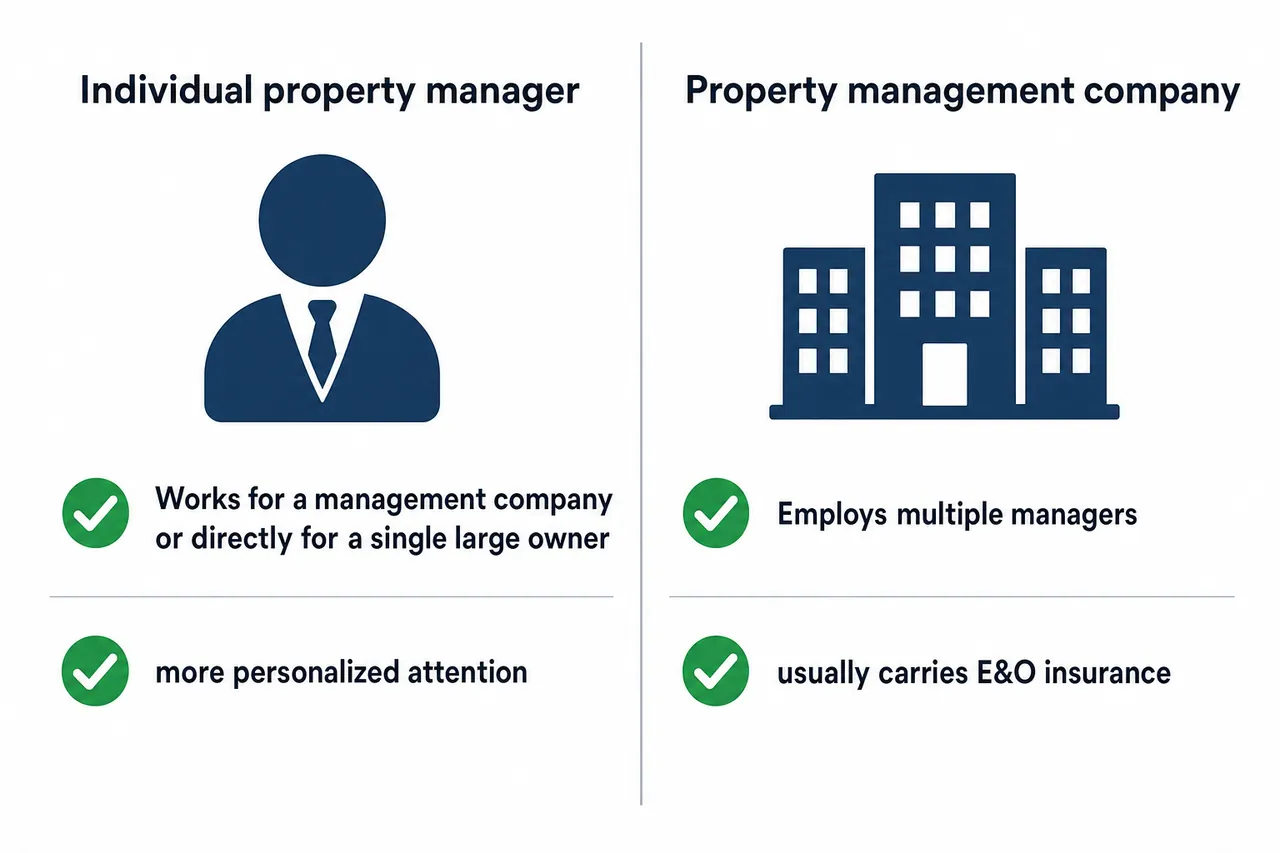
An individual property manager works for a firm or directly for a single large owner. A property management company is different—it has multiple managers on staff, systems backing them up, and E&O insurance in place to cover their mistakes. If you're weighing your options right now, check out our article on Airbnb Property Management: Self-Manage vs Hire Out. It breaks down the self-management versus outsourcing question in detail.
Back to topCore Responsibilities and Daily Duties
Tenant Management and Relations

Tenant management eats up most of your manager's calendar. It doesn't start when they sign the lease—it starts the moment you open applications—and doesn't end until the final walkthrough.

Screening and placement means pulling applications, running credit and background checks, verifying employment and rental history, then making the call on who moves in. The Fair Housing Act (42 U.S.C. §§3601–3619) protects 7 federally protected classes: race, color, national origin, religion, sex, familial status, and disability. And that's just the federal floor. Many states and municipalities add their own protected categories—sexual orientation, source of income, housing status, and more. If you're managing across multiple jurisdictions, you need to know what your local laws require, not just the federal minimum. Break the rules, and you're looking at penalties that sting: a first HUD violation costs $26,262. A second one within five years jumps to $65,653. Two or more violations within seven years? That's $131,308 (2026 figures, frozen at 2025 levels per OMB Memo M-26-11).
Move-in and move-out coordination hinges on paperwork. At move-in, you do a room-by-room inspection with photos, document what you see, and get the tenant's signature on a written record. Use our Move-In Checklist Template to standardize it. Move-out flips the process to justify any security deposit deductions. Between tenancies, coordinate cleaning, repairs, and prep work. Our Rent-Ready Checklist walks the full scope.
Ongoing tenant relations—that's maintenance requests, lease enforcement, complaint resolution, and multifamily mediation. When violations happen, follow a documented escalation process. Serious or repeated violations? That may lead to eviction. And here's where state law matters: eviction procedures vary wildly by jurisdiction, so you need to know your state's unlawful detainer statutes cold.
Rent Collection and Accounting
Rent collection is your financial heartbeat. Set clear payment procedures: due dates, accepted methods (ACH, online portals, certified check), grace periods, late fee schedules. Late fee caps differ by state and aren't standardized nationally, so know your state's limits and disclose everything in the lease before you collect anything.
Rent doesn't show up? Issue a formal pay-or-quit notice within your state's timeframe (usually three to five days) and escalate to collections or eviction. All rent goes into a dedicated trust or escrow account—never mix it with operating funds.
At the portfolio level, it matters. With a national rental vacancy rate of 7.6% as of Q3 2026 and median asking rent at $1,531/month as of Q2 2026, even small vacancy gaps or collection hiccups damage your NOI. Use our Rental Property Calculator to model the impact on your specific deal.
Property Maintenance and Repairs
Routine upkeep, emergency repairs, preventive programs, capital improvements. That's the full spectrum. Managers field maintenance requests through ticketing systems or property software, assess urgency, dispatch contractors, track completion, and log everything in the property's history.
Vendor management is where many managers make or break their reputation. You build a roster of licensed, insured contractors—plumbing, HVAC, electrical, landscaping, cleaning. You negotiate rates, verify insurance and licenses, bid out larger projects, and ensure work meets code. Managing across multiple jurisdictions? You'll need to track code variations. What passes in one city won't in another.
Emergency response separates the pros from the also-rans. Burst pipes, electrical fires, gas leaks, security breaches—these demand 24/7 response or a formal after-hours protocol with a qualified service. Miss the window and you're facing habitability violations, tenant injury claims, and serious property damage.
Before you close on a property, understand what deferred maintenance you're inheriting. Our Real Estate Investment Property Inspection Checklist shows what to look for before you buy.
Property Marketing and Tenant Acquisition
Every vacant day costs you money. Start with competitive rent pricing based on comps and vacancy data, then add professional photography and sharp copy on Zillow, Apartments.com, Realtor.com, and Facebook Marketplace. Running short-term rentals? Airbnb and VRBO need separate optimization.
Beyond the listing, you need to understand what drives demand locally: employment hubs, schools, transit access, seasonal patterns. A unit near a university? Expect May turnover. A resort property? Plan for seasonal peaks and valleys. Align your lease terms and marketing timing to those patterns, and you'll cut turnover costs. Thinking about short-term rentals? Our guide on Airbnb self-management vs. hiring out breaks down the operational realities side-by-side.
Financial Reporting and Owner Communication
Owners expect monthly income and expense statements, maintenance summaries, and an annual report clean enough for tax prep. The annual report needs clear expense categories because residential rentals depreciate over 27.5 years using MACRS GDS (straight-line, mid-month convention), which yields 3.636% of depreciable basis annually—your owner's CPA will need that broken out from land and improvements.
Good managers communicate proactively. Lease renewals coming up? Mention it. Major maintenance event? Report it. Market rents shifting? Flag it. Regulatory changes on the horizon? Give owners time to adjust. The question every investor asks is whether professional management justifies its cost. Industry standard runs about 8.49% of collected monthly rent, with typical ranges from 8–12%. For a full cost breakdown to help you decide, check our article on How Much Does Property Management Cost: Complete 2026 Breakdown.
Back to topAdministrative and Legal Tasks
Lease Management and Documentation
Your lease agreement is your first line of defense. Property managers draft, review, and execute leases that comply with state landlord-tenant law—and that compliance matters. A solid lease covers the obvious stuff: rent amount, due date, late fees. But it also needs to spell out security deposit terms and handling, maintenance responsibilities, entry notice requirements, pet and parking policies, subletting restrictions, and renewal terms.
At lease end, the manager's job is to decide: renew at market rate, non-renew within the legal window, or start turnover. Each choice hits your bottom line differently.


Security deposit caps aren't federal—they're state-by-state, and they change. California rewrote its limits under AB 12 (effective 2024). Your manager needs to verify the current statute before collecting a dime. Hold deposits in a non-compliant account, skip the required disclosures, or miss the return deadline, and you're personally liable. That's not a gray area.
Record-Keeping and Compliance
Document everything. Maintenance requests. Responses. Lease violations. Payment histories. Emails. Inspection reports. Any tenant interaction that could land in court should live in your file. The difference between winning and losing a security deposit dispute—or an eviction—is often just paper.
And compliance isn't just about tenants. Managers track the building itself: certificate of occupancy status, smoke and CO detector inspections, elevator certifications, lead-based paint disclosures (required for pre-1978 properties), and energy benchmarking requirements if your jurisdiction mandates them.
Insurance, Liability, and Risk Management
You carry the property insurance policy. Your manager doesn't. But they're the boots on the ground managing risk—and that's where liability actually lives.
Before any vendor sets foot on your property, the manager verifies general liability and workers' compensation coverage. A contractor gets injured without coverage? That becomes your problem. They also document property conditions to support insurance claims and coordinate with your insurer after incidents. Many management companies carry their own E&O and general liability coverage too. It protects both of you.
Back to topFinancial Management Duties

Depositing rent checks isn't financial management. Property managers build an annual operating budget that stacks projected income against maintenance, insurance, taxes, utilities for common areas, management fees, and vacancy reserves. This budget becomes your benchmark—the number you measure every month's actuals against.
Your expenses won't match the budget perfectly. When they don't, a sharp manager digs into why and explains it to you in context. A $4,000 HVAC replacement looks like a shock until you realize it was a planned capital expenditure. Want to see the real impact on your investment? Pull your cap rate and cash-on-cash return. Use our cap rate calculator and cash-on-cash return calculator—they'll tell you if that HVAC bill actually hurt your returns.
Trust accounting isn't optional. Your funds stay completely separate from operating accounts and from other clients' money. It's a legal requirement in every state and the manager's core fiduciary duty.
Back to topHow Property Managers Actually Organize Their Work
| Category | Key Duties |
|---|---|
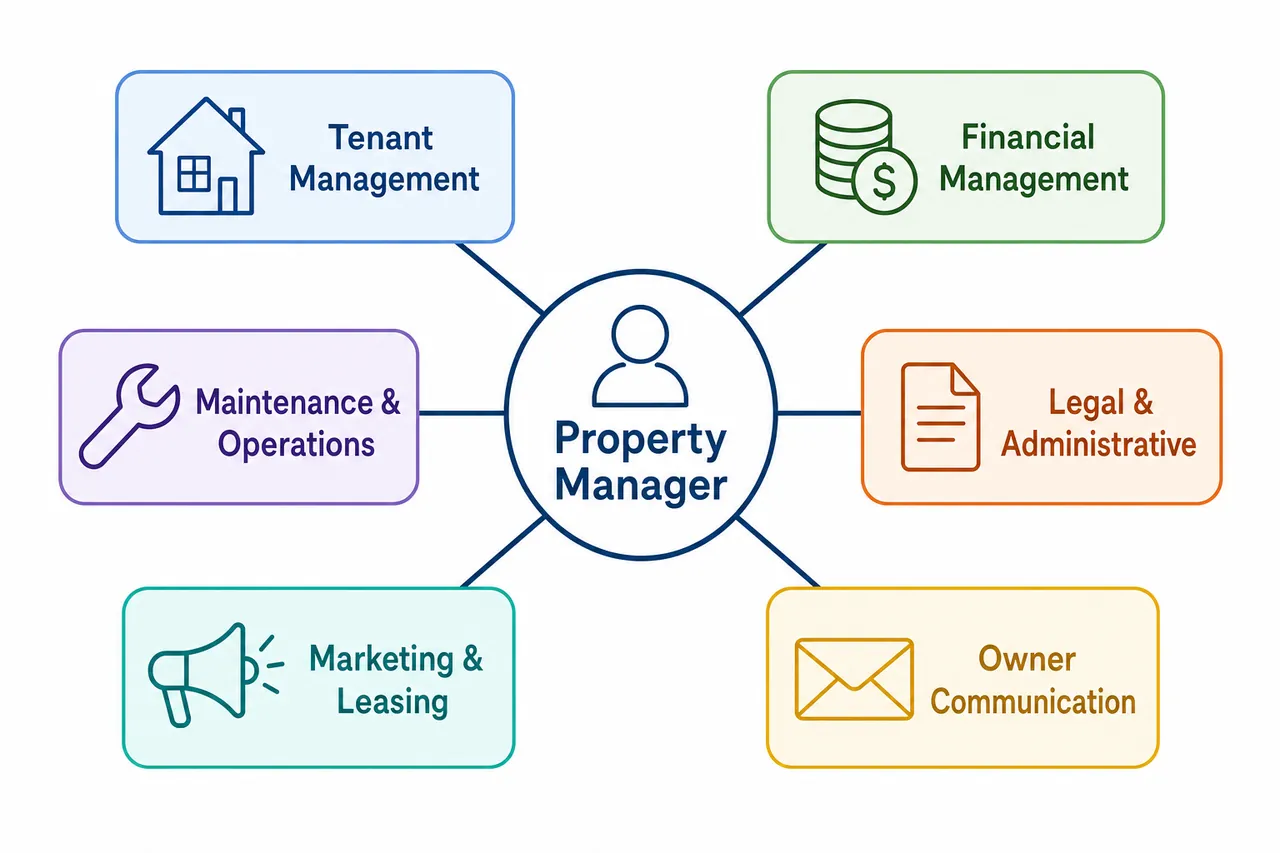
| Tenant Management | Screening & placement, lease execution, move-in/move-out coordination, complaint handling, lease enforcement, eviction processing |
| Financial Management | Rent collection, trust accounting, operating budgets, monthly/annual reporting, expense control, owner distributions |
| Maintenance & Operations | Maintenance request triage, vendor dispatch, preventive maintenance programs, emergency response (24/7), capital project coordination |
| Legal & Administrative | Lease drafting and renewals, Fair Housing compliance, record-keeping, regulatory filings, security deposit management, insurance coordination |
| Marketing & Leasing | Pricing analysis, listing creation and syndication, showings, application processing, tenant screening, vacancy minimization |
| Owner Communication | Monthly financial statements, maintenance updates, market rent reviews, renewal recommendations, regulatory change notices |
Essential Skills and Qualifications
Communication and Interpersonal Skills
You're talking to someone new every single day. Tenants call with complaints (sometimes angry ones). Owners want updates on their investment. Vendors need crystal-clear work orders and deadlines. Occasionally, you're dealing with attorneys or court paperwork. Your written communication has to hold up legally; your verbal skills need to calm things down without you making promises you can't keep.
Problem-Solving and Conflict Resolution
Property management doesn't follow a script. The pipes burst at 8 a.m., a tenant escalates a dispute by noon, and your owner is calling about lease renewals by 2 p.m.—all on the same day. You've got to prioritize ruthlessly, make solid calls under pressure, and write down why you made them. Conflict resolution isn't just soft skills either. You're managing disputes between neighbors, fighting with tenants over security deposits, pushing back on vendors who charge too much for sloppy work. It takes both procedural knowledge and actual interpersonal ability.
Technical, Financial, and Organizational Competencies
You don't need to fix the HVAC yourself. But you absolutely need enough technical knowledge to review a contractor bid and catch when someone's overdiagnosing a problem or padding the invoice.
On the financial side? You're reading income statements, analyzing budget variance, and tracking tax implications for common expense categories. The 27.5-year depreciation schedule for residential rentals matters for your owners' tax planning, and you need to understand it.
Organization separates the sharp operators from the sloppy ones. Each property runs on its own lease renewal calendar, maintenance schedule, insurance renewal dates, and compliance deadlines. Miss a lease renewal notice window in the wrong state and you've accidentally converted a fixed-term lease to month-to-month. That's a costly mistake.
Technology and Software Proficiency
Software is your foundation now. Platforms like AppFolio, Buildium, and others consolidate everything—tenant communication, online rent collection, maintenance tickets, accounting, owner reports—into one system. We've reviewed AppFolio, Buildium, and compiled our Best Property Management Software 2026 guide with the top platforms broken down in detail. Managers running on spreadsheets and email threads? They lag on response times, their records are incomplete, and owners see it in the reporting quality.
Back to topEducation, Licensing, and Career Path
You don't need a four-year degree to break into property management. That's one of the biggest advantages of this career path. Most successful managers came up through related work—leasing agent, facilities coordinator, real estate sales, hospitality—and learned on the job. The flexibility here beats a lot of other real estate careers.
Licensing Requirements
This is where it gets tricky. Each state makes its own rules, and they're all different. Some states require property managers who collect rent or negotiate leases to have a real estate broker or salesperson license. Others have their own dedicated property management license with a separate exam. Then you've got states with minimal licensing but strict regulatory teeth—trust accounting rules, disclosure requirements, the whole nine yards.
And here's what most people miss: city and county rules layer on top of state requirements. You can't just check one box and move on. You need to contact your state real estate commission directly and get the actual current standards for your jurisdiction. No national standard exists.
Professional Certifications
The Certified Property Manager (CPM) designation from the Institute of Real Estate Management (IREM) is the gold standard. It's what people recognize and respect. You'll complete coursework in financial management, asset management, risk management, and leadership, plus you need documented management experience on your resume. If you're managing commercial or large multifamily portfolios, this credential opens doors.
Beyond that? The National Apartment Association offers NALP (leasing) and CAM (apartment management). The National Association of Residential Property Managers provides RMP and MPM credentials. IREM also offers ARM for newer managers just starting out.
Back to topCompensation and Job Market
What you'll make as a property manager depends on four things: how many units you're managing, what type of properties, where you're located, and whether you're employed or independent. Residential property managers typically earn $50,000–$75,000 a year. Run a large commercial portfolio or work in a coastal market? You'll push well past that ceiling. For the most current wage data on property and real estate managers (SOC 11-9141), hit up the BLS Occupational Employment and Wage Statistics directly—that's where the real numbers live.
Three compensation models dominate the space:
- Salaried employment: You work for a property management company or a large individual owner. You get a steady paycheck and benefits. The trade-off? Your upside is capped.
- Fee-based / commission: This is how most independent managers and small firms structure it. The industry standard runs 8.49% of collected monthly rent, and you can layer on extra fees for leasing, maintenance coordination, and renewals. Your income moves in lockstep with portfolio size and actual collections.
- Hybrid: Base salary plus a cut of the management fees. Growing management companies use this to push their team to build the book of business.
Portfolio size is everything for independent operators. Take 50 single-family rentals averaging $1,531 per month. At 8.49%, you're looking at roughly $77,000 in annual management fees before you pay a dime in overhead. Double that to 100 units and the math shifts dramatically. That's why property management software isn't a luxury—it's the only way to handle per-unit economics and actually stay profitable.
Before you hire a manager, you need to run the NOI math. Use our Rental Property Calculator to see exactly how the management fee hits your returns. If you're buying your first rental and deciding how to structure things from scratch, our First Rental Property guide walks through the full framework.
Back to topSummary
Property management touches everything. Tenant relations. Legal compliance. Financial oversight. Maintenance operations. Marketing. All of it happens at once, across one or more properties. And for investors, that's the critical insight: every single item on this checklist is real operating risk if nobody's handling it right. Aspiring managers need to understand why the role demands so much—and why owners will pay for someone who executes it well.
What separates good managers from mediocre ones? They're organized enough to track dozens of deadlines without dropping anything. They communicate across tenants, vendors, lenders, and owners without letting messages fall through cracks. And they know real estate law well enough to recognize when a situation needs an attorney's signature instead of their judgment call.
Software used to be a competitive advantage. Now it's table stakes. Property management platforms, online payment systems, digital maintenance logs—they've absorbed most of the administrative grunt work. If you can't navigate the software stack, you can't do the job. Period.
Use this checklist whether you're hiring a management company for your portfolio or hiring yourself to build one. Look at each responsibility area: Is it covered? Who owns it? How's it tracked?
Back to topFrequently Asked Questions
What's the most important duty of a property manager?
Everything's interconnected, so there's no single answer. But Fair Housing compliance and trust accounting? Those are your exposure landmines. Mess either one up and you're looking at license revocation, civil penalties, and personal liability for both the manager and owner. After that, consistent rent collection and solid tenant screening drive your actual ROI month to month.
Do property managers need a real estate license?
Most states say yes. If you're collecting rent, negotiating leases, or listing properties for rent, you'll need either a real estate license (broker or salesperson level) or a dedicated property management license. Requirements vary wildly by state and sometimes even by city. Check with your state's real estate commission before you hang your shingle—operating without a required license can torpedo management agreements and bury you in liability.
How much do property managers typically charge?
Residential property management runs about 8.49% of collected monthly rent on average, with most shops falling between 8–12%. But that's just the base. Add separate fees for leasing (placing a tenant), lease renewals, maintenance coordination, and vacancy periods on top. For the full breakdown of what this actually costs you, dig into our How Much Does Property Management Cost: Complete 2026 Breakdown.
What's the difference between a property manager and a property management company?
An individual property manager handles your day-to-day operations directly. A property management company is an actual entity with multiple managers, support staff, and systems running the show. Companies carry E&O insurance, maintain established vendor networks, and deploy enterprise-grade software—that's real risk management and consistency for owners with bigger portfolios. Individual managers? They often deliver more white-glove service and charge lower fees if you're running a smaller portfolio.
What technology do property managers use?
You need purpose-built property management software. Period. Platforms like AppFolio and Buildium handle online rent collection, maintenance ticketing, tenant screening, lease storage, accounting, and owner reporting all in one system. Our AppFolio vs. Buildium comparison and Best Property Management Software 2026 guide break down the leading platforms by portfolio size and what you actually need.
Back to topMore on long-term rentals: guides and how-tos
- How to Buy Your First Rental Property: Complete No-Experience Playbook
- Real Estate Lease Template: Essential Clauses & Legal Protections
- HELOC for Investment Property: How to Fund Rentals with Home Equity
- How to Improve Your Tenant-Landlord Relationship: Communication Tips
- How to Go From 1 to 10 Rentals with The Stack Method
- Rent Ledger Template: Free PDF & Spreadsheet for Tracking Tenant Payments
See our guide: “Long-Term Rental Investing: A Practical Buy-and-Hold Guide” →