


Discover real estate CRM secrets that top producers use to build winning systems. Learn advanced features and workflow optimization to convert more leads.
Products and Tools Mentioned in this Post

Follow Up Boss
Follow Up Boss is a real estate CRM that helps agents manage leads, automate follow-up, and increase conversions. Streamline your sales process today.
Wise Agent
Wise Agent is a comprehensive real estate CRM offering contact management, transaction tracking, email marketing, and automation tools for agents and brokers.
Top producers aren't winning because they use better CRM software — they're winning because of how they configure and actually use it. With 90% of buyers and 92% of sellers using an agent in the July 2025–June 2026 transaction period (both record highs according to the NAR 2026 Profile of Home Buyers and Sellers), you'd think every agent would be drowning in repeat business. They're not. Most agents watch past clients walk to competitors every single year because they never built a system to stay connected. This guide walks you through the five decisions that separate a CRM that generates deals from one that just sits there.

What a Real Estate CRM Actually Does — and What It Doesn't
A CRM is a database with workflow automation built in. For real estate investors and agents, it stores contact records, logs every touchpoint (calls, texts, emails, showings), triggers follow-up sequences, and routes inbound leads to the right person. Want the full breakdown? Check out our guide on what a real estate CRM is and the 7 features that matter most.
But it won't replace your judgment. It won't write compelling offers. It won't guarantee conversions. A CRM is a force multiplier — not a substitute for actual real estate skill. And this matters because plenty of agents lean hard on automation while never picking up the phone, then wonder why leads disappear.
The numbers tell you why this actually matters. The NAR 2026 Profile of Home Buyers and Sellers found something brutal: 88% of buyers say they'd reuse or recommend their agent. Only 24% actually did. That 64-point gap? Almost entirely follow-up failures. A solid CRM closes it.
Back to topSecret #1: Match the CRM to Your Business Type Before Everything Else

Buying a CRM built for someone else's business? That's the most expensive mistake you'll make with this software. The wrong platform will bloat your costs and slow your team down for years.
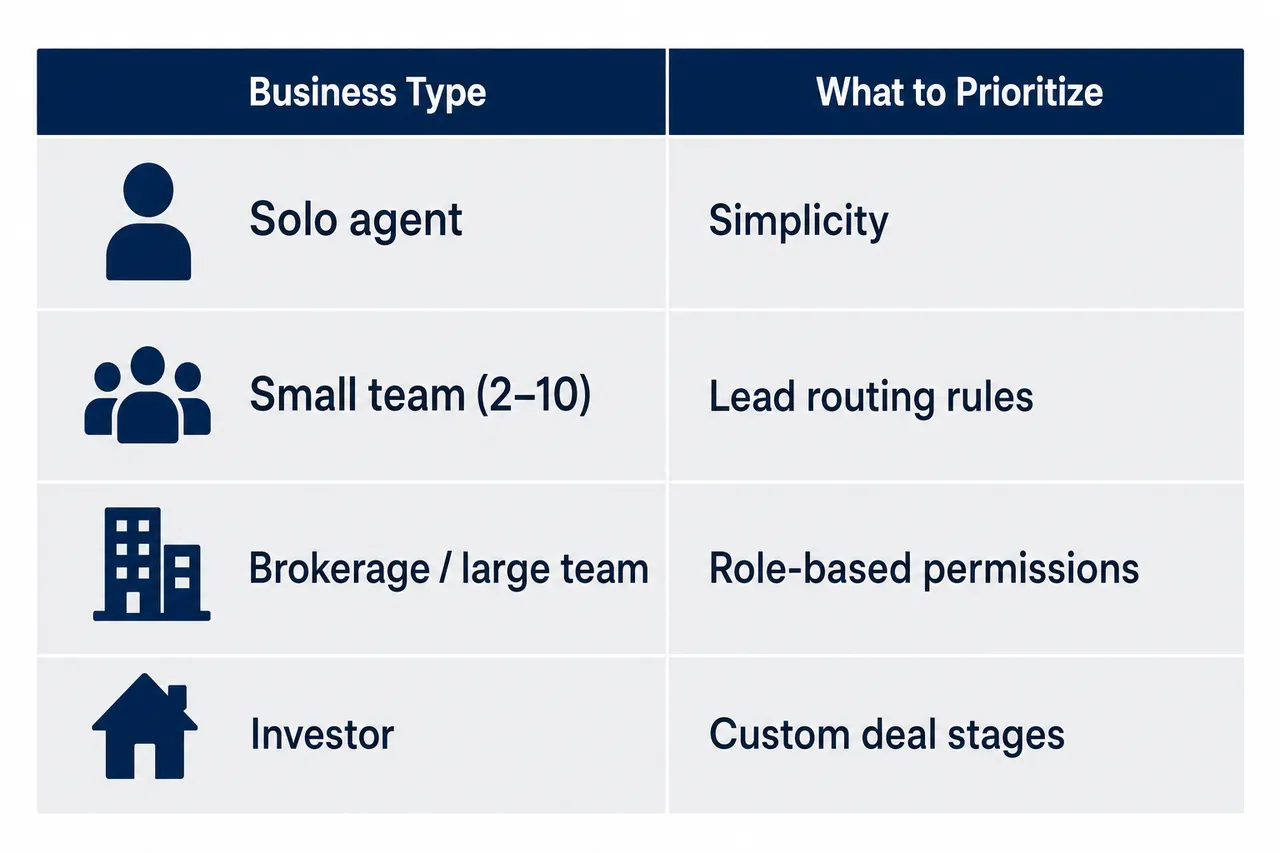
Your business type determines what actually matters:
| Business Type | What to Prioritize | What to Avoid Paying For |
|---|---|---|
| Solo agent | Simplicity, mobile app, automated drip, low per-seat cost | Multi-user role hierarchies, enterprise reporting |
| Small team (2–10) | Lead routing rules, shared pipeline visibility, calling tools | Per-seat pricing that scales against you as you add agents |
| Brokerage / large team | Role-based permissions, compliance tools, aggregate reporting, API access | Rigid closed ecosystems with no integration layer |
| Investor (buy/hold, BRRRR, flip) | Custom deal stages, acquisition pipeline, seller lead workflows, skip trace integration | Buyer/listing-focused templates that don't map to investment deal flow |
What's the spread on pricing? Solo plans start around $49/month with Wise Agent, and most of the commonly reviewed tools land at roughly $79/month as a median entry point. Follow Up Boss charges $69/user/month for Basic, $499/month flat for teams up to 10, and $1,000/month for unlimited users. Running an active acquisition pipeline as an investor? Look at dedicated investor platforms — our REIPro review digs into one purpose-built option.
Before you schedule a single demo, map out your three most common workflows. "New Zillow lead → schedule showing → 90-day nurture" or "motivated seller call → offer → follow-up if silent after 48 hours." Then tell the sales rep to show you exactly how their platform handles those flows.
Don't sit through a generic tour.
Back to topSecret #2: Follow-Up Automation and Drip Campaign Depth
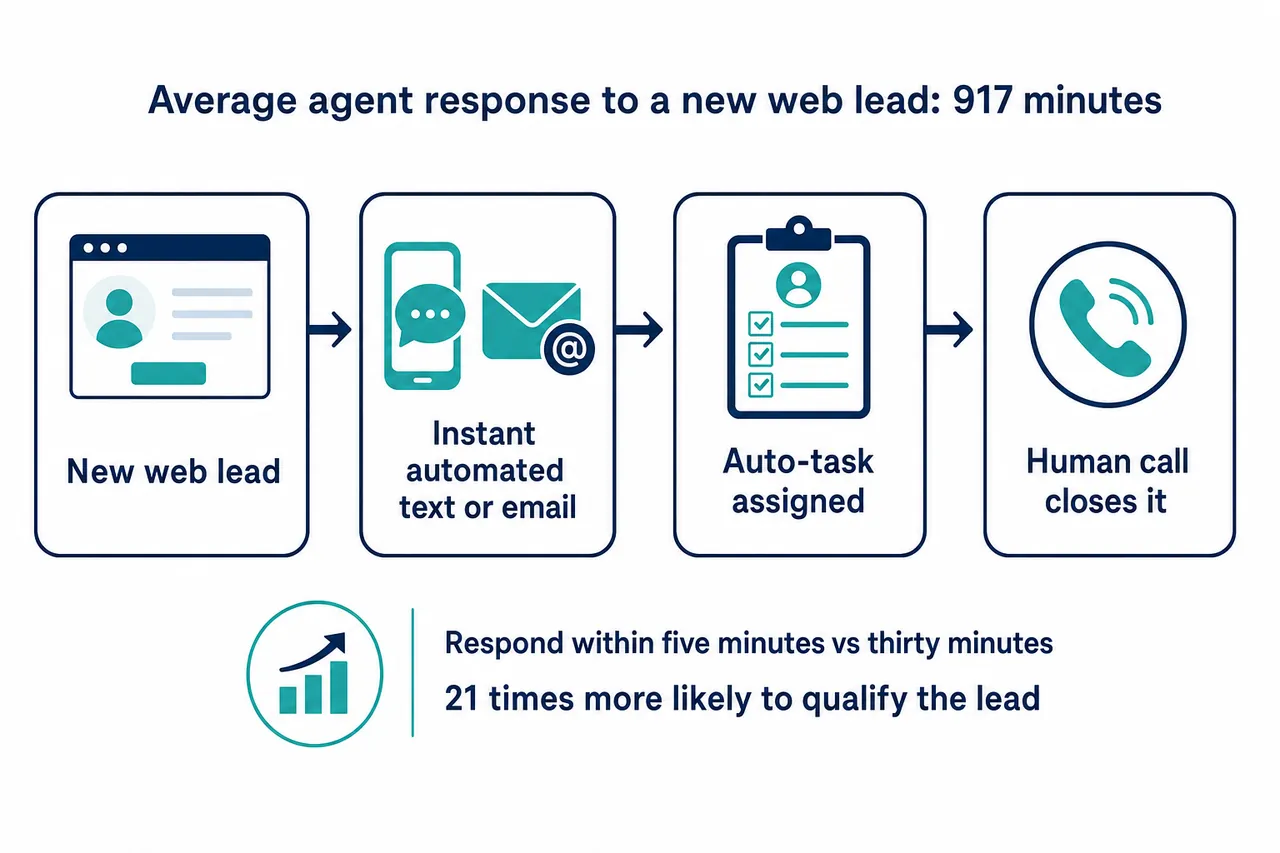
Speed-to-lead isn't theoretical. It's the single most predictive variable in real estate conversion, and the numbers back it up. A 2026 Pied Piper study tracking 2,198 inquiries across 21 brokerage brands showed that 68% of website inquiries got radio silence for a full day. Only 10% of inquiries landed in front of an agent within 60 minutes. The median agent? They respond in 917 minutes—that's 15 hours later. And here's where it gets interesting: responding within five minutes versus thirty minutes lifts your qualification odds by 21x, according to MIT and InsideSales.com research that's been echoed across 2026 industry reports.


So what does that actually look like in your CRM? First, automation does the heavy lifting when you can't pick up the phone immediately. An instant text or email goes out the second a lead lands—something like "Got your inquiry. I'm calling you within the hour." Then a task auto-assigns to you or your team. The bot buys the time. You close the deal.
But drip depth is where most investors leave money on the table. Most CRMs ship with generic three-email drip campaigns. That's not enough. The best platforms let you stack multi-channel sequences—email, SMS, ringless voicemail, direct mail—with logic that branches based on actual behavior. Did they open the email? Click a link? Submit a second form? Your CRM adjusts accordingly. For specifics on platforms that nail this, check out our breakdown on the best real estate CRMs with drip campaign features.
Build these three sequences right now:
- New buyer lead (long-term nurture): Run a 12-month sequence, bi-weekly touches, alternating market updates with property alerts. Most deals close in 3–6 months, but you'll capture outliers converting 12–18 months down the road if you stay in front of them.
- Past client re-engagement: Send an annual check-in timed to their purchase anniversary, include their local market value update, and ask the referral question ("Do you know anyone looking?"). This directly addresses the 24% repeat-hire gap we mentioned earlier.
- Motivated seller (investor pipeline): This one's aggressive—3–5 touches in 72 hours, then weekly for 60 days. If you're using skip tracing to pull off-market prospects, our skip tracing guide walks through sourcing strategy before those contacts hit your CRM.
AI-powered CRMs are starting to optimize sequences on their own now, shifting send times and channel mix based on what actually works for each contact. Want to understand where this technology's headed? Our piece on AI-powered real estate CRMs breaks down how machine learning is reshaping investor operations today.
Back to topSecret #3: Lead Source Integrations and Market Fit

Your CRM needs to auto-capture leads from every source. If it doesn't, your team will manually dump data into it for about three weeks before giving up completely. Before you sign anything, write down every way a lead actually enters your business — then confirm the platform has native integrations for each one.
Where do your leads actually come from?
- Portal leads: Zillow, Realtor.com, Homes.com
- Facebook and Instagram lead ads
- Google Ads / landing page form fills
- Your brokerage's website IDX
- Referral partner forms (lenders, attorneys, CPAs)
- Direct mail response tracking
- Inbound calls (requires call tracking number integration)
For each one, you need either a direct integration or a Zapier/webhook fallback. No exceptions.
But market fit goes way deeper than just getting leads into the system. Does your CRM connect to your phone system so calls automatically log and record? When a deal moves to contract, does it push that data into your transaction management software automatically? Can it fire off tasks in your project management tool without you manually creating them? Our breakdown of the best phone systems for real estate investors compares call tracking options that play nice with CRM platforms. And if you're enabling call recording, our guide on CRM call recording features and legal compliance isn't optional reading — it's required.
Investor workflows are different. BRRRR acquisitions. Fix-and-flip deal tracking. Seller finance negotiations. These aren't generic "lead to client to closed" pipelines, and your CRM needs to reflect that reality.
If your CRM doesn't integrate with your deal analysis tools, you're bouncing between three screens while time bleeds away. Our BRRRR method guide walks through the full acquisition-to-refinance workflow — and your CRM's deal stages should match that sequence, not force you to shoehorn your process into something generic. When you're running numbers on a potential acquisition using our BRRRR calculator, that same deal stage in your CRM should hold your cap rate, ARV, and all the other key metrics right alongside the contact record.
HubSpot gets a lot of hype as an all-in-one platform for real estate teams. The integrations run deep. But real estate fit? That requires heavy customization work. Our full breakdown of HubSpot for real estate — features, pricing, and fit will tell you straight: is the customization work worth it for your operation, or should you go with a purpose-built alternative instead? For a wider view across investor- and agent-focused platforms, check our CRM apps comparison for investors and agents.
Back to topConclusion

Three decisions actually separate the CRMs that work from the ones gathering dust: pick the platform built for your deal flow (not whatever's trending), set up automation that responds in minutes instead of days and keeps nurturing when you're not thinking about it, and wire every lead source into one place so nothing gets lost in the shuffle. The numbers tell the story. The median NAR member closes just 9 transaction sides in 2025. Only 24% of satisfied past clients actually come back to the same agent. That's not a small problem—it's existential. A dialed-in CRM flips this. You're not scrambling for leads constantly. You're running a referral machine instead.
Start here: audit your workflow before you buy anything. What do your three most common deal flows actually look like? Document them. Then match your platform to that reality, build speed-to-lead automation first, and layer in the fancy drip sequences after. Need more specifics? We've got a full breakdown on CRM time management and workflow hacks for busy agents.
Back to topFrequently Asked Questions
What's the most important CRM feature for a solo real estate agent?
Speed-to-lead automation. That's non-negotiable. You can't babysit a dashboard all day, so your CRM needs to fire off an immediate, personalized response the second a lead hits your inbox — and stack a follow-up task before you even get the notification. Everything else is noise compared to winning that first response window.
How much should a real estate agent expect to pay for a CRM in 2026?
Solo plans? You're looking at $49/month on the low end. Most platforms land around $79/month as a starting point. Team-based flat-rate plans run $49–$725/month depending on how deep the features go and how many users you're adding. Enterprise investor platforms swing wider. But always lock in pricing directly with the vendor. SaaS rates shift constantly.
Can investors use the same CRM as agents, or do they need a separate tool?
Some platforms work for both. Most don't. The problem is obvious once you see it: agent CRMs are built around "buyer/seller/listing" pipelines. Those don't translate to your deal flow, underwriting stages, or seller negotiations. Running a BRRRR strategy, fix-and-flip, or wholesale operation? Find a platform with fully customizable deal stages or investor-specific architecture. We broke down REIPro as an investor-first example if you want to see what that looks like.
How do I stop leads from falling through the cracks with multiple sources?
Start by mapping every single inbound channel before you even evaluate a CRM. Then verify each one has either native integration or Zapier/webhook support built in. Any source that requires manual entry is dead weight. Manual entry is where leads go to die. Build your platform search around native connections to your highest-volume sources — that's your priority.
Why do so few past clients re-hire the same agent if they were satisfied?
According to the NAR 2026 Profile of Home Buyers and Sellers, 88% of buyers said they'd reuse or recommend their agent. Only 24% actually did. The disconnect? Systematic follow-up. Without a CRM running past-client drip sequences on autopilot, you disappear between transactions. The next agent who touches them gets the deal.
Back to top