


Explore the complete directory of real estate software companies. Compare property management, CRM, and investment tools to find the perfect solution for y
Products and Tools Mentioned in this Post

Propstream
Detailed information on Propstream. Get How-To's, reviews, Comparisons, and much more.


Follow Up Boss
Follow Up Boss is a real estate CRM that helps agents manage leads, automate follow-up, and increase conversions. Streamline your sales process today.
TenantCloud
TenantCloud offers landlords and property managers a complete solution for rent collection, tenant screening, lease management, and maintenance tracking.
Table of Contents
- How the Real Estate Software Market Is Segmented
- Top Real Estate Software Companies: The Major Players
- Real Estate Software by Use Case
- Real Estate Data Standards: The Technical Differentiator
- Custom Development vs. Platform Extension
- Real Estate Software Development Pricing and Engagement Models
- Geographic Distribution of Real Estate Software Companies
- AI and Automation in Modern Real Estate Platforms
- Data Security, Compliance, and Regulatory Requirements
- Evaluating Real Estate Software: Red Flags and Key Criteria
- Total Cost of Ownership: Beyond the Monthly Fee
- Conclusion: Building Your Real Estate Software Stack
- Frequently Asked Questions
Real estate software breaks into four distinct buckets: property management platforms, commercial intelligence tools, brokerage CRMs, and custom dev shops. That's why picking the right vendor feels impossible—you're not even sure which category solves your problem. This directory cuts through the noise by organizing the market into actionable categories, comparing the major players, and surfacing the technical factors—data standards, integration depth, maintenance models—that separate software that works in production from software that looks good in a demo.
The global real estate software market hit $14.3 billion in 2026 and is expanding at roughly 12.2% annually through 2033. North America dominates the conversation. The U.S. alone captures 33–39% of global spend, making it the single largest PropTech market on the planet. If you're an investor, operator, or brokerage trying to cut through vendor pitches and actually make a smart decision, this is what you need to know.

How the Real Estate Software Market Is Segmented
You need a map before you pick a vendor. The market breaks into four primary software categories—each with its own vendor ecosystem, pricing model, and technical lift.
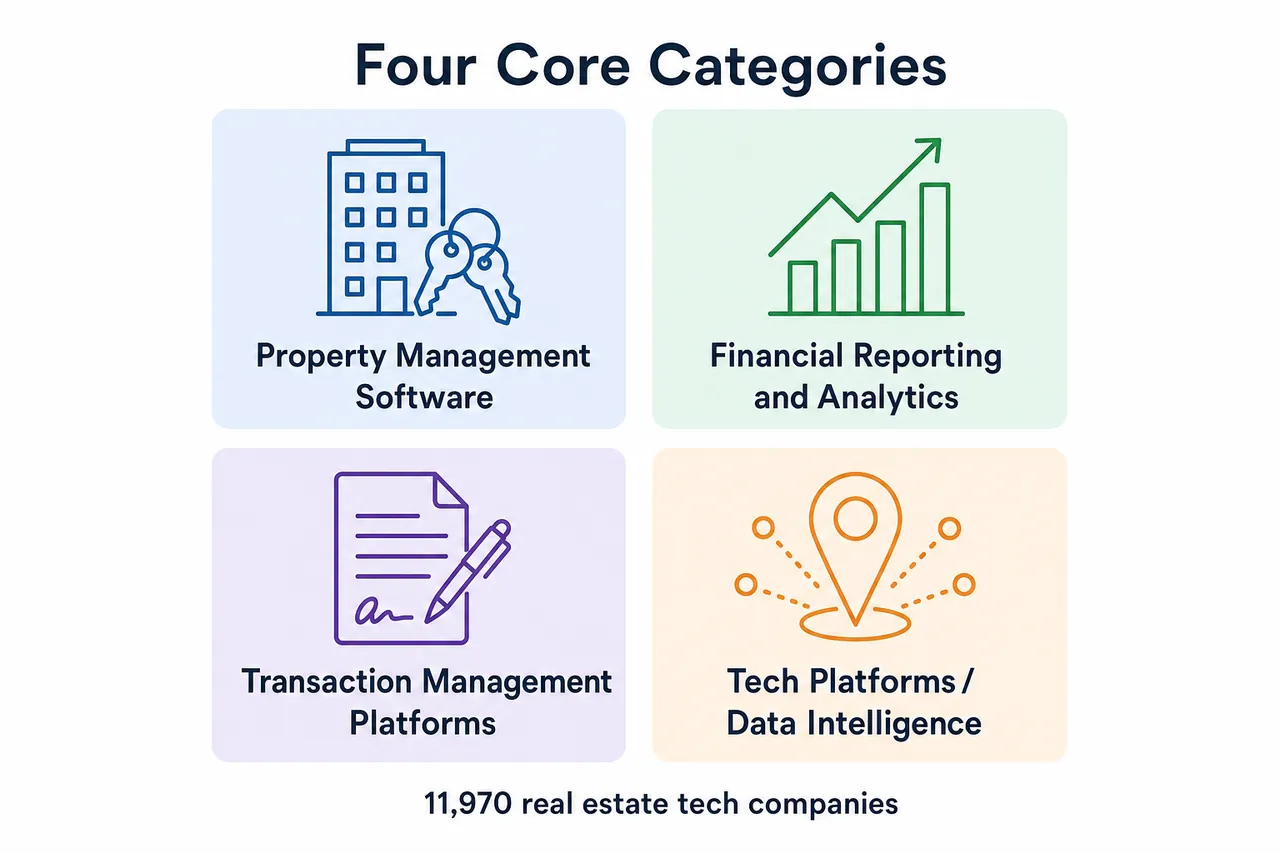
The Four Core Categories
- Property Management Software — Handles leasing workflows, tenant portals, maintenance ticketing, rent collection, and owner reporting. This is the largest segment by sheer number of vendors.
- Financial Reporting and Analytics — Portfolio performance dashboards, NOI tracking, expense categorization, and investor-facing reporting. Sometimes built on top of property management platforms. Sometimes standalone tools purpose-built for syndicators and fund operators.
- Transaction Management Platforms — Document management, e-signature workflows, offer tracking, and compliance checklists for agents, brokers, and title companies.
- Tech Platforms / Data Intelligence — MLS aggregation, AVM engines, market analytics, comps databases, and API-driven data infrastructure. This is where PropTech meets data science.
Globally, there are roughly 11,970 real estate tech companies operating right now. In the US? About 4,045 companies focus on property management software alone. 258 US companies specialize in financial reporting. New York City alone has 76 companies in transaction management—deal volume concentrates software vendors in major metros. Want specifics on which tools actually work for investors? Our best real estate software for investors 2026 guide breaks down individual product reviews by use case.
The Broader PropTech Context
Real estate software exists inside a much larger ecosystem. The global PropTech sector includes hardware (smart building sensors, access control), marketplaces (iBuyers, fractional ownership platforms), and fintech (mortgage automation, escrow tech). The numbers tell the story: the global PropTech market was projected to grow from $45.1 billion in 2025 to $115 billion by 2033—a 12.6% compound annual growth rate. That growth reflects institutional adoption accelerating across the entire real estate value chain, not just property management and analytics.
And here's what matters for your business: technology costs aren't discretionary anymore. They're a permanent, growing line item in operating budgets.
Enterprise vs. Mid-Market Solutions

The biggest market distinction isn't software category. It's whether you match your company size to the platform. Enterprise platforms (Yardi, MRI Software, RealPage) handle portfolios with hundreds of units, dozens of staff, and tangled ownership structures. Deep configurability. Strong integrations. Large professional services teams backing them up. The tradeoff? Implementation costs routinely hit six figures before you onboard a single tenant.
Mid-market solutions price per unit. AppFolio, Buildium, Rentec Direct, TenantCloud—they all require far less implementation work than their enterprise cousins. But here's where most mid-market firms get it wrong: they hire enterprise consultancies with big day rates and overhead to implement software that specialist integrators can deploy faster and cheaper. Mid-market firms running $5M–$100M in revenue consistently overpay when they engage enterprise consultancies instead of specialists who know these platforms inside out.
Back to topTop Real Estate Software Companies: The Major Players
Below you'll find the companies that actually matter—organized by category, HQ, headcount, and who they're built for. We're not talking about all 11,970 vendors out there. This is the roster investors and operators encounter when they're serious about picking a platform.
| Company | Headquarters | Approx. Employees | Primary Specialization | Target Market |
|---|---|---|---|---|
| Yardi Systems | Santa Barbara, CA | 10,000+ | Property Management (all asset classes) | Enterprise / Large portfolios |
| RealPage | Richardson, TX | 7,000+ | Multifamily operations & analytics | Enterprise / REITs / Large operators |
| MRI Software | Solon, OH | 2,500+ | Commercial & residential property management | Enterprise / Mid-market |
| AppFolio | Santa Barbara, CA | 1,800+ | Residential property management | Mid-market (50–5,000 units) |
| Entrata | Lehi, UT | 3,000+ | Multifamily operations platform | Mid-to-large operators |
| VTS | New York, NY | 500+ | Commercial leasing & asset management | Enterprise CRE owners & brokers |
| Compass | New York, NY | 4,000+ | Brokerage technology platform | Residential agents & teams |
| CoStar Group | Washington, DC | 5,000+ | CRE data & analytics | CRE brokers, lenders, investors |
| Buildium | Boston, MA | 400+ | Residential property management | Small-to-mid operators (up to 5,000 units) |
| Square Yards | Gurgaon, India | 8,000+ | PropTech marketplace & mortgage | International residential investors |
| Avenue5 Residential | Seattle, WA | 3,000+ | Third-party property management | Multifamily operators nationwide |
| Castle Group | Fort Lauderdale, FL | 500+ | HOA & community management | HOA boards & community managers |
Yardi: The Category Leader
With more than 10,000 employees across global offices, Yardi Systems dominates property management software by sheer scale. Its portfolio spans Voyager for enterprise clients, Breeze for smaller operators, plus add-ons for energy management, procurement, and revenue optimization. You can run a 10-unit rental or a 100,000-unit REIT on the same platform family. But that versatility comes at a cost—implementation requires Yardi-certified consultants and timelines that stretch for months. Configuration complexity is real. That's the tradeoff.
VTS in Commercial Real Estate
VTS solved a problem everyone else left unsolved: creating one system of record that actually works for owners, operators, brokers, and tenants at the same time. Most platforms force each party into parallel spreadsheets and email chains. Not VTS. It unifies the entire workflow from prospect to lease to ongoing occupancy. If you're evaluating CRE-specific software, VTS is the name institutional landlords and major brokerage firms keep citing. That's not random.
Compass and Agent-Focused Platforms
Compass took a different route. Instead of building pure software, they became a licensed brokerage that sells agents an internal tech stack—CRM, marketing tools, deal tracking built in. Douglas Elliman and similar shops followed that same playbook. And if you're an agent shopping independently of your brokerage? Platforms like Perchwell, Follow Up Boss, and kvCORE each own different corners of the brokerage software stack. Pick based on what you actually need.
Back to topReal Estate Software by Use Case
Residential Property Management

Residential property management software owns the biggest chunk of this market. What matters most? Your portfolio size and how deep you need the features to go.


- Under 50 units: TenantCloud, Landlord Studio, or Rentec Direct keep things lean. You get rent collection, lease storage, and basic maintenance tracking without the premium price tag.
- 50–2,000 units: AppFolio and Buildium own this tier. Tenant portals, online payments, maintenance request workflows, owner dashboards, and vacancy marketing integrations come standard. AppFolio's been pushing hard into AI-assisted leasing and maintenance triage lately.
- 2,000+ units / institutional: Yardi Voyager, RealPage, and Entrata handle the complexity here—revenue management, utility billing, compliance reporting for affordable housing programs. You need them at this scale.
Third-party management companies matter too if you're outsourcing the whole operation. Avenue5 Residential (Seattle), Highmark Residential, and Castle Group (Southeast and Florida focus) run enterprise platforms and might make more sense than buying software yourself.
Before you pick a management platform or provider, run your deal through our rental property calculator. You'll see your cash flow, expenses, and return on equity clearly—that's what actually matters when deciding how to manage it.
Investment and Financial Management
Syndicators and fund operators live in a different world than property managers. AGORA, Juniper Square, and Tango solve investor portals, capital calls, waterfall calculations, and LP reporting—all different from day-to-day operations software. For bookkeeping at the entity level, QuickBooks works fine if you set up a real-estate-specific chart of accounts. Stessa handles it too, built specifically for investors. Our real estate bookkeeping software guide compares what actually works.
And here's the thing most syndicators miss: test how the platform calculates preferred returns and waterfall distributions before you commit. Some investor portals choke on complex structures. Not all of them model it right. If you're new to syndication altogether, start with our real estate syndication guide first—understand the structure before you buy software to manage it.
Commercial Real Estate Platforms
CRE isn't residential. You need lease abstraction, CAM reconciliation, tenant improvement tracking, and stacking plan visualization. Residential platforms don't touch these features. Beyond VTS, here's who matters:
- CoStar Group — Market data, comps, tenant and owner contact intel. It's the research database institutional investors and CRE brokers live in.
- Argus Enterprise (Altus Group) — DCF modeling and asset valuation. Standard issue for underwriting at the institutional level.
- Buildout — CRE marketing and listing management. Built for brokerage teams.
- Dealpath — Pipeline and deal tracking for acquisitions teams moving deals through the funnel.
Fix-and-Flip and Wholesale Tools
Wholesalers and fix-and-flip operators operate on a tighter, more tactical toolset: skip tracing databases like BatchLeads and PropStream, direct mail automation, and CRM systems built for crushing high-volume leads. Our best real estate wholesaling software guide breaks down this whole stack. Before you buy, punch your deal into our fix and flip calculator or 70 percent rule calculator. Validate the acquisition price against real rehab costs and actual ARV estimates—that's how you keep from overpaying.
Back to topReal Estate Data Standards: The Technical Differentiator
Most software directories completely skip this section. And that's exactly why so many real estate software projects crash and burn. The industry runs on proprietary data ecosystems with specific standards that general software developers have never seen before.
The Three Standards You Must Understand
| Standard | Use Case | Complexity Level | Maintenance Requirements | Critical For |
|---|---|---|---|---|
| RETS (Real Estate Transaction Standard) | Legacy MLS data transfer protocol | High — varies widely by MLS implementation | Moderate — MLSs still running RETS require ongoing schema monitoring | Platforms integrating with older MLS feeds |
| RESO Web API | Modern REST-based MLS data standard (replacing RETS) | Medium — standardized but requires certified implementation | Ongoing — RESO schema updates released periodically | Any platform pulling live listing data |
| IDX (Internet Data Exchange) | MLS policy governing public display of listing data | Low-Medium (policy compliance rather than technical) | High — MLS rules change and require policy compliance audits | Consumer-facing listing search portals |
MLS feed integration and RESO Web API compliance separate winners from losers in real estate software—and they're the #1 reason projects fail. The move from RETS to RESO Web API isn't finished. MLSs nationwide are at different stages, and a platform crushing RESO might still need RETS fallback code for regional feeds. Developers who brag about MLS integration experience but only worked with mocked data? They'll hit a wall after go-live when they connect to production feeds for the first time.
IDX compliance gets ignored. But you can't ignore it. MLS boards update display rules constantly. Your software has to stay compliant or the feed gets cut off. Smart platforms don't treat IDX as a launch checkbox—they build ongoing compliance monitoring straight into the maintenance contract.
Want to understand how listing data actually flows? Our real estate comps API guide shows you the complete pipeline from MLSs to investor tools. And if you're comparing data vendors, check out our real estate data services comparison for a breakdown of the major aggregators.
Back to topCustom Development vs. Platform Extension
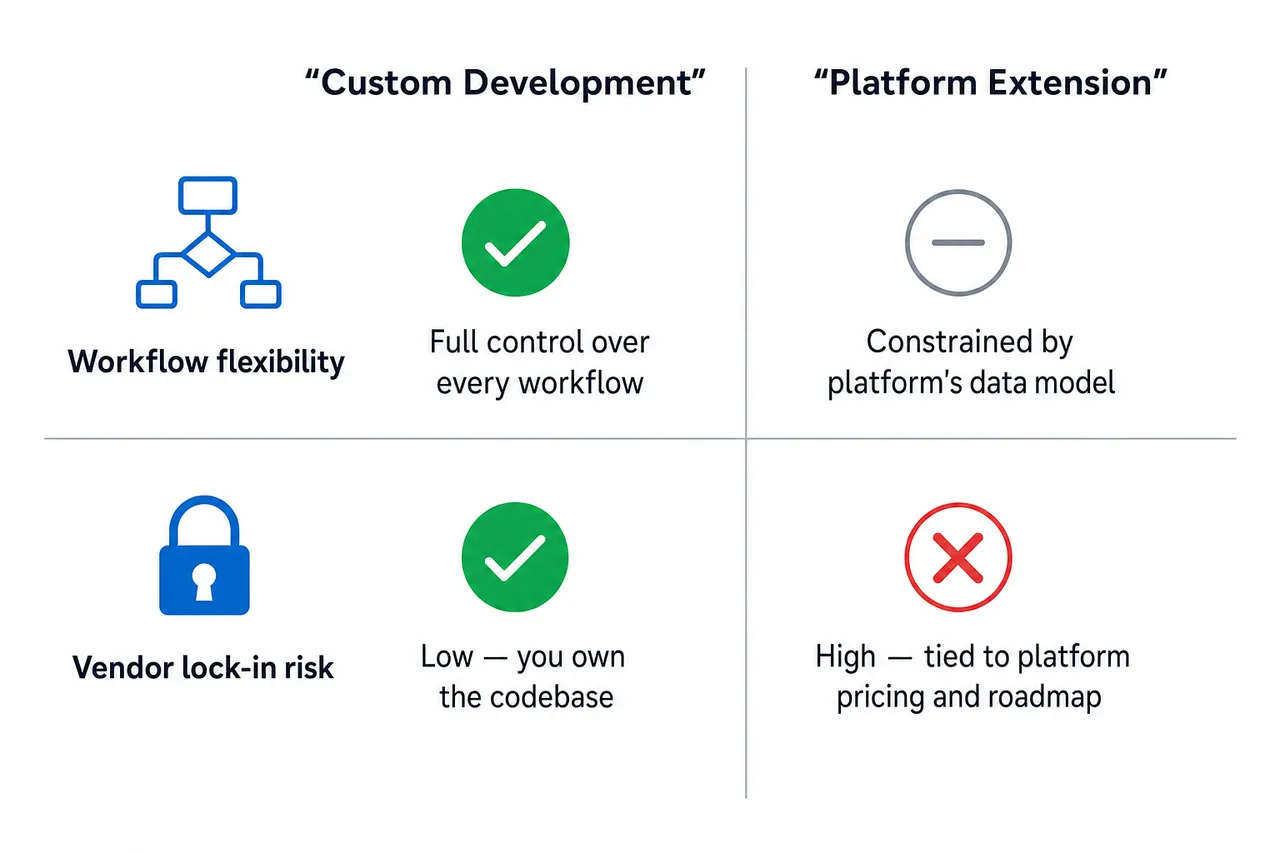
You've outgrown the off-the-shelf stuff. Now comes the harder question: build from scratch or bolt onto something like Yardi, AppFolio, Buildium, or Salesforce with real estate plugins? This one decision shapes your budget, timeline, and maintenance headaches more than anything else in a software project.
| Consideration | Custom Development | Platform Extension | Typical Timeline | Cost Impact |
|---|---|---|---|---|
| Workflow flexibility | Full control over every workflow | Constrained by platform's data model | Custom: 6–18 months; Extension: 2–6 months | Custom adds 40–80% to base cost |
| MLS/RESO integration | Must be built from scratch or via third-party API | May be available as native or certified add-on | Integration adds 4–12 weeks to either path | Live MLS integration adds $15K–$40K regardless of path |
| Ongoing maintenance | Full responsibility — schema changes, security patches, hosting | Platform vendor handles core; you maintain custom extensions | N/A — ongoing | Custom maintenance: 15–20% of build cost annually |
| Vendor lock-in risk | Low — you own the codebase | High — tied to platform pricing and roadmap | N/A | Platform price increases directly affect TCO |
| AI/automation features | Can integrate any model or API | Limited to what platform exposes | AI integration adds 4–8 weeks | Custom AI adds $20K–$60K+ depending on complexity |
When Custom Development Makes Sense
Custom software is the right call when no platform can handle your workflow. That includes unusual ownership structures, complex co-investment tracking, mixed asset classes, or a data model that just doesn't fit the standard property management mold. And if you need production-grade MLS integration with logic that platform extension points simply can't reach—custom is your only path.
Fixed-price engagements typically land between $25,000 and $100,000+. The variance depends on platform complexity, how many data integrations you need, and whether compliance features like IDX or tenant payment processing are on the table. Hourly rates from real estate software shops run $29–$99—offshore and nearshore teams at the low end, U.S.-based specialists with real MLS track records at the high end.
The Most Common Failure Mode
Most real estate software projects don't fail because of a missing feature. They fail because of data integration.
The killer: a dev team builds something beautiful against a mocked MLS feed. Launch day hits. Live production data arrives and it's chaos. Field mappings vary across different MLSs. Required fields sometimes vanish. The MLS board pushes schema updates and your ingestion pipeline breaks without warning.
Fix this before it happens. Demand proof of a live production platform with actual MLS/RESO integration running in the real world—not a demo, not a sandbox, not a mockup. Ask how they handle RESO schema updates in their maintenance contracts. Find out if IDX compliance monitoring comes with the package or gets billed separately after launch. The real estate software space is smaller than you'd think. Far fewer development firms can actually handle production-grade integration than their websites claim.

Interested in AI-powered capabilities on top of this stack? Our AI tools for real estate investors guide breaks down how machine learning is actually being used for property analysis, lead scoring, and rent forecasting—and which platforms deliver real value versus just feature creep.
Back to topReal Estate Software Development Pricing and Engagement Models
| Firm Tier | Hourly Rate Range | Minimum Engagement | Engagement Model | Best For |
|---|---|---|---|---|
| Large enterprise consultancy (Big 4 / Accenture-tier) | $150–$350+/hr | $500K+ | T&M or managed service | Fortune 500 real estate companies, complex multi-country deployments |
| Mid-size real estate tech consultancy | $99–$150/hr | $100K+ | T&M or fixed-phase | Large regional operators, institutional investors |
| Specialist real estate software firm | $50–$99/hr | $25K–$100K | Fixed-price or milestone-based | Mid-market operators, growing portfolio companies |
| Offshore / nearshore development team | $29–$55/hr | $15K+ | T&M or dedicated team | Cost-sensitive projects with strong internal technical oversight |
You'll ship faster with a specialist real estate development shop than you will with a Big 4 consultancy. That's not opinion—it's math. A 10-person team that's already built five MLS-integrated platforms doesn't need to learn your domain on your dime. They've already paid that tuition. For mid-market engagements, the engagement model matters just as much as the hourly rate. Fixed-price, milestone-based contracts put the risk on the vendor's side. Time-and-materials? That risk lands squarely on you. If you're a regional operator or growing your portfolio, understanding which one protects your budget is critical.
Back to topGeographic Distribution of Real Estate Software Companies
PropTech isn't scattered randomly across the country. You'll find the heavy hitters clustered in metros where talent pools are deep and real estate transaction volume runs thick.
- New York City — The epicenter for transaction management software. 76 companies focus exclusively on this category. VTS, Compass's tech operations, and a growing roster of CRE analytics startups all call NYC home.
- Santa Barbara, CA — Punches way above its weight. Both Yardi Systems and AppFolio operate from here—two absolute powerhouses in property management platforms.
- Lehi, UT (Silicon Slopes) — Entrata's headquarters sit here, part of Salt Lake City's broader tech ecosystem that's exploded over the past decade.
- Richardson, TX — Where RealPage set up shop (now owned by Thoma Bravo). Dallas-Fort Worth has emerged as a serious player for enterprise PropTech platforms.
- Washington, DC — CoStar Group's home base. The location makes sense given the proximity to federal real estate data and government property oversight.
- Gurgaon, India — Square Yards anchors this emerging international hub, particularly serving South Asian and Middle Eastern markets.
Planning to invest internationally? Real estate software requirements vary dramatically by country. Data standards shift, tenancy law compliance gets complicated, and payment processing regulations differ materially across borders. Working in Australia? Our Australian real estate software guide breaks down the local vendor landscape.
Back to topAI and Automation in Modern Real Estate Platforms
AI went from buzzword to actual tool in real estate software. And it's worth your time to know which implementations actually move the needle. Three categories matter most:
Leasing and Tenant Screening Automation
AppFolio's Lisa handles initial prospect inquiries, schedules showings, and screens questions without anyone touching it. Entrata and RealPage are doing similar things. What you'll see: leasing teams push way more volume without adding headcount. But fair housing compliance gets tricky. You need to configure this carefully or you risk disparate impact issues that'll cost you.
Maintenance and Work Order Routing
Classification models now triage maintenance requests automatically. They categorize urgency and route work orders to vendors based on trade type and location. Property managers stop drowning in administrative work. Routine repairs get faster—and that directly affects your tenant satisfaction scores and renewal rates, which matter for your cap rate.
Revenue Management and Dynamic Pricing
RealPage's revenue management product and competitors like Yardi's RENTmaximizer recommend rents in real time using competitive market data, unit availability, and your lease expiration calendar. Built for large multifamily operators mostly. They've drawn regulatory scrutiny though. If you're using these tools, you need to track state and municipal pricing regulations as they evolve.
For a deeper dive into AI capabilities across your investor toolkit, check out our AI-powered real estate CRM guide.
Back to topData Security, Compliance, and Regulatory Requirements
Real estate software handles sensitive data. Compliance requirements follow. Most vendor pitches gloss over this stuff entirely.
Tenant Payment Processing
PCI-DSS compliance isn't optional—it's mandatory for any platform collecting rent or security deposits online. Don't assume it. Ask directly: Is the vendor a PCI Level 1 service provider, or do they outsource to Stripe, Braintree, or someone else to reduce their PCI scope? The answer matters.
Fair Housing Act Compliance
Automated screening tools and AI-powered leasing assistants need fair housing scrutiny. HUD has already released guidance on algorithmic screening in housing. Several states have piled on additional requirements. If a software vendor can't explain how their AI screening logic handles protected class variables, walk away.
State Landlord-Tenant Law Compliance
Lease templates, notice workflows, and eviction processing differ wildly by state. A platform built for California investors deals with AB 1482 rent control, strict habitability standards, and byzantine security deposit rules. A Texas-focused tool operates under completely different compliance logic. Make sure your platform has jurisdiction-specific compliance baked into its maintenance schedule—not bolted on as an afterthought.
SOC 2 and Data Residency
Institutional investors and REITs demand SOC 2 Type II certification. Period. Add GDPR compliance and data residency requirements if you operate internationally, and the vendor evaluation gets more complex. These certifications are specific to each vendor. Verify them independently. Marketing materials don't count.
Back to topEvaluating Real Estate Software: Red Flags and Key Criteria
Want to know what separates a smooth implementation from a six-figure disaster? It's asking the right questions upfront.
- Live production integration or mocked data? — Don't settle for a canned demo. Demand a live pull from an actual MLS feed, not some pre-built sandbox with dummy listings.
- Post-launch maintenance model for schema changes? — MLS schemas shift constantly. You need clarity on who patches it when it breaks and what that costs you down the line.
- IDX compliance monitoring? — Ask whether ongoing MLS policy compliance is baked into the contract or if you're looking at change orders later.
- Tenant payment processing compliance? — PCI-DSS scope and responsibility must be crystal clear in writing. No wiggle room here.
- Implementation timeline and go-live milestones? — Fixed dates with defined deliverables shift the risk from you onto the vendor, not the other way around.
- Reference clients on comparable portfolio types? — A vendor who crushed it for a 50-unit residential play might completely botch your 500-unit mixed-use commercial portfolio.
- AI feature production evidence? — Seeing "AI-powered" in the pitch deck doesn't cut it anymore. Which model runs it? Show me actual production metrics—leasing conversion rates, maintenance resolution times, real data on what it's actually delivering.
Running a broader platform evaluation across your entire investor toolkit? Our best real estate software programs guide breaks down the decision framework by investor type.
Back to topTotal Cost of Ownership: Beyond the Monthly Fee
Real estate software comes in four flavors: per-unit per-month (property management), seat-based (CRM and transaction tools), usage-based (data APIs), and enterprise license (Yardi, MRI). That subscription price on the quote? It's not your total cost of ownership.
- Implementation and data migration: You're moving historical lease data, tenant records, and maintenance history from your old system. That bill typically runs $5,000–$50,000 depending on how much data you've got and how messy it is.
- Training and change management: Staff training eats 10–15% of your software license cost in year one. Don't underestimate this.
- Integration costs: Accounting software. Payment processors. Screening services. Listing syndication. Each connection has its own cost, and they add up fast.
- Annual maintenance and updates: Built something custom? Budget 15–20% of original development cost every single year for maintenance, schema updates, and security patches.
- Price escalation risk: Private equity-backed vendors love raising per-unit fees. We've seen it happen. Build this risk into your build-versus-extend decision now, not later.
When you're underwriting a property that needs serious software infrastructure, bake these operational costs into your pro forma. Use our cap rate calculator and cash-on-cash return calculator to run the numbers. You'll see exactly how software costs impact your returns.
Back to topConclusion: Building Your Real Estate Software Stack
The real estate software market is massive—$14.3 billion globally in 2026 with 12.2% annual growth. That's just one piece of PropTech, which is projected to hit $115 billion by 2033. But here's what matters: market size doesn't tell you anything about execution quality. You've got 11,970 vendors competing, everything from enterprise platforms managing institutional portfolios down to solo developers working out of a garage. Most of them lack real production depth.
What's your actual framework? Match your company size to the software tier you need. Prioritize vendors who can show live production integrations—not demos, not case studies, actual working systems. And this is critical: build post-launch maintenance into your total cost of ownership calculation before you sign anything.
This is where most deals fall apart.
RESO Web API compliance. IDX monitoring. Live MLS feed management. PCI-DSS scoping. These technical differentiators are non-negotiable, and getting them right before you're locked into a contract costs a fraction of what you'll pay discovering problems during implementation. Whether you're running 50 units on a property management platform, managing commercial leasing across a mixed-use portfolio, or building a custom investor reporting portal—the data integration story is everything. That's your whole story.
Back to top
Frequently Asked Questions
What's the largest real estate software company in the world?
Yardi Systems (Santa Barbara, CA) dominates by sheer scale—over 10,000 employees globally and the widest footprint in property management software. CoStar Group owns commercial real estate data and analytics. And if you're looking at residential brokerages, Compass leads on the tech-forward side by headcount.
How much does real estate software cost to develop custom?
You're looking at $25,000 to $100,000+ for a fixed-price build, depending on complexity, integrations, and compliance requirements. Hourly rates run $29–$99 depending on the shop's reputation and specialty. Then add 15–20% of the original cost annually for maintenance and updates. Mid-market developers often beat the big consulting firms on price without sacrificing quality—that's worth testing.
What data standards do real estate software platforms need to support?
Three standards matter: RETS (the old MLS protocol), RESO Web API (the modern REST replacement), and IDX (the MLS rulebook for how you display listings publicly). If you're syncing live listing data, you need RESO Web API and you need to track schema updates as they roll out. IDX isn't a "set it and forget it" situation. MLS rules shift, and if you fall out of compliance, they kill your feed. That's not theoretical.
Should I build custom real estate software or extend an existing platform?
Extending Yardi, AppFolio, Buildium, or Salesforce with real estate modules is faster and cheaper when your operations fit what's already there. Custom development wins when your data structure, entity hierarchy, or integrations won't bend to fit any existing platform. But don't build custom just to avoid vendor lock-in without counting the real cost of maintaining an MLS integration yourself. When you're evaluating dev shops, demand live production examples—not sandboxed demos with fake data.
What features should I prioritize when evaluating property management software?
Stack your priorities this way: (1) live MLS/listing sync if you're marketing vacancies; (2) PCI-compliant rent collection and a tenant portal; (3) maintenance workflow that actually talks to vendors; (4) owner reporting tied to your accounting system; (5) your state's landlord-tenant compliance built in. AI features—automated leasing, pricing optimization—are nice once the fundamentals work smoothly. They shouldn't drive your decision if you haven't standardized your core processes yet.
Back to top