


Compare rental property agencies by services, fees & quality. Learn what to pay and how to choose the right manager for your investments.
Products and Tools Mentioned in this Post


Table of Contents
- What Are Rental Property Agencies?
- Key Services Offered by Rental Property Agencies
- Common Pricing Models
- How to Choose the Right Rental Property Agency
- Benefits of Using a Rental Property Agency
- DIY Management vs. Agency Management: The Financial Trade-Off
- Red Flags to Avoid When Selecting an Agency
- Questions to Ask Before Hiring
- Special Situations: Short-Term Rentals and Multi-Market Portfolios
- Conclusion
- Frequently Asked Questions
Rental property agencies handle the day-to-day operations of investment properties. Tenant placement, rent collection, maintenance coordination, legal compliance—it's all on them. That means you can actually focus on building your portfolio instead of drowning in management tasks. Pick the right agency and your net returns will improve noticeably. Pick the wrong one? You'll watch your profit margins get quietly gutted. This guide walks through what agencies do, what they actually charge, how to evaluate them properly, and exactly what questions to ask before you sign anything.
New to long-term rental? Start with our Long-Term Rental Investing Guide.

What Are Rental Property Agencies?

Definition and Core Services
Think of a rental property agency as your boots on the ground. They're the licensed professional who sits between you and your tenants, handling leasing, tenant screening, rent collection, maintenance coordination, and all the legal compliance headaches. Everything gets spelled out in a management agreement—scope, fees, what authority they actually have. Full-service agencies take the entire landlord job off your plate. Others? They might handle only leasing, maintenance, or short-term rental coordination.
Types of Rental Property Agencies
The agency type you choose filters down into every aspect of how your properties actually run:
- National franchise agencies (Real Property Management, Associa, and similar outfits) standardize everything across dozens of markets. You get brand consistency and bulletproof processes. But you also sacrifice local market expertise and flexibility—which can sting if your market has quirks.
- Local boutique agencies manage anywhere from 50 to 500 units within one metro area. They know neighborhoods. They return calls fast. The tradeoff? They often run on dated tech and can't necessarily scale if your portfolio grows from 5 doors to 50.
- Hybrid / tech-enabled agencies combine actual licensed managers with owner software dashboards. Lower overhead, professional management, real-time visibility. These are dominating the single-family and small multifamily space right now for good reason.
- Short-term rental (STR) agencies live and breathe Airbnb and Vrbo. They handle dynamic pricing, guest screening, turnover logistics—all the complexity that comes with nightly bookings. Expect to pay 20–35% of gross booking revenue because the work is genuinely different.
Want a turnkey play where someone handles both the acquisition and ongoing management? Check our Doorvest Review 2026—we break down what that model actually costs.
Who Uses Rental Property Agencies?
Out-of-state investors. Busy professionals. Retirees looking for passive income. Operators scaling a 10-unit or 50-unit portfolio. First-time landlords who want professional guardrails while they're still learning the game. These are the people who hire agencies. You need professional management when you don't have the time, local boots, or expertise to self-manage effectively.
Back to topKey Services Offered by Rental Property Agencies

Property Marketing and Leasing
Good agencies push your listing everywhere at once—MLS, Zillow, Trulia, Apartments.com, social media. That's table stakes. Professional photos. Rent priced to market. Fast turnaround. But here's what matters: with the national rental vacancy rate sitting at 7.6% as of Q3 2026—the highest since early 2014—you're competing hard for quality tenants. A well-priced unit fills faster. Agencies with real local networks beat solo landlords relying on one platform every single time.
Tenant Screening and Selection
This is where you either win or lose. Credit checks. Nationwide criminal background searches. Eviction history. Employment and income verification—usually 2.5–3× monthly rent as the floor. Prior landlord references. For the full picture, check our rental property application form guide. Skip screening rigor and you're buying yourself eviction costs and turnover that'll make management fees look cheap. Period.
Rent Collection and Financial Management
ACH. Online portals. Automated systems. Professional agencies collect rent and enforce late fees consistently—most self-managing landlords can't stomach that conversation with a tenant they've had for five years. You get monthly owner statements showing income, expenses, maintenance charges. Year-end? 1099s and expense summaries that make tax time actually manageable.
Residential rentals depreciate over 27.5 years under IRS MACRS guidelines, so clean expense records aren't optional.
Maintenance and Repairs
Some agencies run in-house crews. Others leverage vetted contractor networks they've negotiated rates with—and yes, that often means savings passed to you, though many charge a 10–15% markup on invoices as a coordination fee. Ask which model they use upfront.
Emergency response separates the real players from the also-rans.
A true 24/7 emergency line with on-call contractors beats a voicemail that gets returned Monday morning by miles.
Security Deposit Handling
Collect it. Hold it. Return it. Do it wrong and you're facing wrongful-withholding claims. State law varies wildly here, and you need to know your numbers. California caps deposits at one month's rent for most landlords under AB 12, effective July 2024. New York caps at one month's rent. Colorado allows up to two months' rent. Nevada allows up to three months' rent. About 20 states—Texas, Florida, Tennessee among them—have no statutory cap, so deposits come down to lease negotiation. A competent agency knows all this cold and holds deposits in compliant escrow, cutting your liability risk significantly.
Legal Compliance and Evictions
Fair housing. State landlord-tenant statutes. Local rent control. Habitability standards. Notice requirements. It all changes by jurisdiction, and it all matters. Agencies worth their salt stay current and train staff accordingly. When you need an eviction, you want someone who handles notices, court filings, and attorney coordination. Mess it up yourself and you're looking at thousands in legal fees plus months of zero rent income.
Back to topCommon Pricing Models
Percentage-Based Fees
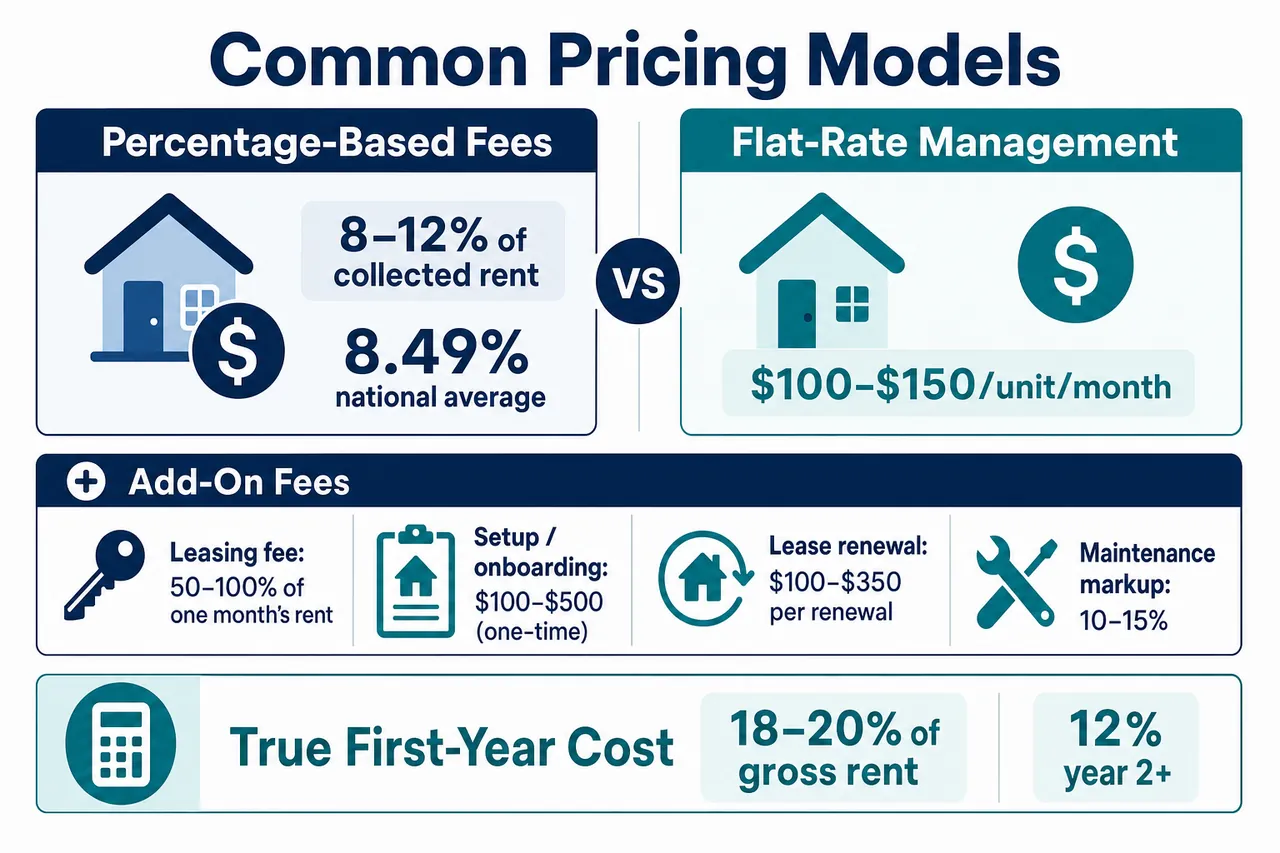
Most property managers use the same model: they take a percentage of collected rent each month. The national average is 8.49%, typically ranging from 8–12%. This structure actually works in your favor during high-vacancy periods because the incentives line up—when a unit sits empty, the manager doesn't get paid either. That's a real structural advantage you won't find with flat-rate models.
Flat-Rate Management
Some managers, especially those running larger portfolios, skip the percentage math entirely and charge a fixed fee per unit monthly, regardless of what rent comes in. You'll typically see $100–$150 per unit per month. Budgeting becomes straightforward—you know exactly what you'll pay. But they still collect during vacancies. Want to see how each fee structure actually hits your cash flow? Use our rental property calculator and run the numbers at different rent levels and vacancy rates.
Additional Service Fees
The base management fee? That's just the beginning. Here's what else gets added to your bill:
- Leasing fee: 50–100% of one month's rent per new tenancy
- Setup / onboarding fee: $100–$500 one-time
- Lease renewal fee: $100–$350 per renewal
- Maintenance markup: 10–15% added to vendor invoices
- Eviction fee: Varies; some agencies charge a flat coordination fee; others pass through attorney costs
- Early termination fee: Typically 1–2 months' management fees if you exit the contract early
True First-Year Cost
Stack up the management percentage, the leasing fee, the setup fee, and the renewal fee together. Year one runs about 18–20% of gross rent. After that? The number drops to roughly 12% once leasing and setup fees aren't hitting you anymore. Before you sign anything, plug these scenarios into our cash-on-cash return calculator. You need to see what this actually costs your yield.
| Fee Type | Percentage Model | Flat-Rate Model | Typical Range |
|---|---|---|---|
| Monthly management | 8–12% of collected rent | $100–$150/unit/month | Avg ~8.49% (% model) |
| Leasing / tenant placement | 50–100% of 1 month's rent | 50–100% of 1 month's rent | Often same across models |
| Setup / onboarding | $100–$500 (one-time) | $100–$500 (one-time) | One-time only |
| Lease renewal | $100–$350 per renewal | $100–$350 per renewal | Often negotiable |
| Maintenance markup | 10–15% on vendor invoices | 10–15% on vendor invoices | Varies by agency |
| True first-year all-in cost | ~18–20% of gross rent | Depends on rent level | Drops to ~12% year 2+ |
| STR / vacation rental | 20–35% of gross booking revenue | Less common for STR | Higher due to complexity |
Let's make this concrete. October 2026's median asking rent was $1,692/month. At 8.49%, you're paying about $144 monthly—$1,728 annually—before leasing or renewal hits. Push that to 12% and you're at $203/month, or $2,436/year on the same unit. And the leasing fee? At 75% of one month's rent, that's another $1,269 stacked on top in year one alone.
Back to topHow to Choose the Right Rental Property Agency
Experience and Track Record
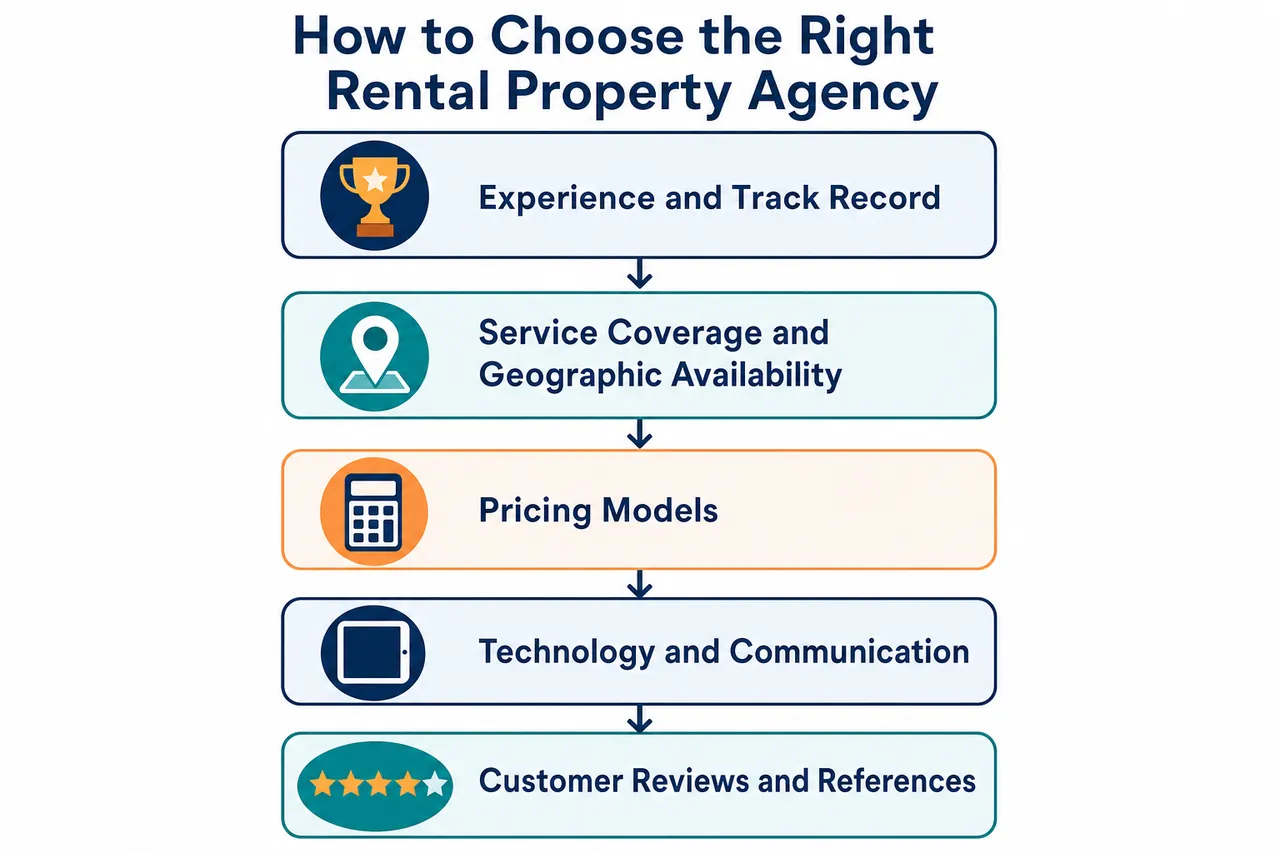
Years in business matter. So does the actual portfolio. An agency managing 2,000 single-family homes has completely different operational priorities than one handling 150 units across a dozen small multifamily properties. That's not a minor difference—it changes everything about how they operate.
Ask for the specific breakdown: how many units, what property types, and which geographies? A well-managed larger portfolio signals real systems in place. High owner turnover on a large book? That's a red flag worth taking seriously. Request owner references specifically—don't waste time with tenant testimonials—and actually call them.
Licensing, Bonding, and Insurance
Most states require property managers to hold a real estate broker's or property manager's license. Confirm that the agency and its individual managers are licensed in your state. They need to be bonded (protecting you against employee theft or mishandling of funds). And they should carry adequate errors and omissions (E&O) insurance. This isn't optional.
For a broader look at how insurance fits into your property ownership structure, see our rental property insurance guide.
Local Market Expertise vs. Geographic Coverage
An agency that knows your specific submarket wins every time. They understand seasonal rent cycles, typical tenant profiles, local ordinances, and which contractors actually show up when they say they will. A generalist can't compete with that knowledge.
Investing across multiple markets? You might need an agency with multi-market presence or a solid network of local partners. Our guide to finding rental property management companies near you covers how to vet local options systematically.
Technology and Owner Portals
Your visibility into the investment depends entirely on the platform quality. Owner portals should show you real-time rent payment status, maintenance requests with photos, monthly income and expense statements, and digital document storage for leases and inspection reports. These aren't nice-to-haves.
AppFolio and Buildium are common backends. Our AppFolio vs. Buildium comparison breaks down the differences between them, and our best property management software guide for 2026 covers the broader field. If self-managing is on the table, our best rental property management apps guide covers tools you can use directly.
Ask about data security practices if the agency runs on a third-party platform. Our coverage of the AppFolio data breach investigation illustrates what can go wrong when platform security is insufficient.
Emergency Maintenance Response
Burst pipes, heating failures in January, electrical hazards—they all happen at the worst possible times. Ask the specific questions: Is there a 24/7 emergency line? Who answers it? Do they dispatch their own staff or rely on on-call contractors? What's the average response time for emergencies versus routine work orders?
Vague answers shouldn't cut it. "We've got a process for that" means nothing. Get specific commitments in writing, ideally in the management contract itself.
Customer Reviews, Testimonials, and Satisfaction Guarantees
Google reviews, the Better Business Bureau, and state real estate board complaint records are all public. Look for patterns in negative reviews—repeated complaints about slow maintenance response, unexplained deductions from owner distributions, or impossible-to-reach managers tell you far more than a single bad review.
Ask the agency directly for three to five owner references. Call them yourself.
Go deeper than just reading reviews. Ask whether they offer any formal satisfaction guarantee. Some agencies—particularly those competing on quality rather than price—offer a trial period or a money-back guarantee on the leasing fee if a placed tenant vacates within a set window (commonly 60–90 days). Others guarantee vacancy will be filled within a specified number of days or they waive the management fee for that period. These commitments vary widely, so read the contract language carefully rather than relying on a sales pitch. An agency confident in its performance will put those guarantees in writing without hesitation.
Treat testimonials published on an agency's own website as marketing, period. Third-party review platforms, direct calls to referenced owners, and your own interview impressions carry real weight.
| Evaluation Criterion | What to Look For | Red Flag |
|---|---|---|
| Licensing & bonding | Active state license, bonded, E&O insurance | Unable to produce license number or proof of bonding |
| Portfolio size & type | Experience with your property type (SFH, multifamily, STR) | Oversized generalist portfolio; no focus match |
| Local expertise | Deep knowledge of your submarket, contractors, regulations | Headquartered out of market; no local office |
| Fee transparency | All fees itemized in writing before you sign | Verbal-only quotes; vague contract language |
| Technology / owner portal | Real-time statements, maintenance tracking, document storage | No owner portal; reports only on request |
| Emergency response | 24/7 line with documented response time commitments | Office hours only; no emergency protocol |
| Tenant screening process | Credit, criminal, eviction, income verification—documented criteria | Screening process not disclosed or inconsistent |
| Owner references & reviews | 3–5 contactable owner references; strong third-party review record | References unavailable or only website testimonials offered |
| Satisfaction guarantees | Written guarantee on leasing or vacancy timelines; trial period option | Verbal promises only; no guarantee language in contract |
| Contract terms | Clear exit clause (30–90 days notice); no auto-renew trap | Long lock-in; steep early termination fees |
Benefits of Using a Rental Property Agency
Time and Stress Reduction
Self-managing a rental property can easily consume 5–10 hours per month per unit once you account for tenant communications, maintenance coordination, rent tracking, and accounting. At scale, that becomes a second job. An agency converts your rental income from active to genuinely passive—a critical distinction for investors building portfolios across multiple markets or time zones. You're no longer fielding midnight maintenance calls or chasing late rent checks.
Virtual Management for Out-of-State Investors
Remote ownership actually works with a competent local agency handling day-to-day operations. You can own rental property in markets you've never visited—benefiting from favorable cap rates and rent-to-price ratios in metros outside your home city—without the operational exposure of managing tenants from three time zones away. Before you commit capital, use our cap rate calculator to evaluate whether a market's yield justifies the management cost. That's the real question most investors skip.
Better Tenant Quality and Reduced Vacancy
Professional agencies screen more rigorously and consistently than most individual landlords do. They also fill vacancies faster through broader marketing reach and established applicant pipelines—that matters when every vacant day costs you rent. Better tenants stay longer, pay on time, and cause less wear. That compounds over time, which further reduces the per-unit management burden and keeps your expense ratio in check.
Legal Protection and Compliance
Fair housing law violations carry substantial penalties. State security deposit statutes, habitability requirements, notice-period mandates, and rent control ordinances vary—and change—frequently. A well-run agency monitors these shifts and updates lease templates, notice procedures, and deposit-handling practices accordingly. For landlords without legal training, that compliance infrastructure alone can justify the management fee. You're protected, and your properties stay compliant.
Back to topDIY Management vs. Agency Management: The Financial Trade-Off
You eliminate the management fee when you self-manage. But you don't eliminate costs—you just trade one type for another. Your time. Fair-housing liability exposure. The temptation to accept a marginal tenant just to avoid vacancy. And opportunity cost: every hour spent on tenant calls and maintenance coordination is an hour you're not using to close your next deal. At the October 2026 median rent of $1,692/month, that 8.49% management fee runs you about $1,728 annually. That stings. But one month of vacancy from lazy marketing, or one eviction cycle with a problem tenant? You're looking at $1,692 minimum—and that's before legal fees. The math changes dramatically once you hit 10 units. At that scale, you're paying the management fee in sweat equity whether you write a check or not.
Run both scenarios against your own numbers. Use our rental property calculator to plug in your specifics. Then decide what makes sense for your cap rate and your sanity.
Need context on what ROI you should actually be targeting? Check our guide on what's a good ROI on a rental property.


Red Flags to Avoid When Selecting an Agency

- Opaque fee structures. You should run—fast—if an agency won't hand you a written, itemized fee schedule before signing. That's a classic tell. Legit agencies actually want you comparing their rates to competitors.
- No owner references. Website testimonials are worthless. Can they connect you with current clients managing property in your actual market? If the answer's no, that silence speaks volumes.
- Vague or one-sided contracts. Get a real estate attorney to review the management agreement. And don't skip this. What you're looking for: termination rights spelled out clearly, fees defined explicitly, liability caps, and a real dispute resolution process.
- High owner turnover. Ask directly—how many owners walked in the last year, and what were their reasons? Client churn rate is your single most reliable indicator of whether this operation actually runs smoothly.
- No local office or on-the-ground presence. You'll run into problems with an agency managing remotely from some regional call center. Maintenance response times suffer. Rent pricing gets soft. Tenant relations deteriorate.
- Resistance to exit clauses. Any solid contract lets you walk with 30–90 days' notice and no penalty fees—especially early on. When an agency pushes back on this, they're counting on you staying unhappy.
- No written performance guarantees. Promises about fast vacancy fills or leasing guarantees only count if they're in the contract. What they say in a sales call doesn't protect you.
Questions to Ask Before Hiring
| Category | Question to Ask | What a Strong Answer Looks Like |
|---|---|---|
| Licensing | What licenses do your managers hold, and are you bonded? | Active state license number provided; E&O and bond confirmed in writing |
| Experience | How many units do you currently manage, and what percentage are my property type? | Specific numbers; relevant property-type experience |
| Fee transparency | Can you give me a written breakdown of every fee I'd pay—including add-ons and surprise charges? | Full written schedule provided on the spot |
| Tenant screening | What are your documented screening criteria, and which third-party services do you actually use? | Written criteria; named screening vendor; fair housing compliance noted |
| Maintenance | Do you use in-house staff or contractors? And if contractors, what's your markup rate? | Transparent answer with markup rate specified |
| Emergency response | Who's answering the emergency line after hours, and what's your actual average response time? | Named contact or rotation; specific response time committed in writing |
| Financial reporting | What reports do I get, how often, and can I access them in real time? | Monthly statements; real-time portal access; annual tax documents |
| Satisfaction guarantee | Do you offer a leasing guarantee, vacancy guarantee, or trial period—and is it actually in the contract? | Written guarantee with specific terms; not just a verbal assurance |
| Contract exit | What notice do I need to give to terminate, and are there early termination fees? | 30–90 days notice; no punitive fee within reasonable period |
| References | Can you give me three current owner clients in my market I can actually call? | Contact information provided without hesitation |
Special Situations: Short-Term Rentals and Multi-Market Portfolios
Short-term rentals operate in a completely different world than long-term residential management. You're juggling dynamic pricing, guest communication, cleaning coordination between stays, and staying compliant with platform requirements—Airbnb Superhost standards, Vrbo rules, the whole list. These aren't skills that transfer from traditional property management. Our Airbnb property management guide breaks down whether you should manage it yourself or hire out. And if you're curious about Airbnb arbitrage—running STRs without actually owning the property—our Airbnb arbitrage guide covers that model in detail.
Multi-market portfolios follow the same selection framework. Apply it market by market. But here's where most investors stumble: they sign with a national brand for convenience and assume that name recognition translates to better local management. It doesn't. Local expertise wins every time in the day-to-day grind. A national franchise *can* work if they've got a genuinely strong local operator under their umbrella—but you've got to verify that local team's track record independently. Don't just trust the brand.
Back to topConclusion
Rental property agencies aren't all created equal. Some transform your business. Others just shuffle paperwork and drain your margins. The difference? Due diligence. You'll see fee structures ranging from 8–12% of collected rent for long-term residential management, but first-year costs typically hit closer to 18–20% of gross rent when you factor everything in. The fees themselves are predictable once you demand a written schedule. Execution quality? That's the gamble. References, contract review, and hard conversations during the interview process are your only real tools.
Start here: What do you actually need? Full-service management. Leasing only. STR coordination. Multi-market oversight. Each requires a different vetting approach. Then dig into licensing, local expertise, their tech stack, how rigorously they screen tenants, how fast they respond to emergencies, and whether they'll put any satisfaction guarantee in writing. Run both fee models—percentage and flat-rate—through a rental property calculator using your actual numbers. See what sticks to your bottom line. The right agency makes your portfolio actually passive and scalable. The right due diligence is what gets you there.
Back to topFrequently Asked Questions
What percentage do most rental property agencies charge?
Long-term residential management runs about 8.49% nationally, with most shops landing in the 8–12% range of monthly collected rent. Short-term and vacation rentals? They'll hit you for 20–35% of gross booking revenue—blame the nightly turnover grind.
Are there fees beyond the monthly management percentage?
Absolutely. And they're not trivial.
You'll see a leasing fee of 50–100% of one month's rent every time a tenant moves in, a one-time setup charge of $100–$500, lease renewal fees hitting $100–$350, plus a 10–15% markup on whatever maintenance vendors bill. That first year? Expect to pay 18–20% of gross rent total. Year two drops to around 12%.
Do I need to use a local agency, or can I work with a national one?
Local knowledge wins on contractor relationships, rent comps, tenant sourcing, and knowing what the city council actually requires. National chains offer consistent systems and convenience across markets, but their local performance depends entirely on that individual franchise operator. Pick either route, but audit the actual local team's numbers—not the corporate brand's marketing.
How do agencies handle security deposits?
They've got to hold them in escrow according to state law, and those rules vary wildly across jurisdictions. California caps deposits at one month's rent for most landlords. New York's the same at one month's rent. Colorado allows two months' rent. Nevada? Three months' rent. And about 20 states have no cap at all.
Return deadlines typically run 14–30 days after move-out, and they're enforced hard. A solid agency tracks all this by state and maintains proper documentation so you don't get hit with wrongful-withholding liability.
When does it make financial sense to hire an agency versus self-managing?
It depends on your time's worth, how far you live from the property, local regulatory complexity, and how many units you own. One nearby property with stable tenants? Self-management pencils. Three units spread across markets? Or you're running a business that pays better than fixing toilets? An agency's fee usually pays for itself through lower vacancy, better tenant screening, and reduced legal risk.
Run your numbers with our rental property calculator using your actual rent, vacancy rate, and maintenance costs before you decide.
Back to topMore on long-term rentals: guides and how-tos
- Property Management Duties and Responsibilities: Your Complete Checklist
- How to Buy Your First Rental Property: Complete No-Experience Playbook
- Real Estate Lease Template: Essential Clauses & Legal Protections
- HELOC for Investment Property: How to Fund Rentals with Home Equity
- How to Improve Your Tenant-Landlord Relationship: Communication Tips
- How to Go From 1 to 10 Rentals with The Stack Method
See our guide: “Long-Term Rental Investing: A Practical Buy-and-Hold Guide” →